
Watch the video of this podcast on YouTube here.
The Sales Game Changers Podcast was recognized by YesWare as the top sales podcast. Read the announcement here.
FeedSpot named the Sales Game Changers Podcast at a top 20 Sales Podcast and top 8 Sales Leadership Podcast!
Subscribe to the Sales Game Changers Podcast now on Apple Podcasts!
Purchase Fred Diamond’s best-sellers Love, Hope, Lyme: What Family Members, Partners, and Friends Who Love a Chronic Lyme Survivor Need to Know and Insights for Sales Game Changers now!
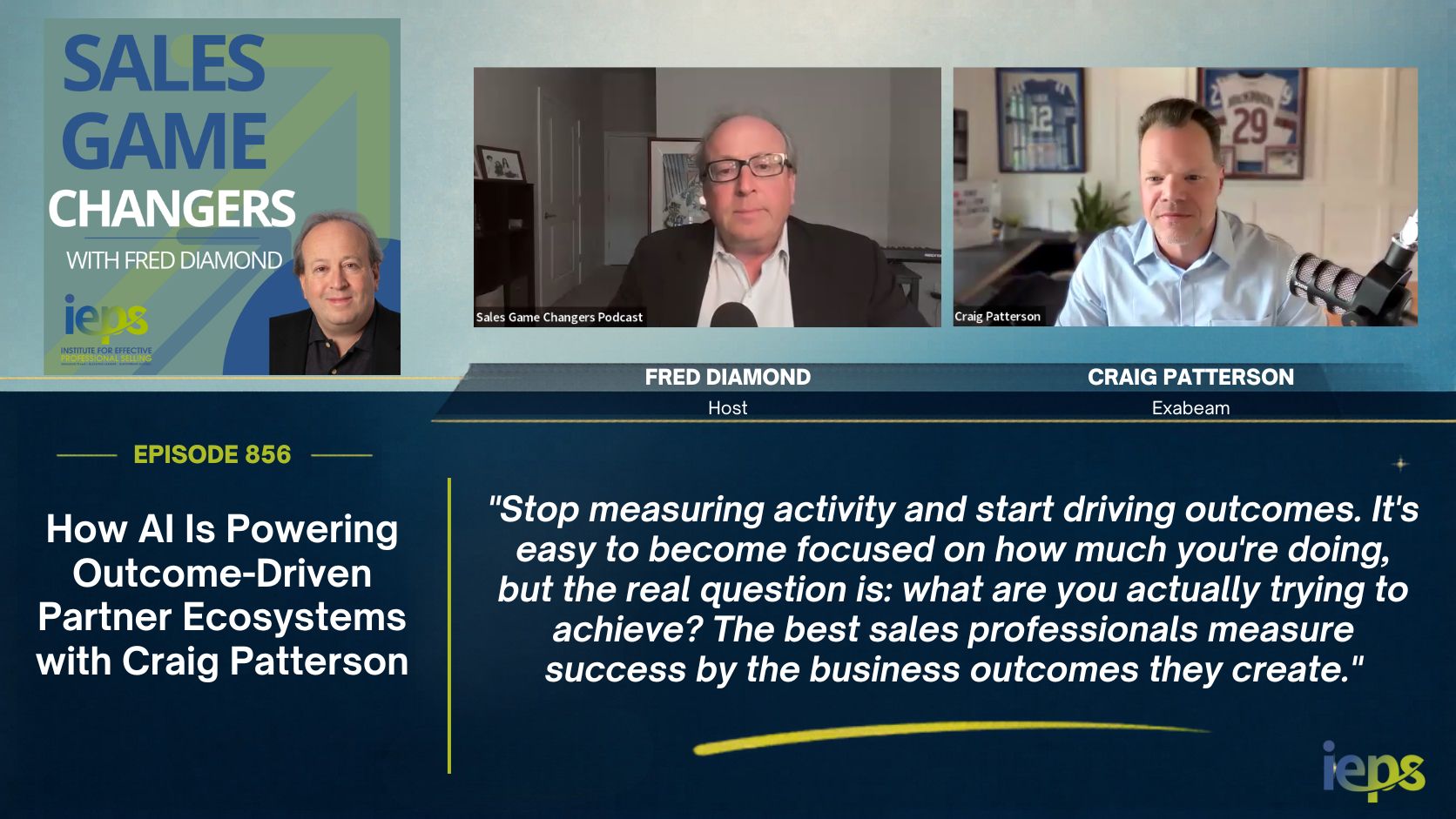
Today’s show featured an interview with Craig Patterson, Global Channel and Ecosystem Chief at Exabeam.
Find Craig on LinkedIn.
CRAIG’S TIP: “Stop measuring activity and start driving outcomes. It’s easy to become focused on how much you’re doing, but the real question is: what are you actually trying to achieve? The best sales professionals measure success by the business outcomes they create.”
THE PODCAST BEGINS HERE
Fred Diamond: We’re doing today’s interview in late May of 2026. A lot of things have happened with the channel, the disintermediation, shifts, of course, AI has played a large role. Craig Patterson with Exabeam, I’m excited to talk to you about that. Let’s get started here.
Introduce yourself to the audience briefly. Tell us a little bit about you. Tell us what you’re doing now. We’re going to get deep into topics such as how AI is affecting the role and true value for sales professionals, especially those managing channel relationships.
Craig Patterson: Channel is the operating model for scale. I’m glad you’re incorporating that into your program. As you think about if you’re a sales professional sitting in cybersecurity or technology, the channel is the unlock to actually scaling.
Who is Craig Patterson? Craig Patterson is a guy that spent the last two decades of his life focused on the channel, getting up every single morning, having some coffee and thinking about how do we drive favorable outcomes in the channel community. Today I work for a company called Exabeam. Exabeam is a market leader as it relates to cybersecurity. The area we focus is in the security incident, events management space, which think of that really as the brains. Software that lives in a security operation center, it’s the brains that analyzes all the different log sources to correlate potential risk for companies. That’s our primary focus.
Our secondary focus is around insider threat. When you think about all the breaches that are happening out there, a good percentage of all breaches correlate back to insider threats. I know we’re going to talk about this a little bit more today, the insider threat landscape is changing rapidly with the emergence of AI and all the adversaries out there leveraging AI to create harm. That’s a bit on me. I’m based in Colorado and excited to be on here my man.
Fred Diamond: For people who don’t know, let’s talk about what the channel is for Exabeam. Help explain that, what type of companies do you work with, who do you manage, how does your team manage, those kinds of things?
Craig Patterson: First on the Exabeam side, we’re roughly a $300 million cybersecurity vendor, Gartner Magic Quadrant Leader six times in a row. Really good technology validated by the market. That’s a bit on who we are. In terms of the channel, when you think of the channel, it’s the way the companies scale. The way that works in cybersecurity is about 90% of all sales and revenue flows through channel distribution. What we’re talking about here is strategic global partnerships to get created. Basically, partners come on board, they become an extension of our sales force. We train them, we enable them, they position our services with the entire portfolio of offerings they’re providing to customers.
Our ecosystem, we have about 3,000 partners globally, some big names such as Optiv, one of the largest cybersecurity vendors in North America, GuidePoint, CDW, these are names you probably have heard of. We focus globally, so I’ve got partnerships in the Americas, also Europe, also Asia Pacific, and the Middle East. You name it, my friend, I probably have a partner in those countries that we work with. The name of the game really is building a program that drives value to our strategic partners as they’re out meeting with customers, talking and helping them solve some of the biggest challenges that exist in cybersecurity today.
Fred Diamond: Quick question for you before we get a little bit deeper. I’ve been training myself not to use the word channel anymore and to more effectively use the word ecosystem, which you brought in. I’m just curious on your thoughts on what are some of the words that you use to describe the partnerships that you manage?
Craig Patterson: Ecosystem is definitely the big topic today because you think about the evolution of how deals get structured. What we found, if you manage the ecosystem, basically what we’ve determined is there’s about 28 touch points a customer goes through in terms of the buying cycle, 28 different moments in terms of them researching your topic, researching your technology. Then across those 28 buying moments, there’s about six, seven, eight different partners that are aligned across that journey.
When you take all those different buying signals, you take all the different partner types and you map them together, now we’re talking about an ecosystem. I always use the phrase channel sells, ecosystem scales. What we’re seeing today is more and more companies adopt these ecosystems. They’re analyzing all the signals that are happening across those buying signals and getting their entire partner ecosystem working together across those buying cycles.
Fred Diamond: One thing I’ve seen you post about is, I’m going to use a quote here, “The unlock isn’t more partners. It’s more capable partners.” We’re doing today’s interview in May of 2026. There’s no shortage of partners. It’s really good ones that we’re trying to work with and grow and depend upon. Give us some more of your insights on that.
Craig Patterson: This is a great topic and one I write often about. I post a lot of content around this. Cybersecurity vendors are all faced with a lot of the same dilemmas. We have these very large ecosystems. In my example, I’ve got 3,000 partners globally. I’m not in a situation where I need to go recruit hundreds and hundreds of new partners to drive an outcome. What I need to do is I need to align better outcomes with the partners that I already have. How do I look at the ecosystem I have today? How do I raise their competency level? Because that’s the name of the game. It’s less about volume, having more and more partners. It’s more about driving more favorable outcomes.
The way we do that is by raising their competency level, making them smarter, making them more knowledgeable so they’re going to be more effective in terms of how they position my services. Everything we’re doing here, we think about how we drive those outcomes, those outcomes aligned back to the operating plan for my company around very specific measured things we’re tracking. I can go into more detail on that if you’d like as well.
Fred Diamond: Yeah, let’s go into more detail. One thing that I’ve seen you post about is the shift from tools to outcomes in cybersecurity. In the previous answer, you used the word outcomes four times. Talk about why that’s so important, why it’s happened. Then talk about how are you working with your partners to enable more outcomes for your customers around the whole concept of cybersecurity? That’s a big topic, I realized as I threw it out.
Craig Patterson: Really two topics here. One is the topic around how our companies really position themselves for more favorable outcomes using cybersecurity. One of the things around the cybersecurity space is that we were in this mode where people were just like, “I want to have a different outcome, I’m just buying a new tool.” For many years, we’re just buying more and more and more tools until we got to the point that these CISOs, these chief information security officers, had themselves in a situation they had so many tools they didn’t know what to do with. In fact, if you do some research, I think a lot of the Fortune 500s have more than 130 different cybersecurity tools they’re running at any given moment. The average enterprise runs 76 different tools, by the way.
Think of the complexity there. You’re sitting in an environment, you’re managing a security posture, you have all these tools that are stacking on top of each other, and it just becomes a bit of a tool sprawl, if you will, very difficult, complex environment. Now what we’re saying is like, how do we take those tools and how do we drive a more favorable outcome? Things like how do I reduce my mean time to detect an issue? How do I take all these different sources? You think about the world I live in, basically I’m analyzing all the log sources that are happening across an entire company. That could be thousands or 10,000 or 100,000 different events happening very frequently, how do I take all those different events and correlate that back to risk?
The way we play that out is we help companies detect these issues in a much more efficient manner. It’s basically the mean time to actually detect. Then there’s the mean time to actually respond and repair the situation. Those are some of the outcomes that we drive, is reducing that cycle time.
Secondarily, when you think about the emergence of AI, what we’ve done is we’ve built part of our engine in our platform, it’s called Nova. Nova basically helps triage a lot of those events. It can essentially make a normal analyst, think about the guy or gal sitting down every single day, analyzing all these tickets, all these different events, it makes them 80 percent more efficient in their day. If I can be more efficient, I can be more effective. I can analyze more tickets. I can respond in a quicker manner. All those actually align back to an outcome I’m looking to achieve in terms of improving my overall security posture. That’s the big trend that we see in the cybersecurity space in terms of how we’re effectively changing the outcome.
Now, on the partner side, we’re also leveraging AI to improve variables. I talked about how we align our plan with the operating model for my company. We’re private equity backed, so we’ve got certain outcomes we’re looking to achieve. Obviously, we want to grow new bookings. We want to increase our conversion rates. We want to improve the probability of the opportunities we’re winning. We want to improve our speed and velocity. How do we improve with speed and velocity through our sales cycle time? How do we increase our conversion rates?
Then as we look at the partner side, how do we improve the time to the first deal? If you’re a new partner coming on board, if the average time is nine to 12 months, how do I make that eight months? Then how do I do that at scale? Those are some of the outcomes that we’re looking to improve on the partner side. The way we’re solving that is we’re introducing new enablement platforms that are powered by AI that really help the partners become a better seller of Exabeam across a number of different use cases.
Fred Diamond: Let’s get into the enablement side for a little bit. Talk about the end user customer, the customer at the end of the day who is utilizing Exabeam solutions. What do they need today from partner and what do they need from Exabeam?
Craig Patterson: Maybe if you look at the partner lens first, and then we’ll correlate that back to the end user customer. The partner essentially, we’re helping them become a better seller of Exabeam first. The way we do that is we built a platform, we call it Sherpa. Sherpa is a powered AI tool that we created. We launched about six months ago, so we’re well beyond MVP stage, and really three use cases in terms of how we’re improving those outcomes we talked about before.
Number one is a virtual always on what we call channel account manager. I’ve got a team of channel account managers around the globe that supports the partners. The real value of AI isn’t for me to actually go out and replace my team, it’s amplifying them, making them better. The way we do that is we augment the work they’re doing and we create this virtual channel account manager for the partners. Use case number one is basically always on. You can ask the general questions, “Hey, how do I position this service? What are the capabilities? What are the use cases? What are the ICP customers? What are the target accounts?” things like that. You as a partner can integrate through Teams, through Slack, or you can just log into my portal. You now can talk to a virtual channel account manager 24/7 in your natural language. If you’re sitting in the Middle East and you speak in Arabic, no problems, talk to it in Arabic. That’s use case number one.
Use case number two is our training and certification platform. If you’re a partner, you want to be a better Exabeam seller, you’ve got a very intuitive learning path, structured learning path. You log in, you take the learning as you like to take it. You practice your pitch, you upload your pitch and it says, “Hey, Fred, you did a great job in this. But next time, to be better, say it this way.” Now we’re raising a competency level, making them actually better, helping them positioning in a practical manner.
The third use case is the virtual coach where if you are on with an end-user customer, you’re having a conversation, it’s going to help you in the background. Customer gave this objection, talk to him about this value, this use case, this feature or functionality. It’s basically helping you position with that end-user customer real time. That’s the tool we’ve built for the partner community. We’ve really focused there because when you think of the cybersecurity market, 90% of all the customer demand is coming through the partners. That really is the unlock. If I can help create education and awareness, raise competency level there, the opportunities are going to come. They’re going to follow because I’ve raised their competency level, they’ve identified the issue the customer is looking to solve, and they bring it to us.
Fred Diamond: Craig, the landscape has changed a lot with the whole shift to AI-driven threats, where primarily it was attackers, maybe inside, maybe outside, malicious, hackers, etc. How has that changed the dynamic? How has that also changed the channel perspective as well?
Craig Patterson: Great question. We’re seeing a major shift in the market. You think about the traditional insider threat landscape, that’s where most companies are really focused because it correlated back to the majority of the breaches they were seeing. Various types of insider risk from people intentionally causing harm, the malicious insiders or people that are accidentally causing harm, or maybe something isn’t set up correctly, or there’s the hijacked situations as well, where maybe you’ve fallen for a phishing email, something like that, and they essentially take over your credentials. That’s the normal state of what we’ve seen over the years as it relates to insider threat.
The thing that’s really changing is the evolution of AI. This is happening so rapidly right now. Actually, I just read a stat on this from Gartner. Gartner said by 2028, about 28% of all security breaches will be caused by Agentic AI. Massive amounts of breaches will be caused by Agentic AI. I read a survey the other day, about 93% of all security professionals are extremely concerned about the rise of Agentic AI. It’s happening so fast. Microsoft Copilot, there was over a million AI agents created in one single quarter. The last quarter, over a million AI agents created in Microsoft Copilot, which is up about 130%. What do all these numbers tell you? That the landscape is changing so rapidly, which puts everyone in a situation they need to be thinking about, how do I protect against Agentic AI?
What we’ve done is we’ve taken our UEBA capabilities, which is basically the insider threat framework, and we’re now applying that to Agentic AI. Now we’re starting to profile what the AI agents are doing within an organization so we understand what a normal behavior of an agent is so when we see them acting out, we can start to predict risk. Basically, the way that works is every AI agent within an organization gets identified. We correlate an identity to every single AI agent. We understand their workflow. We understand what time of day they’re operating. We understand the systems they have access to. We understand the sequence, things along those lines, so we can correlate all the work and activities going on.
Time and time again, we’re seeing examples of these AI agents that are acting out outside of those workflows. In fact, there was one that just happened last month, a company called PocketOS. PocketOS is in the car rental space. They had Claude running on some development work. Claude was going through this non-production workflow and it hit a roadblock. Basically, the roadblock was it didn’t have the right credentials and so on its own accord, it’s starting to look for the answer across all the files it had access to. Well, it finds this API key and it uses that API key to try to solve its particular task.
Long story short, it takes the entire production environment down and deletes the entire database in a matter of nine seconds. The interesting part is the company went back and asked the AI agent, “Why’d you go do that?” and the AI agent responds, “I violated every credential, every workflow that you gave me, I violated it,” and it was very honest in its feedback. It’s like, “Well, why would it do that?” Well, it’s because these AI agents, they have reason now and they have the ability to access information to solve challenges.
All these things stacked up create enormous risk for all the companies out there. Those risks create opportunity for all the channel partners, going back to your question. How is this landscaping changing the opportunity for the partners? Every single company out there needs to be thinking about the emergence of AI and how do I set up these guardrails to protect against it? That’s why we’re leaning in on these enablement tools, is to really help partners understand these use cases so they can become better and educate the clients on how to actually solve them.
Fred Diamond: Let’s talk about channel managers, the people at Exabeam and companies like that. You’ve been a leader for a long time. I’m interested in your thoughts on building high-performance cultures and teams. But what is your advice specifically for people who have the title and the position to manage these partners? It’s complex. Like you were just saying, especially in the cyberspace, almost all technologies now, things are changing quickly. AI is forcing a lot of the change. You were just giving this great example of how the Agentic AI can even begin to rationalize and reason, which is absolutely insane, but that is the reality. That’s what it is, reality. We can’t just go back. What’s your advice for channel professionals? How can they be as effective to your company right now as they can be?
Craig Patterson: The channel or ecosystem world is very much a trust and relationship game. How do you become better? You build the trust. You build the trust in your local markets. How do you do that? Number one, you create value for your partners. They’re always looking for ways to increase their opportunities, increase the production of their companies. You find ways to actually create value.
I always believe relationships are built in hard times. Whenever there’s a problem and the people that are taking this device right here and they’re picking it up and they’re answering it, when things are really, really difficult, those are the ones that are actually creating a relationship with their partner, because they’re creating credibility, they’re creating trust. You do that every single day over the course of the career and that compounds your brand in that local market. All of a sudden, then you’re known, you’re trusted. People rely on you, they trust you. That’ll open up a lot of opportunities and doors. I think that’s the key for people out there, is to really spend time building relationships with the partners in their local markets.
The other thing is these ecosystems are starting to evolve a bit. You really need to take the time to educate yourself on where they’re going. There’s new types of partnerships being created. For us in the cybersecurity world, think of relationships such as companies that deploy AI agents. They’re going to need a security partner to go right along with the deployment of those AI agents. It’s understand the market where it’s going, building relationships and building trust in those local markets.
Fred Diamond: I want to talk a little bit more about trust and then I’ll ask you for your final action step. Build relationships, build trust, give us some examples on how channel professionals, ecosystem professionals can build trust. One of the challenges too is that trust can be built over years and decades, and unfortunately, it can go away in seconds. Give us a little bit of a deeper dive into what trust is needed to be built. The channel partners, where do they need a trusted partner coming from the OEM, if you will?
Craig Patterson: I want to correlate that back to how do you actually build trust with your own team? I’m thinking about all the listeners out there, and I guess it’s a very important topic too, and I’ll circle back to what you just said. For me, when I think about culture, it’s something that I’ve always been very focused on because culture really helps me bridge the gap and build trust with my own employees. What I have always found over the last two decades is if I get really focused and prescriptive around building a high-performing culture, the results always follow, because at the end of the day, people want to follow leaders that create good culture. They want to follow leaders that are actively working in their best interests, they’re helping them be better in life. For me, when I think about culture, it comes down to a number of key things.
Number one, you always want to have clarity with your organization. When I say clarity, it’s spending the time to really build a strategy. Obviously, you’ve got to do that, but then being very clear in terms of how do you align your organization to the mission, because every single person wants to be part of that mission. They want to understand what is their specific role, not only just what their role is, like what does good look like? How am I measuring success around their specific role as they’re aligned to that particular mission?
Then the second piece is you’ve got to have accountability. You’ve got to have accountability, which means everybody has to have clear goals set, a real KPI set that aligns to that mission. You’ve got to hold people accountable on a weekly, quarterly basis, just making sure we’re moving the ball forward.
Then the third piece is about opportunity. When you think about all the people in your organization, everybody wants to be better in life. They want an opportunity to grow. It’s giving them an opportunity to grow, to be better in their career. Maybe that’s creating more exposure. Internal to the organization, getting them aligned to the right people, or giving them opportunity externally to help build their brand up a little bit. Maybe that’s getting them ready for a speech or a podcast like this. Helping teach them on how to better their own personal brand.
I also think just the overall recognition is important for me in terms of high-performing culture. We always recognize people for a job well done. I think the flaw that people sometimes make here is they wait for those big moments. They wait for that big monumental win, but you got to take the small wins that happen every single day that lead up to the big wins.
I think you got to have an element of recognition. Then you got to have an element of candor, which means you got to be willing to tell people the hard truth, obviously in a professional manner. But I found if you focus on all those things together, you put yourself in a situation, you build a high-performing culture that people want to be a part of and they actually fight to be a part of. That’s why when you look at good, high-quality leaders, you can validate if a culture is good or not by how many people follow them, how many people have followed that leader on their second time or third time. To me, that’s a good measurement you can look. If you’re researching an opportunity, look at the leaders, see how many people have followed them across multiple steps. That’ll give you some correlation to actually how good of a leader they are.
That’s what I think of internally, what I focus on to create that trust with my employees, and externally with the partner community, you think about building a program that creates value. There are a million programs out there, but the ones that really are helping to drive value for the partners. When I think about what partners actually want in the market, they want a path to profitability. Making sure they have a clear path to actually making money and understanding that path.
Secondly, they want to have good, high-quality enablement. Making sure you’ve built the tools to drive enablement, the things that we talked about previously. The third piece is not all partners are created equal, so making sure, at the end of the day, you have a specific path for the partner type that they are. Then making sure you have the variances that cater to partners globally, whether they’re based in Europe or based in North America, not everything is the same. Then making sure you have the right programs aligned to really help partners create value.
There’s a number of ingredients to go in to really creating that trust with the partner ecosystem, but I think if you think about it from the lens of how do I create value, how do I support partners in a time of need when things are really difficult, you do that time and time again, that’s how you separate yourself from the pack.
Fred Diamond: It’s a great answer, particularly point number one, which is understanding, of course, you got to understand your company and what your drivers are, but what are the profitability drivers for the partner? Every company that we deal with in the tech space has gone through a lot of shift and change over the last two years, and how they’re going about their market, how they’re serving their customer, their cost model, AI has affected everybody throughout the channel and the economy in 2025 and early 2026. I love that answer there. You build trust by understanding what their drivers are, what their shifts have been, what their leadership is now directing their company towards and who their customers are, how their customers are demanding things from them.
Craig Patterson, Exabeam, great stuff here. Congratulations on all your success and the recognition that you’ve gotten, which originally drove us to you. I appreciate all these answers. Once again, the Institute for Effective Professional Selling, we’re launching our Partner Growth Program, where we’re working with partner managers through the ecosystem. Great insights.
Give us one final action step. You’ve given us a lot of great ideas, but give us something specific that either channel partners or people who are working with them, or your salespeople, should implement right now to take their sales career to the next level.
Craig Patterson: I’d go to two different things quickly. I think the first is you got to do a good job of building your brand. Think about the domain that you live in. Go find the people that are actually experts in that particular domain. Follow them every single day. Read what they’re posting about. Read the content they’re driving. Understand their perspective. That’ll help you become better in your own particular domain. It’s understanding the people that are thought leaders in your domain and then following them every single day.
The second piece is on this topic that we’ve had over this podcast, is stop measuring activity and start driving outcomes. I think that’s the key, is people get so focused on activity they sometimes lose sight of, what am I actually trying to achieve?
Fred Diamond: Outcome is obviously one of the key words that came out of here today. I’m going to give that a lot of thought. Once again, I want to thank Craig Patterson with Exabeam. My name is Fred Diamond. This is the Sales Game Changers Podcast.
Transcribed by Mariana Badillo
Nice breakdown of the episode—Craig’s “channel sells, ecosystem scales” framing is a genuinely useful way to think about the 28 touchpoints in a modern buying cycle. I’ve spent a lot of time mapping partner contribution data back to pipeline metrics, and the hardest part is always tying a specific partner’s enablement activity to a closed outcome rather than just logged training hours. Interesting to see how Exabeam is operationalizing that signal across their 3,000 partners. Do you know if they’re using any standardized telemetry or data models to track that partner competency uplift, or is it still mostly manual reporting?