
This is a Women in Sales Leadership sub-brand of the Sales Game Changers Podcast.
Watch the video of this podcast on YouTube here.
The Sales Game Changers Podcast was recognized by YesWare as the top sales podcast. Read the announcement here.
FeedSpot named the Sales Game Changers Podcast at a top 20 Sales Podcast and top 8 Sales Leadership Podcast!
Subscribe to the Sales Game Changers Podcast now on Apple Podcasts!
Purchase Fred Diamond’s best-sellers Love, Hope, Lyme: What Family Members, Partners, and Friends Who Love a Chronic Lyme Survivor Need to Know and Insights for Sales Game Changers now!
Find Marty on LinkedIn.
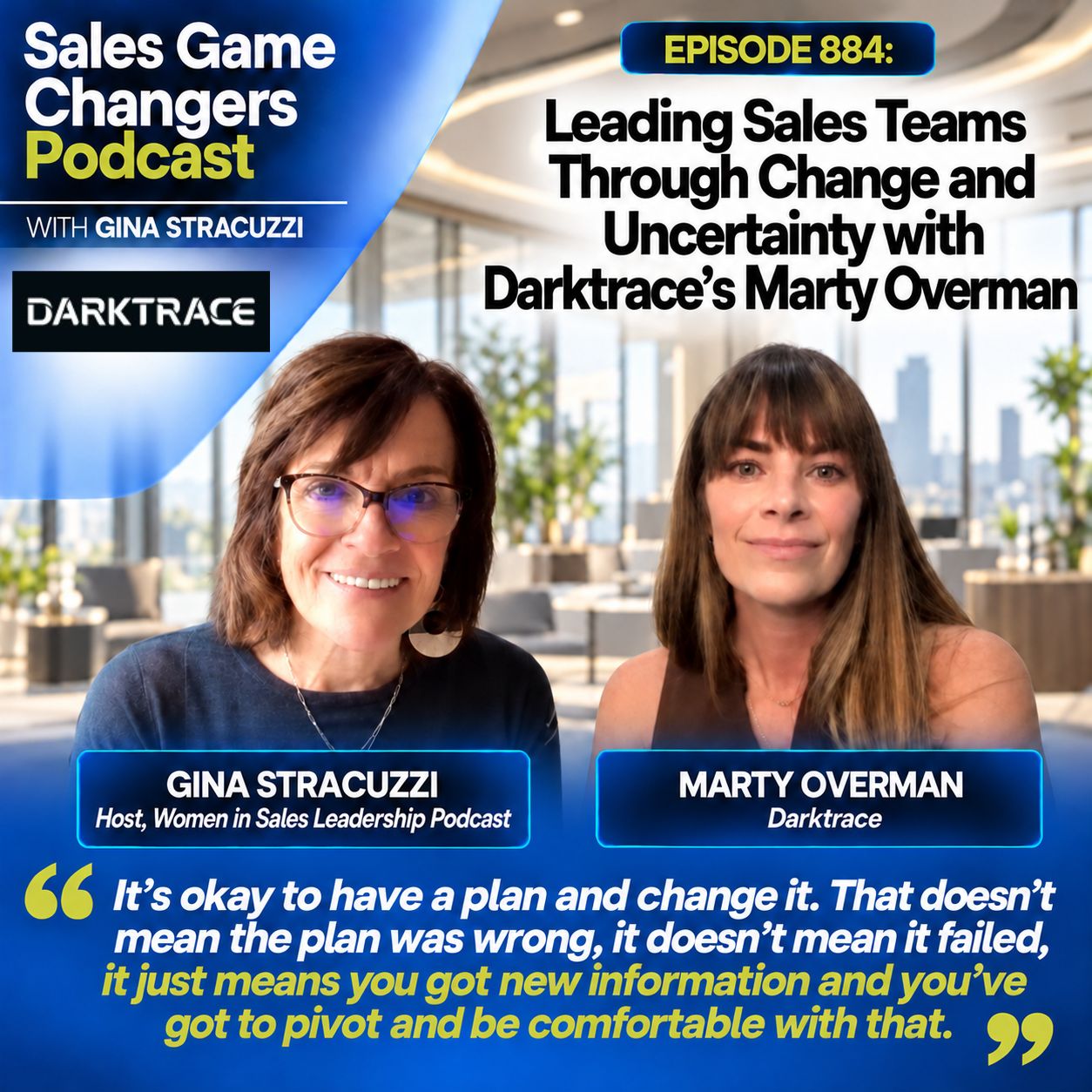
MARTY’S TIP: “It’s okay to have a plan and change it. That doesn’t mean the plan was wrong, it doesn’t mean it failed, it just means you got new information and you’ve got to pivot and be comfortable with that.”
THE PODCAST BEGINS HERE
Gina Stracuzzi: My guest is Marty Overman. She is executive vice president of America sales at Darktrace, which is a global leader in AI and cybersecurity. Welcome, Marty.
Marty Overman: Hi, Gina. Thanks. Excited to be here.
Gina Stracuzzi: I always like these kinds of conversations because there’s so much happening and you read so many things and it’s an interesting time to be in that career. It’s changing daily, as I’m sure you know. Before we get into the conversation at hand, why don’t you tell us a little bit about yourself and how you got where you are today.
Marty Overman: Gina, you said it best. Everything’s changing rapidly. I think that’s probably actually how I ended up where I am, is that openness to change and just going with it, how things play out. I have been in cybersecurity sales for 20 years now. I say that out loud and I’m confused because I still am 46 years old in my brain, but I started at Cisco in the Sales Associates Training Program and took a chance on specializing in security. At the time they had product sales specialists in security. It was a very different world back then. Nobody really cared about cybersecurity yet. It was an insurance policy and we did the best we could with it. I sold a lot of firewalls.
Fast forward a few years and cybersecurity was suddenly top of mind for everyone. I found myself in different rooms and different roles across public sector, mid-market enterprise, and eventually global enterprise, all within Cisco, which offered me great career mobility. Then eventually, actually working for a gentleman who had just been a fantastic mentor to me at Cisco, he’d left the company. A couple years later he called and said, “Hey, I need a leader here. I think you’re the one.” It was interesting because it was specifically in the commercial space. I said, “But I’ve never done commercial before.”
He said, “Exactly.”
It’s like, “I’m sorry, I’m confused. What do you mean?”
He said, “I fully believe you’re going to lead a sales organization one day, and you need commercial sales experience under your belt. Come do it here. Come build out this org for us.”
I went and did that and picked up some new skills that were super vital to my overall journey, and that’s what set me on the path into VP roles. Now I’ve played CRO at cybersecurity companies and now as the EVP of sales at Darktrace. Always in cybersecurity, I’ve seen it change in many ways and definitely very quickly over the last years.
Gina Stracuzzi: There is a lot in that brief overview you gave us. My first thought was how intuitive of you to glean on to the cybersecurity piece, when you could have probably had your pick of a number of avenues to go down. That really, I think, served you very well. I love that you had this mentor. Really, it’s interesting, is we talk about this in the Women in Sales Leadership Forum that I run, that’s really a sponsor. He’s talking about you when you’re not in the room and he’s telling you, “I know you can do this. Here’s why you should.” Those kind of people in your career are invaluable, because they see something in you before you do and they make you go for it. Literally, we just had this conversation for three hours in the forum on Friday.
Marty Overman: It’s a three-hour conversation.
Gina Stracuzzi: Yeah, a prime example of what happens when you have a sponsor. That’s how you got into cybersecurity. Let’s talk about people like that gentleman who is not only a mentor and a sponsor, but a great ally. Cybersecurity, at least initially, was pretty much a man’s field. You had to have had allies along the way that helped you. Let’s talk a bit about that, what they’ve shown you and the roles they’ve played in your career.
Marty Overman: I have benefited from so many. I feel like at this point, they would tell you that I really embraced the opportunity. I think probably mentors and sponsors pop up in our world all the time and we miss them. It does help to be intentional about what you want and learning, and they’re going to pour into those who are sponges and soaking it up. I’ve had so many mentors and sponsors and they’ve shown up at different points in my career and led me down great paths.
To get into cybersecurity, Cisco had at the time, I think they actually just started it again, a Sales Associates Training Program. It’s for recent college graduates who exhibit these certain qualities and they figure they can teach you anything else. I got into that and it was designed for generalist account managers and channel account managers. There was a gentleman who was a huge supporter of the program and he happened to be a leader on the security sales team. He said, he’s like, “I think I could turn one of these kids into a security specialist.” At the time, to your point, they were all former military, they had been cryptographers and working for the NSA, they had real hands-on cybersecurity experience. Again, we weren’t even calling it cybersecurity yet.
This guy’s like, “I could turn one of them into a specialist.” Like, “Okay, this sounds fun. I love a challenge.” But part of what he did, he went to the program and he said, “Hey, I think we could do this. Let me run this experiment.” They agreed to it, because they had a set curriculum, but they agreed to it. They said, “Anything you do is going to be outside of it. She’s going to be studying on her own time.” He’s like, “If you’re good with that, then we’ll do it.” One of his key things was, “I will connect her with a great mentor.”
He had a very, very committed mentor, Rich Taylor. This is actually a fun story. I love telling this story, Gina. I’m glad you asked. They connected me with Rich. In our first meeting, I said, “Rich, why are you doing this? It’s extra time out of your day.” He was an individual contributor. It wasn’t retiring quota for him or anything. He said, “Well, I have two young daughters. They’re 8 and 13.” He said, “The way I see it, if I help you now, you’ll blaze a trail for them and help them.” I was like, “Okay,” I’m 25 years old, and thinking, “Okay, all right, we’ll roll with this,” but he was into it.
He gave me a fantastic learning curriculum. He really walked me through so much of what I needed to know in the early days and taught me how to show up in rooms that people were going to be looking at me and going, “What could you possibly know about this?” He was actually the first one who said like, “They’re immediately going to think you don’t know what you’re talking about. When you walk in, they’re just going to look at you and think you can’t possibly offer anything.” He’s like, “You got to be brilliant in the first 10 words out of your mouth.”
That instilled in me early, I’ve got to prepare. I’ve got to know my message and I have to nail my message and not let it waver. He also encouraged me to study for and get my CISSP, which was a huge piece of me being able to establish that credibility that I needed, and learn the vernacular, and be able to show up credibly in the rooms I was in.
Rich also, through the mentorship, said to me, “I also figure I’m going to work for you one day. I need you to feel a little indebted to me.” Rich has a sense of humor that if he hears this, he’ll laugh at that. It was amazing. That was 2006. Actually, I’d forgotten about this until the other day. Rich, literally, he was my first coworker to hold my son when my son was born in 2010. We ended up developing a really, really great relationship.
In 2016, 10 years later, I called him and said, “Hey, Rich, remember when you said you were going to work for me one day?” I’d now gone to this other company. He said, “Yeah.” I said, “Are you ready?” He was like, “Yeah, I am. Let’s do it.” I hired Rich. He went to club that next year. It was awesome. It was so much fun to be able to work with him again. But also, [inaudible 0:09:49] in there, he had reached out to me at one point and said needs to do the Cisco program, “Would you write a referral for her?” I did, and she got in, and they had reswizzled it at that time to help place people in partners who had Cisco training and then they could go put them in a partner at a reseller.
She ended up doing that, which was great for her. Then by a couple turns, she ended up working at some marketing software company, but also a couple years later, let’s see, that was 2016. I think it must have been 2021. I reached out to Rich. I said, “Hey, I see Katrina’s available. Do you think she’d come work for me?” Rich is long retired, and he’s like, “You should call her.” I ended up hiring his daughter at Imperva and she was my rookie of the year and is now at another startup where I hired her and she just continues to do great. I was literally just texting with her this morning. Rich’s vision came to fruition. It was awesome.
He shared with me that vision, which I think is an important element of really, ultimately getting a vision out there and being able to execute it. Then he was also telling his daughter all along, “You can do these things. You can be in that environment.” You got to open doors for them, but Katrina, every room she gets in, she holds her own. She has taken that to heart. It’s just awesome to see that whole relationship come full circle and Rich’s vision come to life.
But you’ll notice, in my story, he’s not the one who got me to that other company. That was a different sponsor. To your point, Rich was a mentor, he taught me the ways and made sure that I was getting the certifications I needed and helped me be mentally prepared for what I was getting into, but that sponsor had actually hired me. He hired me there and he hired me at another company another time and has been that one speaking up for me in rooms I’m not in, and helping me see the potential that I maybe didn’t even know that I had, and really pushing me to go do those next things.
But also, I had to earn it every step of the way. I’ll never forget when I was interviewing for my first VP job. We had this big deal. Basically, it was if I didn’t get the deal closed by the end of the quarter, it was a seven and a half million dollar deal, I literally wouldn’t get the job. If I got it closed, I could get the job, and I will never forget, my entire body broke out in hives. I was so stressed out. I was like, “This is big stakes on the table,” and spoiler alert, we got the deal and I got the job. That continued to set me on that path. But it came about the way a lot of those jobs do, which is I was approached and they said, “Hey, this person is going to leave this role. We think you’re great for it. You’re going to interview and you’ve got to show us that you’ve got the chops to step into it.” When that time came, again, he spoke up for me, made sure that they knew about the ambition that I had to move into a VP role. It got me in the conversation, and then I had to close it. I had to finish it.
Gina Stracuzzi: You’re just hitting on so many things that we discuss in the forum, but that are really critical parts of the equation for women to take their careers where they want to go. It’s one knowing where you want to go, but also making your aspirations known to the people that can help you. If you keep them to yourself and wait for someone to tap you on the shoulder, the likelihood of that happening is slim to none. I love that. You spoke up, you weren’t afraid to say what you wanted. That can change everything. What great stories, and I love that his daughter, really, he had a vision all the way along, “Marty’s the woman to get us there.” I love it.
Marty Overman: It worked.
Gina Stracuzzi: Let’s talk a little bit about what all of that career journey taught you about good leadership. One thing that I really like to talk about or get people thinking about is it’s sometimes easy to identify really good leadership, but there’s a lot of bad leadership out there. It can impact careers, it can impact morale, numbers, all of it. Let’s talk a little bit about both.
Marty Overman: I’ve seen some bad leaders. I’ve seen some great ones. The interesting thing is, it’s usually the great leaders who don’t realize how great they are, and the bad leaders who think they’re awesome, which is the conundrum in life. I think great leadership, and this is where I think, and I’m just going to say it pretty openly, women are, I think inherently, very wired to be incredible leaders. I think the thing that can hold us back is believing that. You do need some people to tell you, like, “Actually, I see great leadership in you and you’re doing all these things,” and then even then we’re going to discount ourselves and be like, “No, I’m not that great.”
I also was thinking about this before you even asked the question of a lot of times women will, I think there’s some research out there that says we have to meet 90% of the requirements of a job description before we apply. Whereas men will be like, “I got fifty.”
Gina Stracuzzi: “Hey, I got two of those things.”
Marty Overman: “I’ll figure the rest out later.” We’re wired to want to already be all of those things before we jump into the role and [inaudible 0:15:58] can be a little uncomfortable with most of us are just figuring out as we go. Again, women I think are inherently wired to be great leaders, and why is that?
We tend to be nurturers, and we notice what’s going on around us and who needs to be fed, who needs to drink some water, who’s having a bad day. But that intuition really comes into play because you’ve got to see when, particularly in sales, you’ve got to see when somebody is struggling and may not be okay asking for help, and help them get to a place where they accept the help that’s needed. I think especially in male-dominated industries, you see a lot of people who are just going to keep banging their head against a wall trying to figure it out, brute-force success, versus being able to recognize like, “Hey, I think this is an opportunity to take a little bit of a step back.” Then we can help shape your direction or the path that you need to go down.
Then you contrast that with the bad leaders, the ones who destroy a culture, or the ones who create attrition problems. What are some common qualities? I think it is a little bit of a lack of self-awareness and maybe you don’t realize how you’re coming off to your team. It’s interesting because we say that you’ve got to have ambition and communicate your ambition in order to get ahead, but if you only have ambition and are only communicating your ambition, that means you’re managing up a lot, and that is terrible for your team. They see that, they feel it, and they don’t feel supported, they don’t feel like they’ve got an advocate.
You’ve got to strike that balance of, hey, I want that, but I’m also really, really focused on the mission in front of me and the team I’m leading today. That I think is a massive distinction between a great leader and a not great leader. The ones people want to follow, those are the ones who are aware of what the team needs and tuned in and are there for them, not always working on the next thing.
Gina Stracuzzi: There’s an empowerment that when we talk to leaders on these programs, you can hear their real desire to have their team empowered to take chances and really go for it, versus people who somehow almost it’s like they want to instill fear more than empowerment. I don’t really know what they think they’re going to achieve by that, and sometimes they just don’t want people to outshine them either. There’s a lot of ego involved and we’ve all had bad leaders in our lives just so we can, I think, know a good one when we see it, but those are great answers.
We talked a little bit about the mentors that you’ve had. How do you help the peoples on your team? Do you have them have a mentor? What roles do you see them playing in the people that work for you?
Marty Overman: It’s a super interesting thing about mentors. They can be assigned, and sometimes they work out great, but they don’t always, and it depends on how you show up to it and who’s willing to commit and whatnot. Often, as I said earlier, mentors are presenting themselves to us all the time. They’re all sorts of people we can learn from and bounce ideas off of. You’ve just got to be on the lookout for them and actually take the opportunity to develop that mentor. I do think some of it takes development and time, where you’ve got to be comfortable asking, “Can you spend a few minutes with me?”
For my team, for really anyone in my organization, I encourage them to look out for those peers and those who have done the job before them, whether they were promoted up or moved into a different type of role within the company or outside of the company, to develop those relationships and keep those up. Actually, one of my direct reports currently, he’s only ever worked at Darktrace. He has been at Darktrace for 10 years. He is brilliant and he’s so great at what he does. I’m like, “Hey, let’s get you a mentor outside of the company, because you know Darktrace so well. I want to build your brand outside of the company. Let’s get you talking to peers at your partners. Do we have somebody within Thoma Bravo, who owns Darktrace, is there someone within Thoma Bravo who can be a mentor to you and help you understand other pieces of the business?” because he’s so curious about it.
Nobody’s going to teach you anything about Darktrace, you already know it. But let’s get you some outside mentors who can help you not only have more presence in the market, the cybersecurity market is big, it’s ever-changing, it’s growing, and it’s important for people to know and recognize and trust him, but also for him to learn more about the world outside of Darktrace. He’s so curious, he’s a sponge, he will take what is poured into him, and give back. He’s like, “Yeah, let’s do that. What’s that look like?” Some of it’s very intentional, setting that up for him. Then other pieces of it, now he is looking for people who he can build those relationships with and grow and expand. Maybe he’ll be a mentor for them too. You can learn from each other. Learn by teaching. It’s super important.
I think another premise of it is, and I think about this in my journey a lot too, a lot of times people think about the saying, send the elevator back down when you get to the top, don’t wait till you get to the top. It literally stops at every floor. I’ve got AEs who can mentor SDRs. We’ve got VPs who can mentor AEs. There’s this whole matrixed universe of people who can help you and show you a different perspective and guide you along the way. You got to take it though.
Gina Stracuzzi: That is so true. Honestly, in my coaching and in the people that go through our different programs, that is advice I always give them, that you can have a variety of mentors. The ones you just unload on so you can get it off your chest, but then situational ones, project related mentors. But your advice about an industry mentor is so spot on, because you have to get known in your industry too, not just within your company. Those are great opportunities, joining organizations that’s in your industry so people get to see you. Then you develop those things naturally.
Marty Overman: Gina, every job I have ever had, I got because of somebody I know. A mentor who knew somebody, a sponsor who knew someone, and again, was speaking up for me in a room I was in, or just somebody I knew in my network and they said, “Hey, do you know someone great?” and they said, “Call Marty.” You have to build that.
Gina Stracuzzi: Absolutely, you do. Let’s talk a little bit about, we’ve skirted around it in a number of ways, the leadership practices that get you the great results. Everybody listening to this podcast is in sales in one form or another. Really getting results today has probably never been more challenging. People are struggling with all kinds of things these days in terms of selling and connecting with buyers. What leadership practices do you employ that really you think helps your team and gets you the results you need?
Marty Overman: It’s going to sound really simple, but I think a lot of people overcomplicate this and end up getting it wrong. Consistency and transparency are our two best friends in leadership, especially in times of great change, and I’ll use the word chaos. It can feel chaotic. I’ve been saying to my team a lot, “Hey, you’re going to have the updates, you’re going to know what’s going on, we’re going to make sure you’ve got visibility to this, but I need you to be okay if something changes two weeks from now.” Because a lot of times I think we hold stuff back from our teams because it’s not baked, or because there’s some element of it that could change in three weeks, and so we’re waiting for this perfection before we share a plan, or before we share results, or before we share an update.
Especially in this environment, just AI is changing everything so quickly, both with the pace of innovation, but also the undercurrent of just, hey, what we say today may need to be different tomorrow because Hugging Face is going to happen again, or who knows, or Anthropic is making free tools available. Now that means we’ve got to pivot.
I think in this world, we’ve got to be transparent to share where we are, where we’re going, and then that we’ve built that trust with our teams where we can go ahead and, “Hey, if I tell you something different two weeks from now, it doesn’t mean that was wrong, it just means the environment changed.” I think that’s actually, globally, it’s probably something we could all open our minds up to, which is, “Hey, it doesn’t mean I’m flaky. We got new information. Based on that new information, we’ve got to pivot and we’ve got to do it quickly, because this window is going to close, this market’s going to move, and we’ve got an opportunity and we need first-mover advantage. I’m going to be transparent, I’m going to tell you this, and then I’m going to need you to trust me if I say that something needs to change a couple of weeks from now.”
Now I’m going to contrast that with consistency. Everything I just said flies in the face of consistency. But I think it all plays together because if we’re reporting metrics and results that are consistent, and then we can see the movement within them, that helps support the transparency and the shift that has to happen. This is where communications get so, so important.
Our new CEO, Ed Jennings, came in and the first mission he went on was to define our True North, because if you don’t have your True North, if you don’t have that North Star, then everyone’s just running around doing what they think is the right thing to do, but not moving in the right direction. We’ve defined our True North, but then every layer of leadership, you’ve got to translate that to, what does that mean for us? Then on a very consistent basis, tell them where we are. You got to look at your map and go, are we going where we think we’re going to go? By the way, I do think it’s important to look back and appreciate how far you’ve come, because otherwise, the mountain always looks really tall. You got to look back and go, “Okay.”
Gina Stracuzzi: “We’re halfway up.”
Marty Overman: “We’ve come a long way.” I realized I just mixed my metaphors with the sea and with the mountain, but it’s such an important leadership principle, and that’s what your teams are looking for, is that consistency, that guidance, and then the transparency of where do we say we’re going? Are we going where we said we need to go, and do we need to change our route to get there? Then I’ve got to trust you that you’re taking me the right direction still.
Gina Stracuzzi: It’s interesting because of all the changes that are happening around us, and there’s just reorg after reorg and a lot of companies are doing massive layoffs. It’s an alarming time for many people and it’s a question I get asked a lot, and it’s different for every person, but I’d love to hear what you have to say. When do you know that it’s time to leave a job and what do you look for? What advice would you give people who are thinking about leaving before the other shoe drops, so to speak?
Marty Overman: That’s a hard one, and it’s so deeply personal. Actually, I’m going to tie it to a sales campaign. What is your desired outcome? Do you know what it takes to get to that desired outcome? Any time you’re selling something, you’ve got to think about, where am I trying to get to? What problem am I trying to solve? Do I understand the path to get there? I think in your career and in the role you’re in, you’ve got to look at that desired outcome. Why am I here? It’s real easy to say you’re there for a paycheck. None of us works for free, but there are these other values that you’ve got to get really in touch with and look at it and go, “Am I getting that here?”
They say that people don’t leave bad jobs, they leave bad bosses. Do I feel like I’m growing? Am I getting the development that I want to get? When I raise problems, does somebody hear me or am I screaming into the void? I think that’s probably, in the context of the way you frame the question around there’s so much change, there’s all these layoffs, I think that’s one of the big things, is when challenges are surfaced, when you’re struggling, are you getting the help and the support that you need?
When that answer turns to no, that tends to be the, “All right, I should probably look elsewhere,” because, A, you’re going to continue to be frustrated, but, B, then you’ve also got to look at the broader business around it and go, “Okay, if they’re not interested in fixing this, there’s probably something else going on and I can tune into that.”
None of us can predict what things are going to look like, we don’t have a magic 8 ball to know that perfect time and that perfect timing. I think ultimately if you’re not growing, if you’re not developing, and then if it’s starting to feel like your leader is not really engaging with you a lot and helping you solve the challenges and those kinds of things, then probably read the tea leaves and there’s a shift happening even above them that they don’t know about. You can go find a place that you’re going to feel supported and you’re getting the development that you need.
If it’s always about a paycheck, and I see a lot of people doing this, they job hop to get the pay increases, I don’t think you ever really develop your business. Going back to the brand and your mentorship and your sponsors, it’s really hard to develop those relationships that are going to be so vital to helping you get to the next thing that is interesting for you. I see a lot of people follow leaders too.
Gina Stracuzzi: Yeah, I know that does happen. Sometimes it works and sometimes it doesn’t.
Marty Overman: Could go either way.
Gina Stracuzzi: We are at that point in the conversation where I and Fred usually asks our guests, what piece of advice do you have for the listeners that they can put into place today to take their careers to the next level, or maybe it’s to find a sponsor or a mentor, or build their brand, what would you leave us with?
Marty Overman: Can I give two? One is always relevant and one I think is very relevant to the era that we’re in right now. Build a personal board of directors. I’m going to tie up that point we were making about mentorship and sponsorship. A company has a board. The people on the board have all different skillsets, because you don’t know what you’re going to need to pull from at what time, and it’s important to get those different perspectives. I think your personal board of directors should be the same thing. People from different industries, different age groups, because everybody’s seen different things, and different skillsets so that you have various expertise. People who care about you who can give you the counsel that you need when you need it and help you identify a blind spot or answer that hard question you just asked around when do you know it’s time to move on? That personal board of directors is super, super important for that. Build that, be active and intentional about it.
Then the piece of advice on the era that we’re in, it’s get comfortable with change. A lot of people are really scared of it and very uncomfortable with it. I often joke that I thrive in chaos.
Gina Stracuzzi: Me too.
Marty Overman: Apparently, nobody actually thrives in chaos.
Gina Stracuzzi: Well, we like to think we do.
Marty Overman: [inaudible 0:34:24] just you know what to do with it, you know how to man it, because it’s actually exciting. If we’ve got the stomach for it, I think it’s going to take us in a really incredible direction. I’m not saying just throw the cards up in the air just because like, “Hey, change is fun let’s go do it,” but getting comfortable with the idea that it’s okay to change. It’s okay to have a plan and change it. That doesn’t mean the plan was wrong, it doesn’t mean it failed, it just means you got new information and you’ve got to pivot, and be comfortable with that. Don’t hold on to it so long out of pride, out of a sense of ego, or any of that. Be willing to embrace the change, and I think it’s going to take us somewhere really amazing.
Gina Stracuzzi: I agree. Thank you very much, Marty Overman. We look forward to hearing more from you in the future. Thank you everyone for joining us. We will see you next time.
Transcribed by Mariana Badillo