
Watch the video of this podcast on YouTube here.
The Sales Game Changers Podcast was recognized by YesWare as the top sales podcast. Read the announcement here.
FeedSpot named the Sales Game Changers Podcast at a top 20 Sales Podcast and top 8 Sales Leadership Podcast!
Subscribe to the Sales Game Changers Podcast now on Apple Podcasts!
Purchase Fred Diamond’s best-sellers Love, Hope, Lyme: What Family Members, Partners, and Friends Who Love a Chronic Lyme Survivor Need to Know and Insights for Sales Game Changers now!
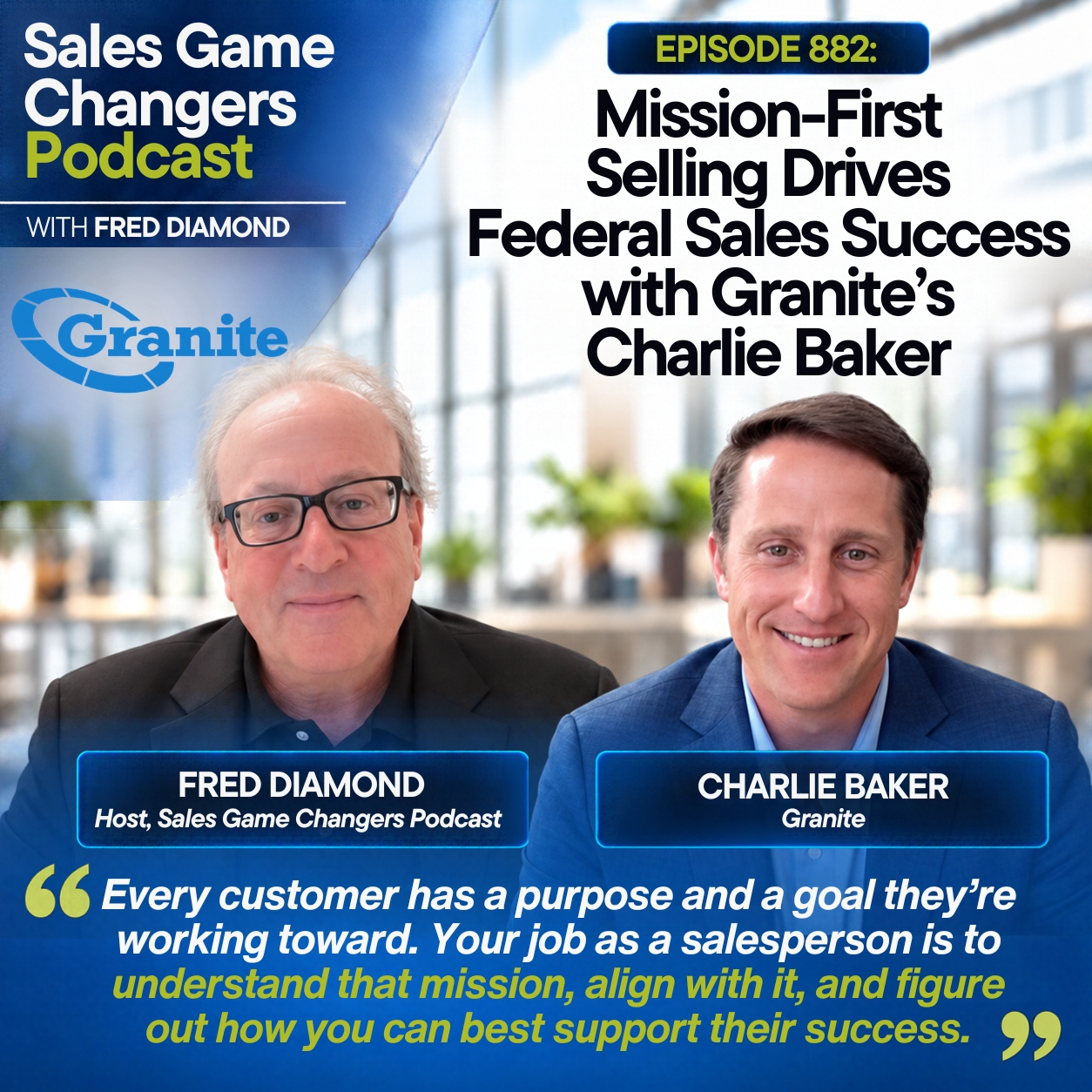
Today’s show featured an interview with Charlie Baker, Vice President of Federal Sales at Granite.
Find Charlie on LinkedIn.
CHARLIE’S TIP: “Every customer has a purpose and a goal they’re working toward. Your job as a salesperson is to understand that mission, align with it, and figure out how you can best support their success.”
THE PODCAST BEGINS HERE
Fred Diamond: We’re going to be talking today with Charlie Baker, VP of federal sales at Granite. Charlie, it’s great to see you. We’re doing today’s interview in September of 2026. For people who understand the business to government, particularly the federal marketplace, this is known in some cases as the busy season. There’s a lot of end of fiscal year activity going on and it’s definitely a buzz. Charlie, why don’t you give us a little bit of an introduction to yourself and what you’re doing at Granite?
Charlie Baker: I’ve led the federal sales division here at Granite for two and a half years now. We are the fourth largest supplier of internet and telephony to DISA. That’s army bases, navy bases, and really anything DOW nationwide, getting them connected to the internet as well as getting them on the phones. Think about phone on your desk, traditionally you pick it up. How does that get out to the person you’re trying to call? Granite is the company making that connection. We also do a lot of work in the wireless space as well with both the FedCiv and DOW.
Fred Diamond: Has your career mostly been in telephony on that side of the business?
Charlie Baker: No. Two and a half years old in telecom. The rest of my career was in staff aug, mostly on large federal government contracts.
Fred Diamond: You put your career in federal sales. What do the very best federal sales professionals do differently from everyone else?
Charlie Baker: I think it’s all about mission first. Across the federal government, everybody has a mission, whether it’s the Department of Treasury, FAA, DOW, everybody has some kind of mission. These people are duty-oriented. The people that you’re working with are there because they believe in serving the civilians of the United States. Your goal is to align with that mission and figure out how you can best support the job that they are there to do.
Fred Diamond: That’s absolutely true. We’ve done over 870 shows and a good portion of them have been VPs of sales in public sector, specifically federal. I’m just curious, what attracts you to the fact that your customers are very mission-driven?
Charlie Baker: Give you a good example. I think one of the coolest things that Granite does is multi-carrier SIM. We’re able to provide connectivity across the world to as many different wireless cellular carriers as you can think of anywhere on earth. The traditional cell phone plan is locked in to one device. Granite sells that to the federal government as a pool of data that you can hook any device up to at any given point in time. That type of creative problem solving, where you’re sitting there and telling the federal government that they have more flexibility than they’ve ever had, that’s the piece of our job that I find super exciting, is we’re helping the federal government cross the chasm from traditional technology that locked them into dangerous, frankly, scenarios where you have vendor locked, you have single points of failure in creating that flexibility. That’s the kind of stuff that makes me really excited to support those missions, because you’re talking about people who are saving lives day in and day out and keeping us safe. Those are the kinds of missions that I like being involved in.
Fred Diamond: Interestingly, for people who are listening, even though the show is going to be posted in the future, we’re doing today’s interview a couple of days before September 11th in 2026. Of course, the 25th anniversary of the tragedies of 9/11 happened. A big problem was the facts that these communication systems didn’t communicate. That led to a bunch of the challenges with a lot of the recovery efforts. Based on your previous answer there, especially now, again, we’re doing today’s interview in September at 2026, federal customers are being asked to modernize much faster, especially with a lot of the activities that have happened over the last two years, while dealing, of course, with budget, procurement, and mission pressures as well.
How has that changed how the great sales professionals need to engage with a government customer? The way we usually ask this question is, the government customer doesn’t need you if you’re not helping that. Especially now, with them having access to AI and information on the internet and social media groups, how has that required the federal selling professional to step up their game?
Charlie Baker: I actually stay away from terms like modernization and upgrade and stuff like that. The reason I stay away from it is because a lot of the time, that’s not the goal. The goal is to solve some kind of problem. I think when you’re selling to anybody, not just in the federal government, because my world is both commercial and direct to Fed, we sell to our partners. We sell internal IT to federal contractors. Both ends of that spectrum, my goal is always to get on the same side of the table and look at the problem from their perspective, because that’s where you’re going to find that they care about stuff that you as the salesperson may not. That’s where you’re going to really be able to actually drive home where you can help.
It might not always be modernization. There’s a customer we had a couple of years back who was down in Arkansas. We went through an entire meeting about giving him something that was 20-year-old technology because that’s what kept working for him. He wasn’t quite ready to make that shift to modern technology. What we wanted to do is build a relationship that helped him solve the problem of today and create a dialogue that would help him figure out how to make that transition into something that ultimately would make him better, faster, and stronger. But until that person’s ready to move, they’re not going to move, and it’s your job to be around when they’re ready.
Fred Diamond: Let’s probe that a little bit there. We talk a lot in the sales world about having to be patient, doing as much as you can to get the customer to have your sense of urgency, if you will. What are some things that you tell your selling professionals or you work with your partners on to create that urgency when the customer, for whatever the reason is, pro or con, may not have that desire to change? Maybe they feel burdened because of procurement and all those related things.
Charlie Baker: I think this goes back to the salesperson themselves. The ultimate test of a salesperson is somebody who can see that commission is a byproduct of doing a really good job. If you can walk around as a salesperson understanding that urgency will be created by the fact that you’re helping somebody solve their problem better, faster than somebody else, urgency is not going to be hard to find, because everybody wants to get stuff done. Everybody wants to succeed in their role. Do you understand what their win is? Are you helping them do that versus trying to get them to buy a product that will help you get commission? Those are two completely different mindsets. I think the difference between good and great is right there.
Fred Diamond: I want to probe that a little bit. Back to the federal customer. That being said, what does the federal customer expect from selling professionals right now? With the internet and AI, they can get whatever information they want about your products. I’m not going to put the answers into your mouth here, but what do you think federal customers want from selling professionals? Not just want, but need.
Charlie Baker: I think the answer is actually relatively simple because it works the same way. With the introduction of AI and the internet and so on and so forth, there’s no piece of data or information that’s not available to absolutely everybody. You’re not going to impress a customer with endless amounts of spiel on what they have going on right now, because it’s available in one single search from your car on your phone. That part of the equation is assumed that you’ve done your homework and you’re walking in with a little bit of understanding about who they are and what their mission is.
I think the hard part about sales for a lot of folks is maintaining a level of attitude and effort that’s consistent past the first meeting. You can walk in and make a great first introduction. Show up on time, dress the right way, be polite, be gracious, be respectful, ask good questions. That’s your first meeting. The difference maker is going to be how do meetings two through ten go? Do you bring that same level of attitude and effort every single time? Are you showing them that when they buy something from you, you’re going to be attentive to making sure that what they bought actually serves the mission objective at the end of the day on the follow through? I think so much of sales is about whether or not you can sell your consistency in who you actually are, not just who shows up to the first meeting.
Fred Diamond: That’s a great point there. It’s the old adage that sometimes it may take 15, 20 phone calls to get a customer to respond or shift, but most selling professionals stop after three to five. Actually, I’m not even going to call them selling professionals, just basic people in sales.
We’re doing today’s interview in September, and come October, there’s going to be a lot of people getting promoted into management. You were an AE, you were promoted to sales leadership. What would be your advice for the selling professionals out there who are also getting that promotion? What are some things that they need to stop doing? What are some new things that they should be doing to be successful?
Charlie Baker: I’ve got a great line that I say to anybody who asks me going from sales to leadership, and that’s really good leaders oftentimes make good salespeople. Really good salespeople don’t always make good leaders. The reason I say it like that is because leadership is about service and about duty. It’s about understanding boundaries, but being very willing to go beyond them. Great leaders by and large, the people I’ve studied, the people I’ve worked with, the mentors I have, all of them act in service of the people that they lead. They go out every day and they say, “I’m going to do what it takes to get my team what they need to be very, very, very successful.” They measure their value based on the success of their team, their own personal intrinsic value.
Great salespeople, at least some of them, who wouldn’t make a great fit to go into leadership, those people tend to also be very, very good with boundaries, but they’re coin operated. Their level of duty and their level of service does not go far beyond the line of the dollar. That makes them super successful in sales because they know which opportunities to take, which opportunities not to take. The opportunities that look good, they drive everything they have into them. They don’t waste a lot of time on the other stuff. But taking someone who looks at the world that way and putting them into a situation where you say, “Hey, this is really a 30% chance that it’ll work. You’ve got a junior salesperson who doesn’t know what they’re doing. But we’re going to go through the sales cycle and rip this process anyways, because it’ll be a good learning opportunity for them.” That is when I don’t think sales translates into leadership well.
For anyone who wants to make that jump, I think you also have to make the commitment that it’s not about you anymore. It’s about the people you lead. It’s about taking on risk that you otherwise might not in order to grow that team, in order to grow the people around you.
Fred Diamond: I’m just curious, what is your favorite thing about sales leadership? What is the thing that really gets you excited?
Charlie Baker: Seeing people change their lives. I’ve been super fortunate to be around salespeople that have gone from making 35K a year to making 300K a year in a matter of months. There’s nothing in my opinion that is more rewarding than watching someone who got into something not knowing where it would go and finding themselves in a position where they have to figure out how savings accounts work, and they have to figure out how investing works, and they have to figure out how they’re going to budget their money. It’s one thing to go out and give to charity. It’s another thing to go out and teach people how to create wealth for themselves. That to me is where I get a lot of positive feedback.
Fred Diamond: That is a major shift in someone’s future. It’s possible. We talk to so many people at the Institute for Effective Professional Selling, and we all know that and we all believe that. We’re 15 minutes into the interview and we haven’t talked about AI yet. Obviously, AI is dominating many conversations in our world on the sales side, of course, on the government user side as well. How are you utilizing AI? Better question is, how are you directing your sales organization to best utilize AI to be more effective?
Charlie Baker: At the beginning of this year, I made a point that I would take sales calls from AI companies as often as they came. I’ve sat through hundreds of demos from different AI companies at this point, seeing what kinds of things they had to offer. I think the first thing that I landed on that I thought was brilliant was training. There’s a lot of repetition that’s necessary in sales, both on the cold calling standpoint as well as the meeting standpoint. Some of these AI bots that are available now for training salespeople, where it used to be me sitting at the conference room across from somebody, repping the same meeting over and over and over again, just getting to the point where their fast twitch reflexes to say the right thing at the right time, or have the right inflection, or remember to ask this question. All of that can be programmed into an AI bot now, and you can give that to a salesperson, they can do it at home, they can do it in off hours away from selling time, it just made the entire team’s day more valuable. Because now we can be out talking to customers and training in the downtime as opposed to using valuable business hours for training. There’s that.
Then I think the other piece of it is reporting, getting AI to run reports on your behalf so that things are at your fingertips. There’s so much data available out there. If you can write a good prompt and get a good report that just hits your inbox every day, you can totally change the direction and strategy of your business almost instantaneously.
Fred Diamond: One of the things about federal sales is that, especially in the technology side, for most cases, it’s complex. You’re dealing with a lot of stakeholders, obviously on the tech side, on the program side, obviously contracting, procurement, whatever it might be. Selling professionals who are going to be successful need to understand how to manage those relationships, manage the steps, etc. What is some of your advice for junior selling professionals who are looking to be successful in federal sales, knowing that that’s a big piece of it?
Charlie Baker: Manage your professional relationships the same way you manage any other relationship in your life that you want to be valuable. You wouldn’t call your girlfriend once every other month. You wouldn’t call your buddy and ask them for a meeting every single time you call them. You wouldn’t only call someone and not text someone. The professional relationship world should be managed almost more consciously than your personal relationship world, because you don’t want to have a deal on the table and you haven’t talked to this guy in six months. You want to be very close. You want to be knee-to-knee on a regular basis and you want the people that you need in your corner to be ready in your corner. That goes for your customers, your partners, your internal stakeholders. Everybody’s got to be informed and every single relationship should be something that you are very intentional about making sure you’re talking to them all the time, whether the lights are on or off, you should be in touch with those people.
Fred Diamond: A lot of junior selling professionals who want to be successful, usually the ones who want to be successful listen to podcasts, or they read our transcript, whatever it might be. Give some specific advice. You’ve given us a bunch of things throughout the course of the show, but if someone came to you and asked for a half an hour of your mentor time, obviously they could listen to the podcast, which they probably have by now, but what might be two or three things that you would say are essential for their success?
Charlie Baker: I would say go out and get a mentor. Number one. Get somebody that you meet with every single week. Frankly, pay them. Go pay for coaching outside of your job. The third-party perspective, someone who’s not working at your company but invested in you and you alone can pay dividends well beyond anything you make in commissions. That would be my first piece of advice. My mentors have been my most valuable resource throughout my career and the more senior I’ve gotten, the more mentors I’ve acquired and the more money I invest of my own paycheck into those mentors. That would be my first one. It’s like a cheat code.
The second thing I would say is become habitual about the way you use your social life. Don’t have a social life that doesn’t intermingle with your work life. If you like to golf, golf with other people in your industry. If you like to fish, fish with other people in your industry. Find places where people that you’re already going to work with are going to be hanging out and make that a part of your regular routine, and the opportunities will flow easily. You won’t have to think that hard about where you’re going to go to find your next opportunity.
Fred Diamond: It’s interesting, before the pandemic, I used to do the interviews in-person. Most of the interviews were seeking general advice, if you will. Then when the pandemic happened, most of the interviews were more focused on today. Like, what do I need to do today to be successful? I used to always ask the question, tell us about a mentor. That was the first thing you had said, Charlie Baker. Is there a mentor that you want to shout out?
Charlie Baker: I keep my mentors private and I’d hope that they keep me private as well.
Fred Diamond: That’s very good. We talked today with Charlie Baker, VP of federal sales at Granite. Charlie, you’ve given us a lot of great ideas here. We always end the Sales Game Changers Podcast with a specific action step. Give us something specific people listening to today’s show must do to take their sales career to the next level.
Charlie Baker: I would go back, get a mentor. Make that your first phone call today. Finding a good mentor who’s there to support you and there to ping ideas off of, that is more valuable than a hundred cold calls. That would be my first call.
Fred Diamond: Once again, I want to thank Charlie Baker with Granite, VP of federal sales. Charlie, thank you for being on today’s Sales Game Changers Podcast. My name is Fred Diamond.
Transcribed by Mariana Badillo