
Watch the video of this podcast on YouTube here.
The Sales Game Changers Podcast was recognized by YesWare as the top sales podcast. Read the announcement here.
FeedSpot named the Sales Game Changers Podcast at a top 20 Sales Podcast and top 8 Sales Leadership Podcast!
Subscribe to the Sales Game Changers Podcast now on Apple Podcasts!
Purchase Fred Diamond’s best-sellers Love, Hope, Lyme: What Family Members, Partners, and Friends Who Love a Chronic Lyme Survivor Need to Know and Insights for Sales Game Changers now!
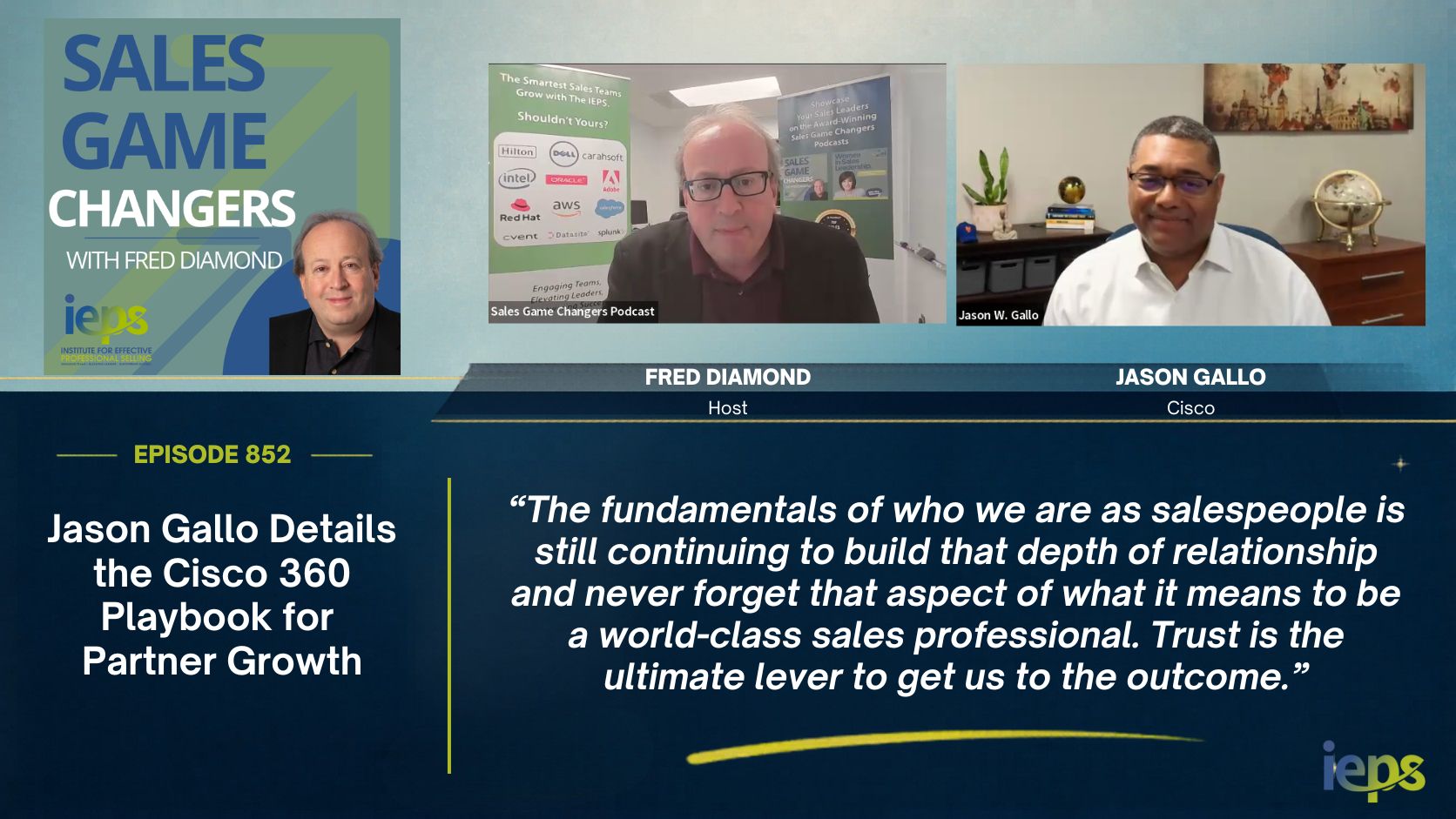
Today’s show featured an interview with Jason Gallo, Global Vice President, Partner Value Accelerator at Cisco.
Find Jason on LinkedIn.
JASON’S TIP: “Innovation is predicated upon trust. The fundamentals of who we are as salespeople is still continuing to build that depth of relationship and never forget that aspect of what it means to be a world-class sales professional. Trust is the ultimate lever to get us to the outcome.”
THE PODCAST BEGINS HERE
Fred Diamond: Jason Gallo, I’m excited to talk to you today for a couple of reasons. One is we recently had our 16th Annual Sales Excellence Awards, and we gave our Lifetime Achievement Award to the great Nick Michaelides. We had a lot of amazing people from Cisco at the event. Nick was the last Cisco leader that we had on the Sales Game Changers Podcast. We spend a lot of time talking about the ecosystems and channels. You’re a leader in Cisco and the channel world. We’re going to get deep into some of the evolution, some things that Cisco’s recently announced. We’re going to get deep into why they were announced and how critical they are. For people who don’t know you, give us a little bit about your background. Tell us about your role at Cisco and how you support the partner systems.
Jason Gallo: As you mentioned, Nick, what an incredible leader and love the fact that your organization recognized him. One of the last projects actually that he did before he retired and left Cisco was working with me as we were looking at how to bring our partner and our sales teams even more closely together when it came to selling enterprise agreements, and really, where we’re headed with the future of recurring revenue. Awesome that we invoked such an amazing sales leader’s name and how we had a chance to partner together.
For my part, I am the global vice president here at Cisco. My role, it really spans a few areas. First and foremost, how do we work with our business unit as we’re thinking about bringing new products to market and driving strategic initiatives? How do we go to market, literally go to the market, if you will, with partners? That’s a really deep and embedded part of the Cisco philosophy and the sales motion.
The second piece is how do we start to expand our ecosystem? We know that partnerships are no longer just built around your traditional resellers and managed service providers and distributors. There are other areas of the ecosystem that complement those motions. We have one, for example, we call MINT, mentored installation type partners, where they focus on advanced services. They will never compete on a resale basis, but are a great complement or a new route to market that we have started to incubate within our model.
Then the third piece, it really has to do with a lot of the partner programs. One of the most exciting things in my role that I’ve had the pleasure to take on in the last two and a half, almost three years, was the launch of the Cisco 360 Partner Program, where we really reimagined and launched a whole new partner program that evolved the long-standing 30-year type of program that Cisco had been known for, with gold partnerships, etc., to this new modern version that I think is ready for an AI environment that we find ourselves in.
Fred Diamond: We’re going to get deep into that. I’ve been in technology for a long time, as a lot of people who are listening to the show. Cisco has historically had one of the top most effective channels in the history of technology. Here you are coming out with the Cisco 360. Let’s talk about how Cisco is reimagining the partner model. I was curious, as I was preparing for this interview today, I was just thinking to myself, is Cisco 360 really a new partner program or is it Cisco forcing the channel to evolve? It’s because of how critical it is, where you all play, and if not every entity on the planet, at least a high number of them. Let’s get deep into that. How is the reimagining taking its place?
Jason Gallo: I would even frame the forcing the channel to evolve part of it to say, in some ways, the partner is forcing us to evolve. I think the recognition and what made it so successful in terms of the way we approached this project was this concept of co-design. From the very beginning, we wanted to do things differently. I think vendors in the past, they wait till the program or that initiative is perfect and they think it’s all buttoned up and ready. Then they reveal it to the partner base, and often it lands flat.
Even if it’s the best, most well-intentioned program, often the partners may not have time to evolve. They didn’t have their fingerprints all over the evolution and the thinking, and so we tried something different. 18 months before the program went live, we announced it. I have to tell you, that was a shock to the partner ecosystem as they thought, “Well, wait a minute, you’re revealing something that’s not ready and this is going to cause confusion.” It’s so many things that aren’t answered.
I can remember doing one of the first webinars and they were asking questions and they’re like, “Well, we don’t know yet.” “What do you mean you don’t know? Is this going to impact our model?” But the reason we didn’t know is because we wanted them to tell us what they needed. It was a very different approach that the market had not really fully seen before when it comes to large scale transformation. We have 35,000 plus partners in our ecosystem. To come out and literally say, “We want to listen to you all, again, not force the transformation, but what transformation would you need, and co-design this with us?”
Once we got past that initial shock, I was probably a good quarter or two into it, of repeating that, “Trust me, it’s not that we’re hiding something and that we have all the secret plans in a file somewhere. It’s we literally want you to tell us so that we come up with the policies and the rebate structures and everything else that will not just drive a program, but really drive business models that will move us into a modern era.”
The second thing, besides co-design, that we said from the very beginning of the outset was, start with a focus on the customer. Even though this is a partner program, it has to have a customer-in approach. I think that term sometimes gets overused, but for us, it really set the foundation, the guiding principles, if you will, of what does it mean for a partner to be valuable in the eyes of a customer? When you ask that question, what is the value that a partner has for a customer? It became a lot clearer on what to add into the program, and frankly, what could maybe sit at the periphery as philosophies that may have existed in prior versions or industry norms of what programs are supposed to look like.
We say, “Well, no, we’re not going to take that approach if that’s not what the customer sees as value.” That allowed us to come up with something called the Partner Value Index, or affectionately, we now call it the PVI. That Partner Value Index is a core part of how we’re able to measure through key metrics the most valuable customer. That combination of co-designing the program, but then also starting with a customer-in approach and measuring the value that a partner brings to the customer.
Fred Diamond: Let’s talk about the customer here. What were some of the major findings that customers told you? That’s actually interesting. We’re doing today’s interview in May of 2026. 18-some odd months ago, a lot has changed in the last year. Things in 2025 with the economy, obviously AI has become not just important from the OEM side, like Cisco and the partner side, but from the customer perspective, the customer is using AI to get a lot more information. What are some of the things, when you were talking to the customers about the relationships through the ecosystem, that came up?
Jason Gallo: Two in particular, and then I’ll tie it back to your second point on AI. The first one was there is a level of breadth but depth. Customers want breadth, as in, bring it all together and just give me the outcome. But at the same time, I need to ensure that they’re deep in certain areas, like security, because we can’t have any environment that is not fully protected and it cannot be vulnerable. I want the best of the best, the most capable. There are certain areas where we said we need to recognize partners that can go really, really deep because the customers want to be protected, or let’s say go deep in AI.
But at the same time, they also want partners that are recognized for bringing it all together into the ultimate outcome. That’s a very difficult balance that we found, depending on the customer, what part of the market you were playing in, or frankly, just which project they needed to be able to, the customer that is, differentiate between different types of partners. The value index is quite a flexible system that you can gain more points in the overall value index, both by bringing together the solution. At the same time, you could also be a partner that just focuses in one area like security and still rise to the top of what we call a preferred partner.
We got rid of this notion of gold, the precious metals of the past, if you will, which was diluted in some ways because it was really generically across. It wasn’t bringing together the different areas and showing how to demonstrate its success and case studies that the partner has delivered those outcomes, or they’ve been able to go really deep. That breadth versus depth balance.
The second part of your question though, I would say we don’t necessarily share that score externally. But with the internal Cisco partner account executive teams, as well as the partner, as they’re able to get more data and insights into these 10 metrics, whether that’s foundational, how they’ve set up their business, whether that’s performance, how they’re growing alongside our salespeople, whether that’s capabilities, the number of trained individuals, sales, SEs, operations, marketing, or the level of engagement that they have, adoption, life cycle, and all of the land, adopt, expand, renew type motions, they have an insight that they can now feed into AI.
We are seeing more partners doing account and practice planning with our field teams because they can feed this wealth of data that we’ve never had before on each partner into these AI models. It’s creating a much richer set of conversations and connective tissue between our teams and the partner teams. It really has changed conversations and QBOs because we can be a lot more specific in these key areas that are now well understood and regularly being measured through the construct of the program itself.
Fred Diamond: A lot of things come to mind here. How are you working with your channel professionals, Cisco channel professionals, to modify their behavior, to work differently with channel partners? This PVI is amazing. How are you training them to work with the PVI and the partner specifically to ensure success? We still need to grow revenue and grow into the accounts and keep Cisco as the top of mind, etc., and you’re so integral with so many places. If you can, talk a little bit about how you’re working with your channel professionals to make their partners more effective.
Jason Gallo: One of the things I’ll say and hit upon a little bit was these four areas, foundational, performance, capabilities, and engagement. By having a standardized view of what the best partner looks like, we are now able to put out more rich quarterly business overviews and performance dashboards on each partner and provide playbooks and training to our partner account executives to have more consistent and I’d say go deeper into conversations. But it also works in reverse.
The partners are now telling us that, okay, well, if this is what I’m being measured on, does this align with your sales teams? Are your sales teams being measured this way? Are your sales teams looking at these same metrics? Because you’re saying this is what I need to drive and my profitability and rebates are based upon that, does this align with your sales team’s compensation? In fact, it does.
With our own partner account executives, we’ve really helped them to explain the program, but more importantly, the business connection points that they can make with our sales teams as they show that part of their metrics are based on TCV growth, which is total contract value, or ACV growth, annual contract value, and understand recurring revenue streams. Those aren’t things that have traditionally been part of the concept of partner programs, but now it creates a sales connection with our field teams and different conversations because it aligns to how we’re compensated.
I think the second part, though, has been more tactically. We created champions in the field, in our partner account executives. We call them partner account executives or PAEs, who took the message forward in each of the regions. My role is global and I can tell you we had very specific advisory boards throughout the globe. I just hit my million miles on United last year, so it was quite a bit of flying, but the amount of partners and advisory boards that I’ve had the pleasure of attending, that these champions put on our field teams, really helped drive that momentum.
Fred Diamond: I attended a regional Cisco Connect event, and I’ve been in technology marketing most of my career, it’s complex. Complexity even gets more so, and I’m not saying that as a bad way, I’m just saying it as a fact. It’s getting more complex. Sales professionals need to be able to communicate, and in the channel, communicate more specific things to customers because it just has gotten much more complex. A couple of follow-up questions here.
One is, we’re doing today’s interview in May of 2026, have you seen a shift? Are partners dropping out because maybe things have gotten too technical and the customer demands have gotten too much? Do you see new partners emerging, or do you see existing partners, the historic 20, 30-year general partners, filling in those gaps, getting technically-proficient? It’s a broad question, Jason, but I’m just curious, where do you see the channel evolving to?
Jason Gallo: There’s a lot in that question, but let me try and unpack it. I do see the normal ebb and flow of partners, and I don’t think that’s necessarily changed or accelerated, so this is not a response to the program. I’m just talking about the market in general and the complexity of where technology is headed. At the same time, though, I think that there has been a call for deeper understanding as well, and so you are finding more specialized or players that can go deep in things like AI or security, and there are some additional players that have come on board, at least in the Cisco context or Cisco ecosystem, but we’re also seeing new routes to market open up. Whether that’s cloud marketplaces and working with the hyperscalers, whether that’s OT suppliers that are selling into the OT space, or even a very new area that has emerged is in the area of what we call connected purpose partnerships where, whether it’s sustainability or crisis management, digital and digitization is hitting every single part of the economy, and there are partners that are adding to what they typically deliver to those customers in the form of Cisco’s portfolio.
Now, Cisco’s portfolio is very broad. We do everything from Webex headsets that you can listen to your music on on your iPhone, to massive routers that you need a crane to take off a truck. Our portfolio, I would say, is comprehensive, but we try to make sure it’s not complex, and that’s where we’ve offered new training as a part of the update to the program. Simultaneously, we came out with curriculum that allowed for journey maps, we call them, teaching these companies to retrain their teams in terms of the emerging technologies if they choose to go deep.
One of the benefits of the program, once you unlock the higher levels, it’s not just rebates and discounts anymore, they get 10 free licenses to Cisco University, so they can send 10 of their people to get trained, and that complexity, hopefully, it simplifies it as they’re now getting some of that free access to their professionals.
Fred Diamond: I want to wind down the show here with some of your advice for channel partners and what your recommendations would be for them to be more successful with Cisco 360 and moving forward over the next couple of years, because like I said, we’ve seen so much change over the last year. The program is great. It hits all the right things and it’s well thought out, so congratulations to you and the team who pulled it all together. It’s definitely an industry-leading program, and Cisco’s always been that way. Cisco’s always been, I believe, at the forefront of channel relationships and optimizing how channel partners should go to market.
What would be your advice for channel partners to be totally successful or more successful moving forward in the Cisco world? For example, one of the words that comes out frequently now is outcomes, and a lot of companies are telling their resellers, “You need to focus on outcomes as compared to tech solutions and things along those lines.” I’m curious on some of your thoughts and how that’s perpetuating within Cisco channel leadership.
Jason Gallo: I appreciate the question. What I would say there, and I’ve mentioned this before to people, an outcome or innovation in general is predicated upon trust. I think the fundamentals of who we are as salespeople is still continuing to build that depth of relationship and never forget that aspect of what it means to be just a world-class sales professional. People think that outcomes or innovation happens because there’s some brilliant or groundbreaking idea or that we talked about the complexity of technology and how that’s expanding so fast, and so the technology is so amazing that everyone’s just going to adopt it. But the truth of the matter is it still takes that frontline relationship to make sure that that innovation succeeds.
Yes, you have the big idea and your customers will have that. You have to bring together a group of experts in an ecosystem and different partner types who can fulfill their specific role and move the customer towards that outcome. But ultimately, someone has to bring that most important ingredient, that trust that says, “Okay, I’m going to let you tinker with my environment and allow you to breathe life into this idea.” But more importantly, sometimes trust is about allowing the right questions to be asked, the hard questions, and then the right truthful answers to come out so that you can get ahead and take that first step towards that outcome. To me, I think it still comes back to the fundamentals, maybe looking at it a little differently, but it’s not just the classic way of looking at trust. Trust is the ultimate lever to get us to the outcome.
Fred Diamond: You all just spent all this time and energy to launch this program. You gave us a great understanding of why it was created and your advice for channel partners to be successful moving forward. I love some of the concepts you brought out here, the Partner Value Index, and all the other things that you discussed. Looking ahead two to three years, what excites you most about the future of the channel? A lot of thought must have gone into where’s it’s going, not just what we’ve got to do today in 2026. But because of AI and the impact that we’re all really beginning to truly see, and we don’t even know exactly everything that’s going to come from this and how that’s going to modify how companies like Cisco not just get to market but are utilized by the customers. Tell us some things that might excite you about this whole channel world moving forward.
Jason Gallo: Fantastic question. For me, it is the promise of AI allowing us to drive more productivity in these types of relationships. Cisco 360 and the data that we now have that we can have these new conversations with our partners to help make them successful. One of the things that we have started to think about and even explore is as we move into a world where we talk about where the critical infrastructure for the AI era, how do we also think about agents? Whether that’s in our sales teams, whether that’s in our partner teams, what is the best of the best in terms of using AI agents in these motions? For people like me, what does that mean in the context of partner programs? How do I measure a Cisco-certified engineering agent? How do we start to, on the next horizon of where we’re headed, ensure that all of our partners have those agents and are profitable and building out great businesses that support the Cisco model, but ultimately with those agents can deploy a better outcome for the customer? I’m really excited for that piece of it. I think there’s a lot of unanswered questions in that. But that’s also where it’ll keep guys like me busy for the next few years thinking of what’s next.
Fred Diamond: Like I mentioned to you in the prep, my MBA thesis was on channel theory and design. It was 33 years ago, but I’m always still fascinated. One thing that excites me is how the various channel participants are going to take their game to the next level. Obviously, companies like Cisco and the OEM side, you’re constantly having to do the innovation and think about the outcomes and understand where the markets are going. Cisco is top four or five in that historically. But the channel partners have a pretty important challenge, which is how do we still stay valid? How do we provide technical expertise? How do we provide industry expertise to provide the value to the customer? It’s great to see a program like this that I think supports those who are willing to figure it out, put the time and energy to understand how they can provide more value through the channel.
Jason, give us a specific action step. You’ve given us a lot of great ideas, but if I’m someone in the channel who’s listening to this, I’m a sales professional in the channel, or even a sales professional at Cisco, I know we’re going to get a bunch of people listening as well, and probably companies, other OEMs in your ecosystem as well. What’s your advice for them as a selling professional to take their careers to the next level?
Jason Gallo: That’s a good one. If I look back on what happened over the last two years, and if I’m very honest in my own career, it was a loud change to happen. I think we get into a pattern of things that worked. I think we may have sold into a territory or a customer set that we become very familiar with. Then something happens, a shift change. We temporarily can lose our footing or feel like the whole game has changed on us. I think the people that succeed and where I think the magic really happened for us here in the team that drove Cisco 360 was embracing that chaos, embracing that change, and making it into an opportunity that said, “We can recreate this. This can be an opportunity to listen differently, to co-design. This can be an opportunity to challenge the norms.” In fact, this is where you can bring everyone with you and turn it from an incremental shift into a movement. I guess as sales professionals, that’s what I would leave your audience with. Sometimes the things that you think are a setback are actually setting you up to have a much bigger impact than you ever expected.
Fred Diamond: That is a great answer. You’re not going to reverse the change. Some things you have to deal with, especially as it impacts your customers. At the end of the day, the only reason we’re having this conversation and anyone’s listening, is because we have customers that we need to serve, and they’re dealing with this change as well.
Jason Gallo, congratulations on the launch of Cisco 360. Thank you so much for taking us through the changes and why they were made and how channel professionals can enact upon this to be more successful. I want to thank our listeners as well. My name is Fred Diamond. This is the Sales Game Changers Podcast.
Transcribed by Mariana Badillo