
Watch the video of this podcast on YouTube here.
The Sales Game Changers Podcast was recognized by YesWare as the top sales podcast. Read the announcement here.
FeedSpot named the Sales Game Changers Podcast at a top 20 Sales Podcast and top 8 Sales Leadership Podcast!
Subscribe to the Sales Game Changers Podcast now on Apple Podcasts!
Purchase Fred Diamond’s best-sellers Love, Hope, Lyme: What Family Members, Partners, and Friends Who Love a Chronic Lyme Survivor Need to Know and Insights for Sales Game Changers now!
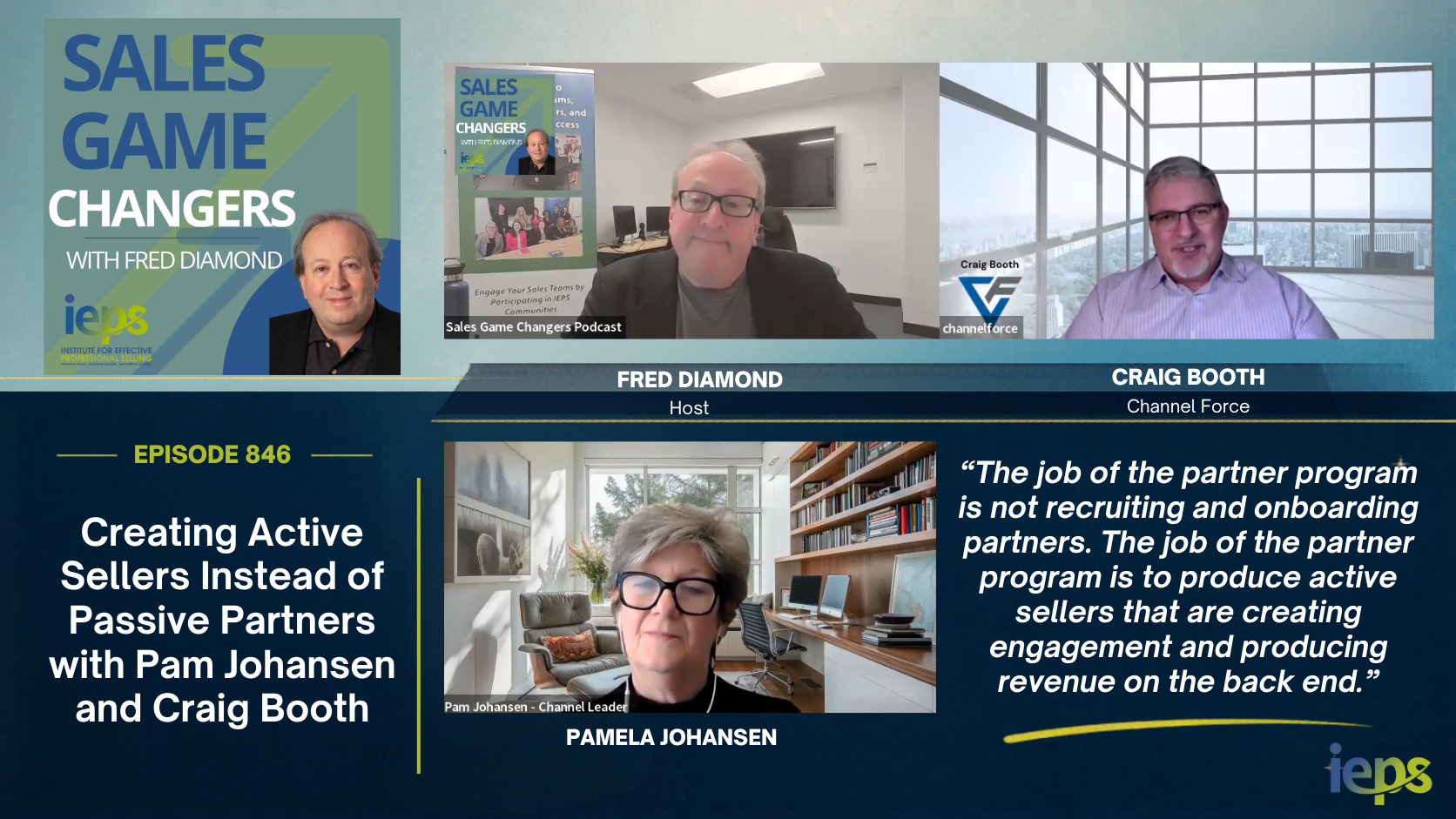
Today’s show featured an interview with channel sales leaders Pamela Johansen and Craig Booth.
Find Pam on LinkedIn. Find Craig on LinkedIn.
PAM’S TIP: “The role needs to be at the table with the customer. The direct seller, the channel seller, and the partner manager all need to be at the table to show the customer they have a responsible team coming together to support them in the sales process.”
CRAIG’S TIP: “The job of the partner program is not recruiting and onboarding partners. The job of the partner program is to produce active sellers that are creating engagement and producing revenue on the back end.”
THE PODCAST BEGINS HERE
Fred Diamond: Pam and Craig, we’re spending a lot more efforts at the Institute for Effective Professional Selling on professionals in the partner community and the various ecosystems, and I’m excited to talk to you both. We’re going to get deep into the state of partner programs. We’re very excited because we’re doing today’s interview in April of 2026, and in July, the Institute for Effective Professional Selling will launch our Partner Growth Program. You both have given some thoughts on that particular program. It’s going to be a six-session program held over three months for partner professionals. We’re going to be bringing on people who’ve worked in the partner ecosystem world for nice, successful careers, and we’re also going to be bringing in some facilitators to get specific on some of the skills that partner an alliance and strategic partner leaders need to have to be successful right now. We’re going to be talking about some of those skills today. I’m very excited to talk to you both today and get going.
Why don’t you introduce yourself? Pam, tell us a little bit about you, what you do, and then Craig as well.
Pam Johansen: Thank you for having me on your podcast today, and congratulations on the launch of the up-and-coming program because the channel is a huge, important transformational opportunity that’s coming in front of us. First off, I’m Pam Johansen. I come to this call with over 25 years of channel experience, and that is in partner programs, in partner strategy, in partner operations, and last but not least, channel sales. Very, very excited to be here, want to share my best practices and things that I have seen as we continue to transform the channel.
Fred Diamond: Pam, you and I have known each other for a number of years. We’ve seen each other at various events, and you introduced us to Craig Booth. You said that we need to talk to him. Actually, Craig, we’ve had some conversations, and one of the things that obviously resounded with me having created the Institute for Effective Professional Selling is where you go at this. A lot of your work is designed to help channel professionals and partner professionals really be more cognizant of what they need to do to help their companies achieve their revenue goals. It’s great to see you. Why don’t you tell us a little bit about yourself as well?
Craig Booth: I’ve got 30 years in technology sales. Believe it or not, half that time, if not a little bit more, was in direct sales. I come at this as a direct sales person that happened to wander my way into the partnering world. When I was working over at Juniper Networks, I was responsible for running the managed services and resale business for the Verizon relationship. That moved me into the partnering world, unbeknownst to me at the time, but we had tremendous success.
I’ve spent 15 years now in the partnering world. I’ve written a couple of books. I’ve written the methodologies that are out there. I’ve got an application that I’m out driving. It’s all about structuring performance. It’s going to fit nicely into your lead-in here.
Fred Diamond: At the end of the show, we’ll give some links where people can get some of your tools that can help them get started. As we were preparing for today’s show, there’s the three Rs, revenue, relevance, and ROI challenges. Each of them have a specific place in my heart. I’ve mentioned this on the Sales Game Changers Podcast before. My MBA thesis at San Jose State was on channel theory and design, believe it or not. My joke is I should have used it to create an online bookstore. But I was deep into the channel at places like Apple and Compaq and creating programs that would generate revenue in the ecosystem, which really wasn’t a word back then. Also, how to be more relevant and how to provide more ROI.
Let’s get into a couple of different topics here. We’re going to address five different topics. The first one, the problem with today’s program-centric partnering models. Why won’t they survive the AI-driven, profitable, efficient growth standard? Craig, tell us what that means. Then, Pam, I want your direct and specific insights.
Craig Booth: It’s a great question. I come at this a little bit different than everybody else. Most people that are brought up in the partnering world, they’ve been trained to think about the production unit of the partnering model as the partner. Everything we do is very program-centric. All of our structures are at the program end of it. The program, when it was built 40 years ago, when that was the model that we were operating from, was completely different. We didn’t have the competition that we have today. We didn’t have the tool sets that we have today. It was built for a different era. Obviously, the reason for having a partner program is to scale large partner ecosystems, put some structure into that, put incentives in place, create compliance to your partner program.
The problem with the model is that it is too program-centric. All the structure is between the partner and the vendor at the program level. From the seller to the economic buyer, it’s opportunistic partnering. That underlying foundation is what causes all of the issues. You brought up ROI, relevance, revenue, those things, the partner program is not that effective, based on what it was meant to do.
If you think about it, less than 5% of partner sellers will proactively prospect. We build these longtail partner ecosystems where we have 80% of the revenue coming from 20% of the partners and the rest are sitting there passive. The partner program creates fulfillment partnerships that are waiting for somebody to ask them to quote before they engage. Rather than addressing the efficiency problem, we scale more partners.
Going back to answer your question around the AI, why won’t it pass the profitable efficient growth test? Because we have to scale expense to scale performance. With AI, that’s no longer the metric that we’re looking at. We want to scale performance with either level expense or reducing expense. We have to change the model in the partnering world or we’re going to end up with more partner leaders cycling out.
Fred Diamond: That’s a great point. Pam, Craig had just mentioned a lot of these programs are 30, 40, maybe even some are 50 years old. We’re doing today’s interview in April of 2026. I can envision, as you were describing that, Craig, just along the last 30 years of fixes and band-aids and adjustments, but not really addressing where we are today in 2026.
Pam Johansen: Let me comment a piece on that because we talk about traditional, and you’re absolutely right. We continue to do the same thing over and over again in partner programs. We have the tiers, we have the expectations, and then we have the benefits, but it always touches on the organization. It never touches on the partner individuals because, think about it, our partner programs, to be tiering, you have to have so many bookings. How you got there doesn’t really matter. We just keep repeating that over and over again, opposed to really going down to the next level within your partner programs, to really start looking at the individuals within the organizations.
The outcome could mean you could have fewer partners because you’ve got so many different sellers within your partner organizations. If we don’t really transform, we’ll continue to repeat every time there’s a new channel chief. We’ll keep going through the same thing. This will probably be common. We always have to, when a new channel chief comes in, we never have the right partners. Sound familiar?
Craig Booth: Yeah, 100%.
Fred Diamond: That’s a great point. I remember when I was an Apple computer, I went to one of our partners. The guy who owned the company, it was a mom-and-pop type of a thing, he was so excited that one of his guys just sold five Macintosh IIs, was the product at the time, and it was a pretty robust program. I remember thinking like, “That’s great, but I wish he sold like a thousand or a hundred.” But then as I thought about it over the years, I remember thinking like, “I wish we had more of those guys.” It was a big deal for a mom-and-pop to sell five of these, which was an $8,000 product at the time. It was pretty substantial. I liked what you talked about there, about understanding who’s really moving the needle.
Craig, when we were talking before, you mentioned something called the dark funnel and the need for sales education methodology to address this hidden pipeline. Talk a little bit more about what that means.
Craig Booth: Let me first explain the dark funnel. The dark funnel is the point between the end of our product enablement to the deal registration, it’s completely dark. We have no execution visibility to what the partner seller has actually done to produce the deal registration or to produce the engagement. This is a real issue and I think it’s a really big issue in the partnering world. That lack of strategy execution visibility creates some of the major problems that we have with the 24-month cycle of a channel leader.
The average tenure for a channel leader is 24 months or less. The reason for that is when they build their strategy, unlike a direct sales team that can build a strategy and walk all the way through to the end result of a PO, and show you how deals have flowed through every stage, we have that gap that sits in the middle. We can never show the true execution of the partner all the way through from one end to the other. That creates this attribution issue where the direct team and the channel team and marketing are always fighting over who created the deal, who influenced the deal, all of that. The channel team typically loses in that argument.
We have to start addressing the dark funnel and there are ways that we can address that dark funnel. Part of that, going back to the sales execution methodology, I’ll use the analogy of a 100-meter race. We enable to the first 50 meters, meaning we enable to our partner program, we enable to compliance to the program, certifications, product training, but from that seller to the economic buyer is completely Wild Wild West, opportunistic, doing whatever.
What we need and what my company is all about, what we typically do is we bring a sales execution methodology that underpins visibility into this. We want to structure the performance of that seller with the economic buyer so that they are following the recipe. It might be a joint recipe that we build together that sells their solution sets, as well as ours. But we want to structure that and then we want to capture performance intelligence on that execution, run it through AI analytics to find the trends, and then recycle it back out as a better product to go out and enable too. That’s what I mean by the dark funnel. We can solve that, but it’s the core issue.
Fred Diamond: Pam, what do you think?
Pam Johansen: As Craig was talking about this, coming with my operations background, that is the hugest issue, transparency, and transparency for both sides. That’s where there’s the biggest issue because we really do an amazing job with direct sellers to make sure that they’re on point. They know where it’s at in the deal as well. Then you’ve got this channel. That’s where this greater transparency has to happen. We also need to make sure that they’re aligned with the same instep, with the same sales execution that’s required to generate revenue. When Craig says that, it’s like, you’re right, that is the biggest gap, is that you may not have the transparency or the tools even to support it sometimes.
Fred Diamond: The thing that excited me, Pam, when you introduced us to Craig is Craig coming at this from the active seller mentality, not just the mentality, but with tools and ideas and ways to visualize and to utilize AI to process, etc. Let’s talk a little bit now about the transformation from these passive participants to truly active sellers.
I run the Institute for Effective Professional Selling and we’re launching our Partner Growth Program because we believe that the channel professional is so critical and can be. I hear VPs of sales longing for that, wanting their people to be deep, because they have to be. Now in 2026, it’s no longer the management of the program is of value. It’s how are you helping our partners generate revenue? Tell us, Craig, some of your ideas on making that shift. Then, Pam, I want your insights on how it can really happen with the people who are tasked with doing it.
Craig Booth: Great question. The first thing that I would mention, I have two points that I would make in this. First and foremost is we have to shift to active sellers. This is one of the biggest fallacies that we have in the partnering world. Nobody cares about how many partners we have. They’re all sitting on the bench. Half of them aren’t producing. Your partner program isn’t about actually recruiting and onboarding partners. That’s not really the job of the partner program. The job of the partner program is to produce active sellers that are creating engagement and producing revenue on the back end.
There’s actually a company called Strategyn, they have a theory called Jobs-to-be-Done, which is basically saying that people think their job is one thing, but it’s actually something else. This is part of the problem with where we are in the partnering world. We believe that our job is to produce and recruit partners and onboard partners and enable. Those are all foundational things, I take nothing away from that, but that’s not really the job. It’s all about creating active sellers and measuring how many active sellers and the trending on those active sellers and those engagements. What does that mean?
It means we’re shifting even the role of the partner account manager. Rather than managing 50,000 partners in their territory, why wouldn’t we make the role creating 40 active sellers every quarter that are targeting four accounts? That’s 160 account engagements that are net new that you’re bringing in. If we start moving into more of the metrics-based enablement and we’re really focused on producing the end result that the program is meant to do, it shifts the focus, it shifts the strategies, but it actually produces the results and lowers the cost of the expense of your partner program.
Fred Diamond: I like what you said before that it’s not about the number of partners. A lot of times a new leader will come in and say, “We need more partners.” I remember having a conversation with one of my bosses at Compaq Computer. I remember I was talking about this in concept and he said, “There’s only three partners who are making a huge difference for us,” and he listed who they are and he said, “We got to make sure that they’re as successful as possible and we have to maintain our program so that the other 800 or whatever in this particular market segment have the tools and the methodology as appropriate.” He goes, “But we’re going to make our number if these three hit.” Pam, give us some of your insights on that.
Pam Johansen: One of the things that, going back to what Craig was talking about, and to your point about transformation, the biggest transformation is going to be around what your partner manager, your channel account manager has to evolve to. I always heard these words, partner managers are care and feeders. What we’re talking about right now changes that particular role of the channel manager. I know there’s, at least from my channel sales experience, is that I had those of which that really wanted to get out there and sell with the partner and enable the partner and go with customers and everything. That’s where we need to transform to, is that we’ve got to get those roles prepared to be able to play that role to work with those active sellers.
Fred Diamond: That is a great point. The job has shifted. Craig, did you want to comment on that?
Craig Booth: Pam is spot on. The role of the partner account manager in this new millennium isn’t necessarily just relationship management and program management. It’s to become a revenue architect. It’s how do I go out and architect revenue through my partners, and with AI and trending analysis, we have the ability to show up with a partner and say, “Hey, listen, I identified the last 15 accounts we sold to, I have an upsell playbook that we’re going to go out and run that’s going to generate, based on the metrics, an additional $1.2 million in license sales for you. It’s going to pull an additional $3 million in services.” That’s what the channel account management job is going to evolve into, not I’m running around compliance to the program. It’s a big shift.
Fred Diamond: I agree with you. Before we wind down the show talking specifically about the role of AI, you and I talked about something, Craig, and I’m interested in Pam’s thoughts on this, on the concept of what you call strategy enablement, and how you believe this is the next evolution in partner readiness. Talk about what that is, and Pam, I want your insights into the specificity about that between the vendor and the channel partner.
Craig Booth: There are four buckets of enablement. The first level of enablement is compliance to the partner program and it’s more of the alignment of the partner. It’s not just training on the program, but it’s how do we connect systems, all of that type of stuff that goes into that. The second level is product enablement. We spend a lot of time getting people certified on our products so they have a baseline knowledge of our value proposition. They can sit in front of a customer and articulate what we do. A lot of programs stop at those two levels.
The next level up is sales enablement, where we’re at least targeting and building ICPs. We’re figuring out who we want to go after and what our value proposition is by vertical, those type of things. But even that isn’t enough because there’s one level beyond that that everybody seems to miss, which is strategy execution. How do I align you or the partner seller downstream with a recipe that I want them to follow to create demand? How do I equip that in a way that’s easy for them to go and execute and it’s profitable for them to go and execute against that strategy? Strategy enablement is the next level.
I’ll throw two other things and I’ll be done, but we package strategies into sales playbooks. They’re not product playbooks, but they’re actually sales execution, where we’ve identified market need, we’ve identified the target, the value propositions, the messaging, the recipe that I want you to follow, the scoring of the accounts. There’s a whole list of things that goes into this, but you build just-in-time learning. You take people through a step-by-step process with videos that align back to each stage. They don’t have to learn everything at once, they just watch the video at that stage, you align AI resourcing into it. They have all the notes and things that they need at their hand. When somebody asks a question, AI can help support that. It’s a complete strategy execution, resourcing, and an enablement process. You have to have that or you don’t create active sellers.
Pam Johansen: If you think about what reality is today for channel managers, is that the things that Craig is talking about are probably not even available to them. They’re the ones out there searching for the information, trying to find a sales playbook, trying to find an expert to help answer. They’re spending all their time on probably the top two things that Craig has talked about, and we’ll never get to the strategy part because of our time. That’s where AI is absolutely changing the dynamics of how channel managers should be able to do their job, but they have to have the content to be able to pull the AI together and do the actions that they need to do with their active seller.
Fred Diamond: Before we talk about AI, I’m going to throw a little monkey wrench into the conversation here based on what you both are telling me. We talked about the vendor, we talked about the channel. One thing we haven’t talked about is the customer, the end customer. It’s interesting. Pam, we’re doing today’s interview in April of 2026, what role should the channel partner professional play today with the end customer?
Pam Johansen: This is my opinion being a channel sales leader, is that I believe that that role needs to be at the table with the customer, and even maybe that direct account manager. That has to be a team, a cohesive team, to show that they’re a forward front. Normally what you see is that the direct seller and the channel seller, the CAM or the partner manager isn’t at the table, but I believe that all three of them need to be at the table to sell to that end user customer, to show that customer that they have a responsible team coming to the table to help support them in the sales process.
Fred Diamond: The second R that we talked about in the beginning, relevance, it’s a tale as old as time. The channel professional, partner professional needs to continue to show value in what we’re talking about here. The value today is helping generate revenue, critical revenue that every company, from the top 10 vendors all the way down to new and emerging technologies, need to produce.
Craig, wrap us up here with the role of AI. We talk about AI in every show. We’ve mentioned it once or twice here. I know you’ve created some models that allow it to help move the processes forward. Just wrap us up here with where AI comes into this or where you think it should be coming to this.
Craig Booth: It’s a double-edged sword. I’m a big fan of AI. I love what AI can produce and what it does produce. My company runs basically on AI and a platform and a lot of other things. I’ll just give an analogy and I’ll share why this analogy I think is important, because I think we’re all caught up in this AI boom, but it’s going to be a boom or a bust depending on how we align.
I always use this analogy of a kitchen. AI is like a phenomenal new kitchen and it allows us to cook food so much faster. It allows us to produce things that we’ve never produced before. But it all comes down to the recipe that we put into AI. If we don’t have a methodology, if we don’t have the right recipe, all we’re doing is we’re serving bad food faster. It’s really important that we, in the partnering world, start aligning AI not just as products to solve point issues, but we have to align AI throughout an entire methodology and it has to fit together into a workflow that makes sense for the partner account manager, for the channel leader, the sales leader, the sales leadership, and the partner themselves. Everything has to fit together.
AI in and of itself is phenomenal, but I see a lot of partner programs that are using AI in a wrong way and they’re producing more issues than they’re actually solving. They’re creating more complexity and they’re producing tons and tons of stuff that nobody ever reads. Let’s get it really, really succinct and align it to a strategy so it produces what we’re looking for it to do.
Fred Diamond: Pam, do you want to give your statement on AI and the channel partner profession?
Pam Johansen: I use the words the crawl, the walk, and the run, and all the things that Craig said is spot on. I believe right now, from a channel perspective, we’re in the crawl. The channel managers, even using AI within their own systems, to be able to pull content together in a way upon which they can communicate to the seller, meaning the partner seller, as well as the customer. There’s a lot of work to do here in AI, but you got to start somewhere. That’s how I see AI in this conversation.
Fred Diamond: I want to thank Craig Booth and Pam Johansen for the great insights here. At the Institute for Effective Professional Selling, we’re very excited. We’re going to be launching our Partner Growth cohort in July. We’re going to be taking anywhere from 12 to 15 channel partners through a six-session cohort with the goal being implementing a lot of the things that we’re talking about here and bringing the profession into what is critical and what needs to happen for the relevance that we talked about and the ROI and the revenue.
I’m going to ask you both for your specific action steps that people listening to today’s show or reading the transcript to implement right now must take. Craig, why don’t you go first? I know that you’ve also created some tools. We’ll put the links to your various tools in the show notes, but you can give us a brief description of those and then give us your final action step.
Craig Booth: The first thing I would say is for anybody listening that you want a better understanding of structured performance partnering. How do I take some of the concepts that we’ve been talking about and get a true education? I’ve got a one-hour-long training program that’s free that I’ve posted up on the website. It’s at channelforce.podia.com and it’s just called Structured Performance Foundations Partnering. I would encourage anybody to take that. It’s definitely worth taking.
As far as the action items that I would encourage people to do, first and foremost, start looking at your partner program in terms of number of active sellers that you’re out producing. I would also encourage you guys to look at partner efficiency. One of the core things is if a partner has 10 sellers, how many of those sellers are active, and let’s start setting KPIs and rewarding people based on hitting active seller metrics. We want to know, are they 10% of the sales force, 30%, 40%, whatever it is, set those KPIs by the size of the partner and the type of partner, you’re going to end up in a better spot. The final thing is, shift your partner account managers to creating, organizing, educating, equipping, and managing active sellers and you’re going to see your revenue go through the roof.
Fred Diamond: Pam, once again, thank you so much for making the intro to Craig. Bring us home here. Give us a great action step people listening to the show must put into play.
Pam Johansen: All the things Craig said for sure, but one thing I really want our audience to really pay attention to is changing out the design of the role of the channel account manager, if you’re going to make them into revenue architects, but you’ve got to get them prepared before you can actually even go into the steps upon which putting the sales process in place. That means it’s the building it out as well as the training, or even hiring those particular roles to be able to support this particular process. That’s how I see it as we come to a close.
Fred Diamond: Now, I went to the two of you and about two dozen other people to propose the idea of, the IEPS, our Partner Growth Program. Everybody said the same thing. This is a position that historically isn’t really trained. There are very few training type things. There’s obviously a lot of sales training they can go through, of course, and we work with a lot of companies at the IEPS, but the specifics of this particular position, a lot of it’s like you got to figure it out. The reality too, like you’ve hit many, many times here, Craig and Pam, the world has changed. What is needed from the partner account manager at the companies, like those we work with at the IEPS, has changed.
Once again, I want to thank Pam Johansen and Craig Booth for being on today’s Sales Game Changers Podcast. My name is Fred Diamond.
Transcribed by Mariana Badillo