
Watch the video of this podcast on YouTube here.
The Sales Game Changers Podcast was recognized by YesWare as the top sales podcast. Read the announcement here.
FeedSpot named the Sales Game Changers Podcast at a top 20 Sales Podcast and top 8 Sales Leadership Podcast!
Subscribe to the Sales Game Changers Podcast now on Apple Podcasts!
Purchase Fred Diamond’s best-sellers Love, Hope, Lyme: What Family Members, Partners, and Friends Who Love a Chronic Lyme Survivor Need to Know and Insights for Sales Game Changers now!
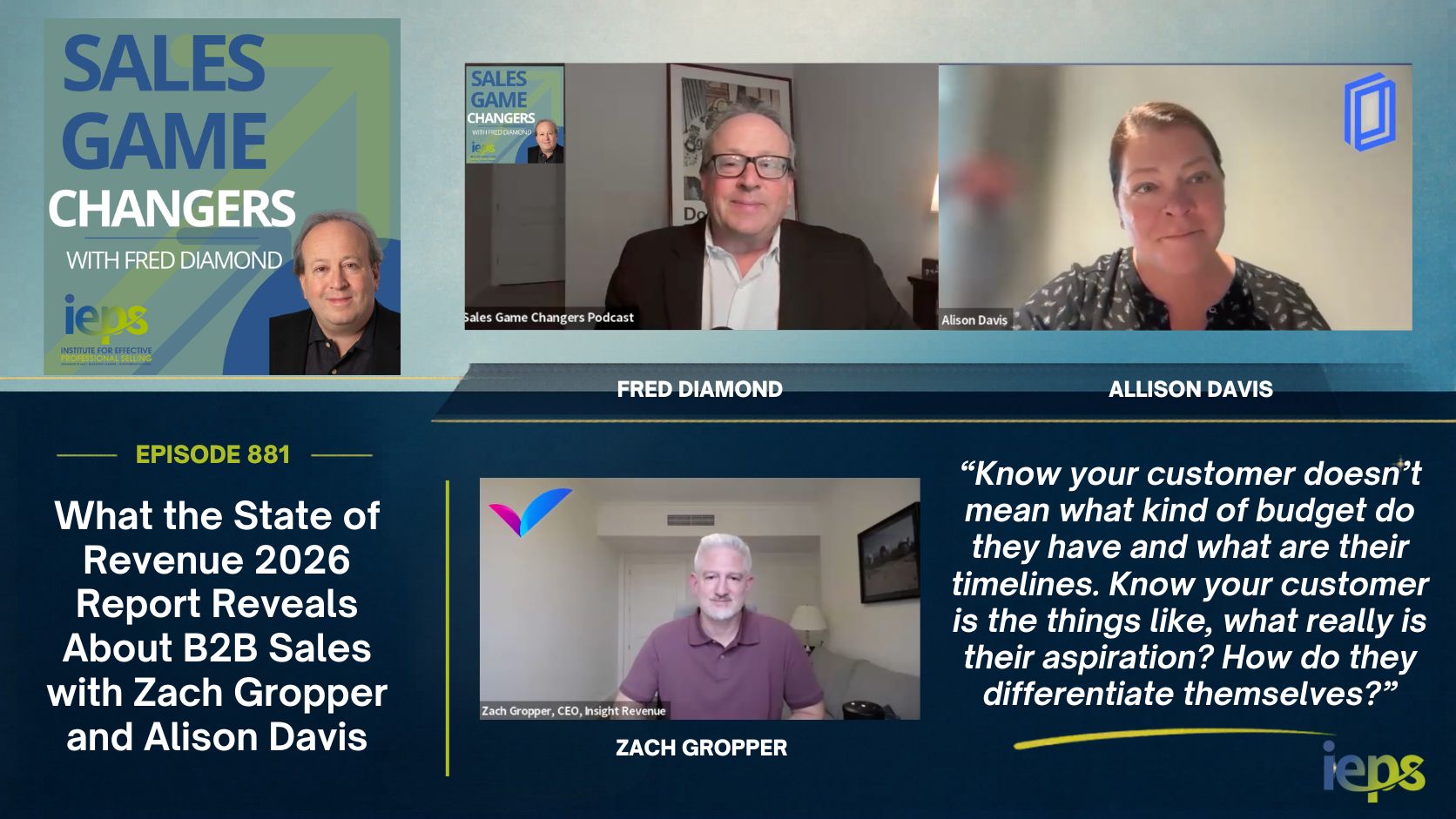
Today’s show featured an interview with Zach Gropper, Founder and CEO of Insight Revenue; and Allison Davis, Head of Client Solutions and Sales at Office Hours.
Find the State of Revenue 2026 report here.
Find Zach on LinkedIn. Find Alison on LinkedIn.
ZACH’S TIP: “Know your customer doesn’t mean what kind of budget do they have and what are their timelines. Know your customer is the things like, what really is their aspiration? How do they differentiate themselves?”
ALISON’S TIP: “In a world of AI slop out there, that human-to-human connection becomes increasingly important. I even go back to the good old days of sales where it was smile and dial. No one’s dialing anymore. If you want to reach a key executive, pick up the phone and call them.”
THE PODCAST BEGINS HERE
Fred Diamond: Zach, we had you on the show two years ago, and today we’re going to be talking about the State of Revenue 2026 report that’s been published by Insight Revenue. You brought on a guest. I remember two years ago, I said, “We’d love to talk to you, but you need to bring on a B2B VP of sales,” and you did that. You brought on one today. Zach, give us a little bit of an introduction, then introduce us to Alison Davis. Then, Alison, tell us a little bit about yourself, and then we’re going to dissect this report from the perspective, Zach, of selling professionals, how they need to act upon what you’re going to be talking about more effectively, and how sales leaders need to drive this increased and improved selling performance. Big introduction. Zach, reintroduce yourself, and then introduce us to Alison.
Zach Gropper: First of all, thanks for having me back. It’s great to be here. A lot has happened in the last two years, so looking forward to dive into that. Just a quick introduction to myself. I’m Zach Gropper, I actually live in Barcelona. You probably can’t tell from my accent, because I actually grew up in the DC area in Northern Virginia, way back in the day. The last 20 years or so, I’ve been really studying, in the best way possible, I could find the art and science of sales in a number of different roles. I’ve been a sales leader, a sales person for many years, and founder of Insight Revenue.
About 20 years ago, I joined a company called Corporate Executive Board, also found in the DC area, and it really looked at deep science and best practices around all functional topics, but I was particularly brought in to help look at the sales side and also how you build professional services to implement on the back of research. That led to the Challenger Sale, which many people know, and a practice we built doing that, before I founded Insight Revenue.
What we’re doing at Insight Revenue is really backed by ongoing research, and that actually informs how we think about the things that you mentioned around how do you drive high performance, the way customers are buying today, and how do you manage teams to a greater effect in this era of constant change, and I’m sure we’ll dive into that.
Alison also worked with us together back at Corporate Executive Board and has done some amazing things in the sales world, so we thought she’d be a perfect guest. Alison, I’ll let you introduce yourself.
Alison Davis: I’m Alison. I head up client solutions and sales at Office Hours. Before that, I spent 17 years at GLG, leading global sales and customer success teams. I learned how to sell at the Corporate Executive Board. I think it was just an incredible learning ground on how to do all things sales. Most of my career has been selling platforms versus products, multi-million-dollar subscriptions, basically things that live or die on ongoing value versus just one transaction, all in the B2B space.
Fred Diamond: Two quick things. When we started the Institute for Effective Professional Selling, it was originally called the Institute for Excellence in Sales, in Northern Virginia, we had a lot of involvement with some great people who really got their chops at CEB. I mentioned a couple of them in the prep and a number of them are still involved with what we now call the Institute for Effective Professional Selling. Our first Partner of the Year, her name was Heather Combs, who I believe you both are familiar with, was a good friend of ours.
Also, another quick point, you’re with a company called Office Hours. We have a sub-brand of the Sales Game Changers Podcast, which is really popular. It’s called Office Hours – Sales Professors Unplugged, where I interview professors at universities, typically associated with the University Sales Center Alliance, universities that have a professional selling program. That podcast we post typically every other Thursday and that’s been a great part of the Sales Game Changers family. Maybe I’ll get you guys to sponsor that, since you have your company with the same name. I don’t know how much you know about the universities, but there’s about 80 of them that have professional selling programs and they’re launching young adults into hitting the ground running at great companies that many of us are associated with.
Zach, as I went through the report, it seems to me that the central premise of the State of Revenue 2026 is that B2B technology companies have moved from selling relatively discreet products to selling broader platforms and integrated solutions. But unfortunately, their selling organizations may not have necessarily evolved with them. Is that correct? If so, give us a little more insight into the developments that you’ve seen as your company produced this report and spoke to hundreds of selling professionals and companies to get deep into this. For our listeners, we’re doing today’s interview in August of 2026.
Zach Gropper: That’s correct. The one thing I would say is it’s interesting when you use the term platform, what you get. I think one of the first things I learned when I talked to people about platform selling is they say, “What do you mean by a platform?” I think the traditional buzz is around AI enabled all-singing, all-dancing platforms these days. Our business actually goes into a lot of different industries that people consider maybe more or less sexy than these rapid-evolving AI companies. But all of them in one way, shape, or form seem to be moving towards what they consider a platform play, whether it’s bundling multiple professional services, or hardware technology.
In some way, shape, or form, I think what we get into is the idea that a lot of sales is really about change management these days. There is an element of service that needs to be applied to get any product, platform, or solution to stick. It’s interesting seeing how this takes root in different industries. We did talk to a lot of different industries, but in one way, shape, or form, adding AI into their offerings was a very consistent theme, as you can probably imagine. A lot of this also was the SaaS data platforms, all kinds of different shapes and sizes.
You’re right, we’ve been, under Insight Revenue for three years, doing these data revenue reports and looking at the data around what this pivot and transformation is of different businesses. It’s culminated in what you’re seeing now, which is it’s so hard to differentiate yourself these days. You have to, unless you’re really going to find this very specific niche or just go as a completely commoditized provider, and that’s fine, you’re going to have to find a way to differentiate. A lot of that seems to have been whether it’s acquiring, delivering new capabilities, or adding AI and services into your solutions.
The fact of the matter is, is most companies haven’t really seen through all those pitfalls or all through the journey into like, what does it actually mean to bring a solution to your customer? What does it mean to sell a solution? What does this really mean for the market? Is this something that we’re driving from the inside out? Or is the market really telling us that this is what they need? Without thinking through all those different steps, they just leave it on the sales team to figure it out. It’s like, “Hey, you’ve got to communicate the value, you’ve got to get people on board to the platform or the platform play.” That’s what we’re seeing, is all these different iterations in the report around what does that pivot really look like? What are the things that can go wrong, that boil up first? Then obviously, we’re trying to determine, what do those best practices look like?
Fred Diamond: Alison, I want to get your thoughts on everything Zach just said. We recently ran a major tech trade show and we were reminiscing because, I’ll be frank with you, every company looked the same. They all had AI-enabled solutions. Even though they were quite large, they all played, and these were big brands in the tech world. 20 years ago, it was very clear what you did. There was really no confusion. This is what we did. Maybe there’s two competitors, maybe some companies would start making acquisitions and grow a bigger solution, but now it’s really fuzzy. One thing that we see a lot of B2B selling professionals struggle with is the fact that it’s hard to differentiate what your company does. Alison, give us your thoughts on what Zach just teed us up on.
Alison Davis: I think for a while it was, do you try to be all things for all people? That’s how you got your foot in the door. Unfortunately, that’s not working anymore. I think many of the people that we’re negotiating with every single day are not the users of the product as well. You’ve got a little bit of this air war and ground war that needs to happen in sales where you need to be looking at the full buyer suite and mapping out who are the ultimate signers of said deal, but then also engaging with the users, because that’s going to be how you continue to grow and get sticky within the organization.
One of the good examples that we even have over here is like, sure, we could run a free trial, but if you run a free trial, there’s no skin in the game for the client to actually use it in the way that you need them to use it. It’s almost better to build the business case for a much larger contract, even though it will take you a longer amount of time, because it will ultimately convert better. I think that’s some of the research that Zach’s company found as well. It’s counterintuitive because you as a seller are like, “I’d love to give something away for free,” but at the end of the day, you need enough buy-in to get it to be catchy, otherwise it’s never going to work.
Fred Diamond: Zach, what are your thoughts on what Alison just said?
Zach Gropper: There’s a couple of really good points in there that we’re seeing around like, especially with all the new AI technology, there’s a lot of opt-in. You could just say like, “Hey, we have all this stuff, try it out,” and then push it out for free. People were pretty excited about that. Then there was this reckoning, I’m sure people have seen it, I think it was an MIT report and a McKinsey report, basically looking at, in the first 18 months of these major rollouts, nobody getting any value. In fact, a lot of disruption.
Then the skepticism in the market converged with the price sensitivity or the budget sensitivity in the market. Now you have a lot of people who stuck their heads out for the early adoption stuff and they’re like, “Whoa, that was disruptive. I got in trouble for that. Some people got fired for these things. By the way, also, shouldn’t we just wait, because everything’s changing so fast.” Then the cost of acquisition has gone up so high for companies on the sales side.
You look at those convergence of those trends and you start to think about, how do we grow our business? It’s not going to be by pummeling the market with more spam. That just doesn’t work anymore. We can’t get people excited and buy things. I think you are seeing this reckoning of sales organizations starting to realize, “Wait, we have to figure out who are we a good fit for?” People talk about ICPs forever, but I don’t think anyone really understands ideal is not what you’re looking for. You’re looking for, where are we a good fit? Where do we have differentiated value? Where are we going to get sticky? Because that’s where we’re going to have long-term value. Because we have to grow companies, we can’t just add new logos and lose them all the time. That shift in behavior, I think some companies are not picking up on that as fast as they need to.
As you piece through that, then you start to figure out like, well, how do we actually get in in a more strategic way? You see a lot of sales teams, and then the delivery teams around them, and the experts around them, are quite siloed. They’re coming into the customer and now they’re saying what Alison was saying, it’s like, “Wait, if we don’t get to the C level now, maybe even if we run a pilot, who’s going to look at the data? Who’s going to care?” You have this convergence also of people pushing on the sales team like, “You’ve got to get into the C-suite.” Again, well, how? Why? Why are they going to talk to us? What are they going to talk to us about? Because you want to show up and tell them all the new things we can do. Then by the way, if we engaged with that company before and we didn’t deliver, they’re going to be highly-resistant to even let us into that door again.
That’s one of the things we looked at, is do you think of, yes, companies are risk averse, but also, they’re much more sharpening around what does value mean? Is this really going to work? I think the three questions that we identified in the research, sales people really need to think about why they should really change. Is it a realistic change or is this just some exciting idea and that bar has gone much higher? Then it’s, is it really worth it? Is it really going to be worth it for them to go through this?
Then finally, the last piece, and I give a lot of credit to Timur Hicyilmaz, our head of research, for, am I going to survive this? Which is what we really heard when we did all of the verbatims. Like, will I survive the journey if I actually buy this thing? Whether it’s personally when we’re next on the line, or within our company, can we properly adopt this thing? Thinking through those things and digging into those questions is a different sales motion, and it’s a different buying motion on the other side, and appreciating that that is the sales job today, as we’re into B2B and especially enterprise B2B. It does seem like there needs to be a different playbook than probably what a lot of people who are in these positions today were taught to do or hired to do.
Fred Diamond: Alison, Zach just answered the next four questions that I had. Let me piece one or two of them and go to you. I was waiting for Zach to say the V word, value, which is the most commonly uttered word in the over 850 Sales Game Changers Podcast episodes that we’ve done. We’re doing today’s interview in August of 2026, we’re still dealing with a lot of the remnants of the pandemic era, and how that’s changed, not just selling organizations, but customers. Customers seem to have less tolerance for selling professionals. Of course, AI has also affected that, and the ability to get what they need from the internet and online, etc., that the sales professionals who are getting the opportunity, Zach, to communicate this to their customer, to those questions, they have to really be bringing extreme value that’s going to help the customer down the road, because that’s what the customer’s thinking about. The customer’s not thinking about, “Gee, when’s this sales rep going to call me, because he’s going to sell me this.” It’s like, how do I provide value to even keep my job?
Alison, based on everything that Zach just said, talk about some of the challenges that you deal with and that you’re trying to instill in your sales organization and with your leaders today to get to the point where this can be the way to go.
Alison Davis: In a world of AI slop out there, that human-to-human connection becomes increasingly important. I even go back to the good old days of sales where it was smile and dial. No one’s dialing anymore. If you want to reach a key executive, pick up the phone and call them. Seriously, there’s so much email, there’s so much Slack, or whatever, insert whatever communication method that your company uses. But you know what? Sometimes a quick text can go a long way.
I do think it’s really important for you as the seller to put yourself in the buyer’s shoes, because it is very risky out there. Companies are not protecting jobs anymore. It doesn’t matter how long you’ve been at a company. I think what Zach said is very true. There are people who put their necks on the line to roll out the latest AI tooling, only to get their hands slapped by legal and compliance, or insert whatever it is. I think you as the seller are responsible for looking out for some of those challenges that your buyer is going to face so that you can help them navigate this buying journey for you.
It’s not an easy one. It takes much more time, especially if you’re selling into the enterprise. While I haven’t sold into government, I know that that’s something that you guys focus on, I have to imagine it’s even worse, even harder, even more conservative. I think those are some of the things that you really need to think about as a sales leader, that you’ve got to really think about your buyer in this market.
Fred Diamond: It’s interesting, on the government side, there’s a lot of that, but there also was major reductions in force, because of DOGE, and a lot of people took retirement. Now selling professionals who knew their customer for 10, 15, 20, 30 years now has to communicate their value to new buyers, new technology executives. They also need to understand how the administration is driving their agencies to be effective and to do things. This isn’t a political conversation, but how they’re directing them to be.
Zach, when you’re making these discoveries, you’re finding companies that have made the shift, that are doing it right. Talk about some of the companies who are getting this done right, and what are some of the things you see them doing and what are they doing differently?
Zach Gropper: I think you can look at a number of levels from the sales person’s perspective of where we saw high performers, what leaders are doing differently, and then obviously as a company, I think embracing that this is a strategic change and investing in your people to make it through that journey. Versus just throwing a bunch of tools at them and telling them they need to communicate the value better.
What we see as the common trends is, starting at the top, is looking at a strategy that’s really built around your customer. I think as you’ve probably seen for years and years, everyone talks about being customer centric. But at the end of the day, what does that really mean? The perfect example you just gave right there is if your customer is the government and it’s a specific department, then you really have to understand, how are they being tracked and measured? What truly are their objectives? What is the strategy they’re trying to achieve? Then be able to break down what are the things that are getting in the way of them achieving success, and be able to position your solution into that gap.
I think that’s where we’re finding the biggest challenge actually in the market, is a lot of people say, “My teams, they need to ask better questions,” or we see these get back to the fundamentals of discovery, but I think it’s a different kind of discovery. There’s a lot of great tools and methodologies out there, MEDDIC being one of them that’s widely proliferated, especially in SaaS and software, but asking a list of questions that are qualification questions doesn’t actually help you understand the strategy of business, and it doesn’t exactly endear you and get them to trust that you actually care about that outcome.
I think the companies we see that are really successful are actually looking at like, how do we truly, as Alison said, you really better know your customer. Know your customer doesn’t mean what kind of budget do they have and what are their timelines. Know your customer is the things like, what really is their aspiration? How do they differentiate themselves? By the way, that helps you understand also like, are we a good fit for them? Are we barking up the right tree? Knowing that is one of the best things you can do for your customer from the beginning.
That’s what we look at from the top, is that, an organization that has a strategy like that looks at their enablement teams, they look at the training that they do, and make it much more about understanding how we align with the customers they’re buying. We are change agents for them, and this push-out idea of, “Well, every year we’ve acquired the newer technology. We’ve got the new AI stuff. Go talk about us,” that seems to be making sales organizations worse.
Having been in this game for a little while, seeing that some of the things we discovered over the years are atrophying and folks are getting worse at sales, even though we have access to so many more tools and technology, I think that’s the second piece. It’s understanding that you can’t over-index on tech to change how your sales people do these things. There needs to be an appropriate balance, which I’m sure is a theme we might be able to talk about. Then the second piece is then as that cascades down, you’ve got your sales managers, as you mentioned.
Sales managers are caught in the middle of this mess, and I’ve never seen it be worse, where I’ve seen managers really struggling. The good news is I see more leaders at the top saying, “My managers are struggling and it’s not their fault.” Let’s not replace them because they’re struggling. Let’s actually support them. We’ve actually never really invested in putting them in a position to do this stuff well. It’s not just that we promoted the high-performing sales people into managers, and that’s part of it, too, but it’s literally like, they’re this cross train station of all this stuff, how do we expect them to lead with data and understand how to communicate our new strategy and do change management, and coach their people, and know how to get them to adopt all these new tools and comply with all the data requirements, and, and, and. That seems to be something that’s also changing a lot, is people are finally investing in that frontline layer to help drive that change, even though they also have much wider spans of control now, which is definitely not probably a trend in the right direction.
Then at the field level, I think that’s what we’re seeing, is getting the basics of companies that are valuing creativity and curiosity and adaptivity at the frontline. They’re not trying to just teach their teams a process and get them to grind it out and just whatever survives the funnel, like it’s a quantity game. I think for where we started, it’s much more about how do we care better about the customers, identify what the right ones are, and go in really deep with those folks.
I think intrinsically, you need to want to learn about those businesses, you need to care about the people to be able to figure out how you become a change management support person for them through that process. I think that all folded together is much more of a cohesive strategy than some of maybe the PE/VC sales playbooks that we’ve seen run rampant through most tech, SaaS, and AI companies up till now.
Fred Diamond: Alison, I’m glad you’re on the show, because I’m sure you solved the problem that Zach just communicated, but let’s just address one part of it. It used to be enough to say, how do we make sales people better at selling. That was an easy question. There’s so much complexity, as Zach just alluded to, that we see all the time. Matter of fact, I just came back from two big tech company conferences. I was blown away at the complexity and the detail that needs to be communicated now. I worked at Apple Computer and Compaq Computer for a long time. It’s pretty simple at the end of the day. Here’s a laptop, here’s a PC. Here’s why our features are better than IBM’s, etc. Now there’s all these unique angles that are coming here.
My question for you, Alison, isn’t how do we make sales people better? It’s, are we capable of developing selling professionals to lead these increasingly complex customer decisions? Is that something that’s top of mind for you? Or are we making this more complex than maybe we are? A lot of people say AI is going to shift the selling organization, I don’t even want to go down that path, but the information that’s available to the customer, which means that our selling professionals need to be where Zach is saying they need to be, tell us down and dirty, you’re leading teams, are we able to do that? Is it a challenge that we can address, or are we beyond that?
Alison Davis: I certainly think we can address it. Otherwise, I wouldn’t be doing the job that I’m doing. I feel very passionately about empowering both the front lines, but the managers as well, to help coach their teams. I think in this environment, you’re right, yes, buyers can do a ton of research before they even get to the point of sale or engaging with the seller. That makes it increasingly important for the seller to understand how the buyer got there, and to meet the buyer where they are and understand the political risks of them buying. I think that’s the one piece that has gotten especially difficult in today’s environment, is it is like the cost of inaction. What if I don’t do anything and I just stay status quo? What happens to me? Versus I take a risk and I endorse this product or I sponsor this pilot or I make the initial buy, it better make me much more effective at my job, or it better make whoever I’m buying it for much more effective at their jobs. I think that’s the proof point that the sellers really need to make and the sales managers need to help the sellers get there.
Zach, we talk about this a lot. A lot of sales managers were just high-performing sales reps that got promoted into these jobs. How do you think about coaching the next level to be as good as you are? I think it’s a huge challenge, but I think you can help them flip that switch on like, “If I were going after this buyer, what would I do? Then how do I tell my friend how to do that? How do I tell them step by step?” because it’s typically not rocket science. It is discipline and you have to be disciplined about your pipeline, about your approach, and about how you research and speak to your customers.
Fred Diamond: Zach, let’s get a little bit deeper into that. You can just go to your AI engine and just type in, how do I become a more effective selling professional? It’ll shoot out all these things that we’re talking about here. But the reality is, it comes down to your discipline, your commitment. You’re really doing the right things, but doing things. We used to always say, the old adage that you got to make more phone calls. Well, no, you don’t. You got to make better phone calls to the prospects who are more capable, the ones that we’re talking about.
Zach, I want you to put on your thinking cap here and let’s get real specific for the thousands of selling professionals that are listening here. Based on all the research and what we just talked about for the last 20 some odd minutes or so, let’s give some prescriptions here to the selling professionals. You mentioned that 15% of the top performers behave differently. Let’s give some specific advice. Alison, I want you to chime in to specifically, what should people listening be doing to crossover, or if they are already successful, to be even more successful?
Zach Gropper: One of the interesting things, we talked a lot about these research organizations who’ve then turned into more services organizations as well, is you’ve got to get out of the ivory tower to really be able to drive practical change within organizations. Having done that for all these years, it’s one of the things that every day that’s changed management behavior, and change is not easy. Training can get a really bad rap for being an event. When we really look at what are the practical things you can do, this is something we really try to get into. We talk about how should discovery, as an example, be different? It’s not just about memorizing a list of questions.
As you even mentioned, yes, AI can give you all the answers to everything. You can go in and put it on paper and put that in front of a client, but the second they push on it a little bit, are you going to be confident enough to even have that conversation, let alone know what the heck you put in front of them? The shortcuts are over. First advice, number one is don’t take shortcuts. Actually try to have the discipline of understanding and being thoughtful about what you’re trying to do. Less is more.
If I’m talking to a client, in simple terms, there’s really three things I’m trying to figure out. You got to activate your own curiosity to figure out, how do I get that from them so I can better help them? I would put it as simply as start with number one, what are their strategy, what are they trying to achieve, and why? Everybody forgets the why question, especially if it’s an inbound lead and you don’t care about why, it’s like, “Well, this is what they want. They have a budget,” so now you get into saying how you’re going to solve. No, why? Why is that important? Why now? All those things. Start there. That’s an easy place to start because people love to talk about their goals, their objectives, what good looks like, how those are tracked and measured, etc.
But then you’ve got to pivot to, well, what are they doing now about it? It’s really easy to organize it that way in your mind. What are you doing now to help get there? How is that going? Then ultimately, what you’re really trying to find out, where the goal is, is what are the gaps? What are the barriers? What are the challenges in the way? That actually, if it’s just them telling you what they need from you and you don’t understand if that’s the right thing or how that fits, you’re not going to win that deal, or you’re going to get beat down on price considerably. This is where it all starts.
I think if you do that discovery process thoughtfully and use the curiosity of following up on their questions and really caring about those answers, tell me more about that, then it gets you out of this checklist for qualification, which most sales buyers are now used to, to say like, “Wait a minute, you’re making me do all the work and then you want to sell me everything you have. You don’t care at all about what’s the right thing for me.” Now it’s like, “Okay, well actually, not only are you actually digging in and helping me think deeper about these things, but then you’re holding the mirror up for me around the things I’m doing and the things that I’ve described.” Then you’re starting to see, “Wait, actually, just like a personal trainer does, when it’s like, hey, you can’t run that marathon and eat hamburgers every day for lunch and breakfast,” you’re there to make sure you’re putting two and two together and having them reflect on what’s really going to work.
That’s where when we did the work around the Challenger Sale, it became very popular, this idea of insight, that the accessible insight for people actually is like, these are the mistakes. I’ve had a hundred conversations in the past two months and these are the mistakes I keep seeing. Every sales person can bring the trends they’re seeing and those mistakes to the forefront and say, “Hey, this is what I see that’s not working. Whatever you do, just don’t do that. By the way, now that you’re listening, here’s the things I’ve seen our other customers do that actually really works for them. Does that relate to your world?” That’s nothing about your products. You’re a conduit to all these other people who do their job.
I think that’s a gift you have in the roles as a sales person, but most people don’t take advantage of that because their team is pushing them to just talk about themselves. I would say that’s where you start. There’s a lot more after that, but that’s some really practical advice of how do you get things moving in the right direction?
Alison Davis: I would agree with that. You as a seller have access to this competitive landscape. You’re trying out different use cases every day. I think there’s a lot to learn from. I also think I would say big call to action for the sales leaders out there as well. You should be on the front lines with your sellers in the trenches, listening to calls, going on meetings. I think that’s where you can identify what’s working versus what’s not working, what’s resonating, and who your really good sellers are. I think that can help you be a better coach as well.
Fred Diamond: The power of going on a sales call.
Alison Davis: Yeah, go on a sales call, go for a meeting, take a client out to lunch. Especially like now that we’re coming out of the COVID generation, I’ve been traveling a ton for work, and everyone’s happy to go grab a coffee. You want to do something in-person? Great, let’s go. I think we’re in a new world, which is awesome. A fun world.
Fred Diamond: So much more comes out of that. Once again, Insight Revenue, State of Revenue 2026 report. Thanks, Zach and Alison. We always wind down the Sales Game Changers Podcast with a specific action step, something our listeners must do to take their sales career to the next level. Zach, congratulations to your company on publishing this report. All the insights make so much sense and I hope you’ve gotten a lot of great interaction with B2B selling organizations from this. For people, I recommend that they go to your site, Insight Revenue, just Google it and it’ll take you to the report, and find it. We’ll put a link to the report into the show notes as well. Give us a specific action item. You both have given us a lot of great ideas. Something nice and crisp and specific that people listening to the show must do right now to take their sales career or their leadership career to the next level.
Zach Gropper: Number one, besides watching the Sales Game Changers Podcast, is the number one advice, the quick thing you can do. If I go back to staying curious, I think especially if you’re in a virtual organization, I think what I’ve seen high performers doing a lot these days is actually doing peer-to-peer coaching. I’d say if you’re in a sales organization, if you’re a manager, you should set this up. Pair up people to actually go and talk through either do call reviews together, don’t just take the AI call advice. Have people review calls together or review deals together on a regular basis, and keep that going. Maybe make it organic, that has to be an opt-in to it, but I think this is the kind of thing you lose the water cooler conversation, you lose the stimulation and the new ideas. I think, as Alison said, giving best practices to each other actually is how we learn and how we do that at scale. It’s obviously a lot more fun that way.
Alison Davis: I love the deal review one. I love a good pipeline review. I would agree with that one. The other one, which this isn’t just for selling, but maybe for just overall career advice, eat the frog. What I mean by eat the frog is the worst thing on your to-do list is the first thing you should do, because it will make you much more productive for the rest of the day. It goes back to the same like embrace the no. If you’ve got a lot of pipelines sitting out there in the middle stages, just get to the no so you can move on and get to the more attractive prospects.
Fred Diamond: I love that advice. I was coaching some young selling professionals this weekend and I basically said to them, “Just do it.” I didn’t say just do anything. They had some goals. I said, “Just do it.” The next thing you know, 23-year-old, you’re going to have done that and you’re going to be past that, and hopefully within a year or two, you’ll have done that 100 times, where it’s not something that you’re wasting time contemplating.
Just one final thought here, for selling professionals listening, you just need to be valuable for your customer. You need to bring them value. They have challenging stuff. Zach, all the companies, I’m sure, the solutions that are being offered here, these are important things that are making a difference in hospitals, in governments, in financial organizations, in education. What you’re bringing to your customers is pretty critical stuff. You need to really understand the depth of why you need to be bringing them value so that they can achieve their mission.
Once again, thank you so much, Zach Gropper with Insight Revenue. Alison Davis, thank you so much, Office Hours. My name is Fred Diamond and this is the Sales Game Changers Podcast.
Transcribed by Mariana Badillo