
Watch the video of this podcast on YouTube here.
The Sales Game Changers Podcast was recognized by YesWare as the top sales podcast. Read the announcement here.
FeedSpot named the Sales Game Changers Podcast at a top 20 Sales Podcast and top 8 Sales Leadership Podcast!
Subscribe to the Sales Game Changers Podcast now on Apple Podcasts!
Purchase Fred Diamond’s best-sellers Love, Hope, Lyme: What Family Members, Partners, and Friends Who Love a Chronic Lyme Survivor Need to Know and Insights for Sales Game Changers now!
The Institute for Effective Professional Selling has launched the Partner Revenue Academy for partner account managers who are looking to become more effective active sellers. The next 6-session cohort launches on October 16.
Learn more here.
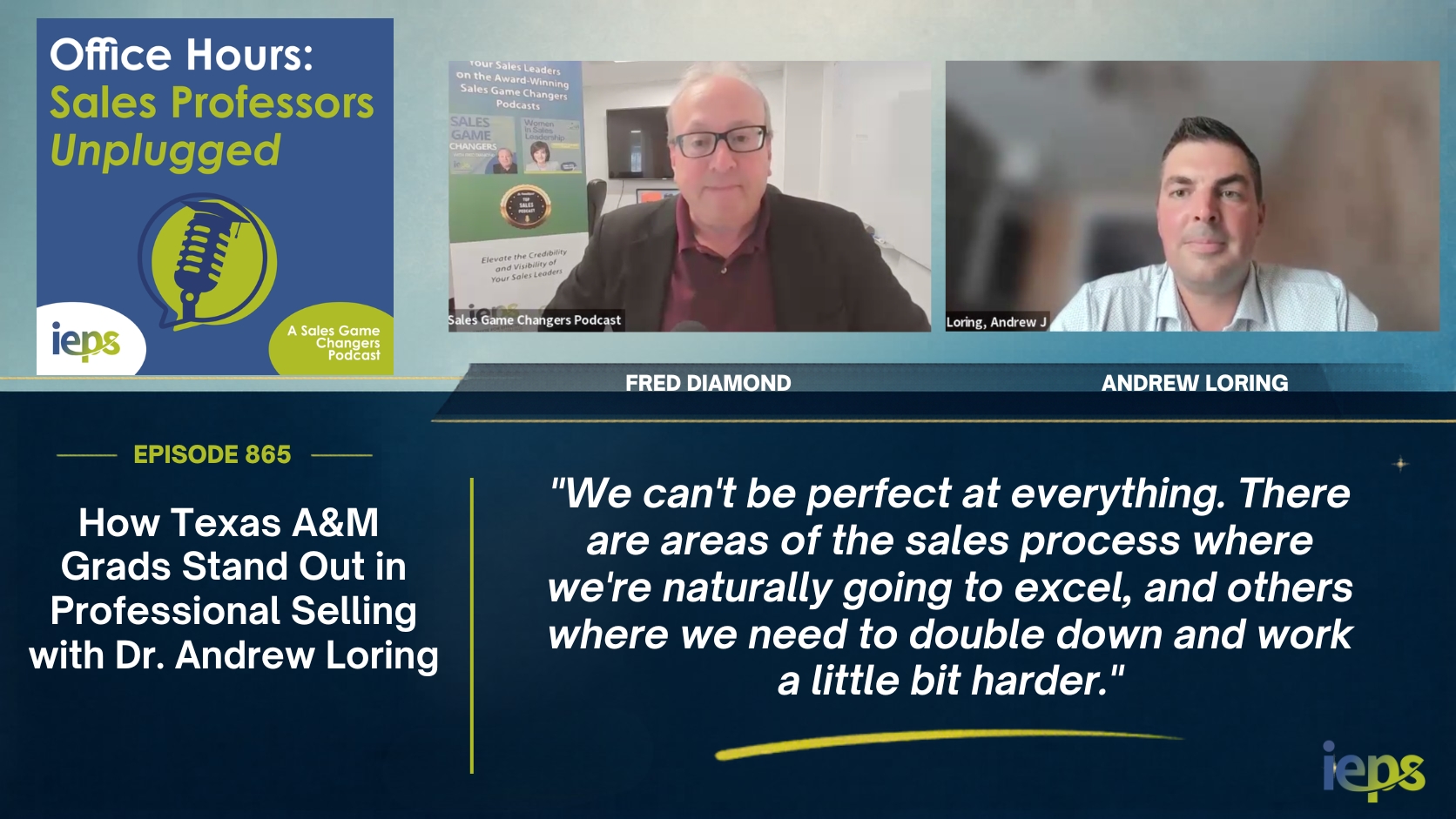
Today’s show featured an interview with Dr. Andrew Loring, Associate Director, Reynolds and Reynolds Sales Leadership Institute and Senior Lecturer at Texas A&M University.
Find Andrew on LinkedIn.
ANDREW’S TIP: “We can’t be perfect at everything. There are areas of the sales process where we’re naturally going to excel, and others where we need to double down and work a little bit harder.”
THE PODCAST BEGINS HERE
Fred Diamond: Dr. Loring, we’ve done about 20 special episodes where I’ll interview a professor, an executive director of a university program. Either it’s a sales major, a minor, or a certificate in professional selling, educating young adults to go work at the companies that are part of the Institute for Effective Professional Selling. Great companies that are doing B2B, potentially B2G, business to government, sales. I got to say, the work that you and your peers do to prepare these young adults for careers in professional selling is world-class.
It’s great to have you here. I’m very excited. I’m excited to learn more about some of your vision for the University Sales Center Alliance, specifically what you’re doing at Texas A&M. Why don’t you get us started? Tell us a little bit about what’s going on at Texas A&M. Tell us a little bit about your program.
Andrew Loring: I’m the associate director of the Reynolds and Reynolds Sales Leadership Institute at Texas A&M University. We’ve been a recognized program for the last 10 years now. Actually, last October in 2025, we celebrated our 10-year anniversary. It’s been a really exciting milestone in everything that we’ve achieved over the last decade in sales education.
Fred Diamond: It’s quite remarkable. Actually, there’s a number of schools in Texas. I’ve interviewed Dr. Howard Dover. I interviewed Semira Amirpour from University of Texas at Dallas. Of course, Dr. Linda Alkire at Texas State. Why is Texas such a great home for some of these programs?
Andrew Loring: I’ll add, Fred, that we’ve actually got more than one sales program at Texas A&M University now. Willy Bolander heads up a program in the College of Engineering as well. There’s sales all over the place in Texas.
As you may see in the news, Texas is booming economically. College Station is right in the middle of what some people refer to as the Texas Triangle. Within three hours of College Station are about 15 million people. DFW, Houston, and Austin are just booming. Companies are moving in and they need to hire great sales candidates.
Fred Diamond: Actually, I neglected to mention Baylor University. We’ve had Dr. Andrea Dixon and Lane Wakefield, and they have multiple programs there as well. Great stuff is happening down in Texas. As some people know, my daughter recently moved to Austin, so I’m excited to learn more.
We’re doing today’s interview in July of 2026, middle of your term as president of the USCA. You’ve had a front row seat to the evolution of university sales education. What changes have you seen in the past, you mentioned 10 years that your program has been around, that have had the greatest impact?
Andrew Loring: We’ve certainly seen a lot of changes. I’d say that more and more companies have come out of the woodwork, so to speak, sharing the great opportunities that they have for our students, for young graduates. The change specifically that I’ve seen are more and more companies wanting to hire sales students off of college campuses. That’s been a dramatic shift. Ten years ago, you’d always have the big players that were there. But more and more lately, we’re seeing companies and really obscure industries that are really interesting, that are great places for our students to go work.
Fred Diamond: When these companies get the message, I’ve done a couple interviews with your peers and sponsors of their programs, and when they get the message, they’re recruiting and hiring young adults that are three to five years advanced from new employees who might not have gone through your program. They have to learn about your technology and your offerings and your sales process, but they understand sales process, they understand solution selling, they understand the various models. One of the great things about these young adults is they’re not afraid. They’re fearless in getting on calls, on doing interactions with prospects.
As the president of the USCA, what trends are you hearing from the sales programs across the country that really should resonate with these business leaders that should be sponsoring and attracted to these programs?
Andrew Loring: For any recruiter or someone who works in HR, sales executive, attrition is a big problem. Anytime you hire a new salesperson, you run a risk of them getting there and realizing, hey, this isn’t what I thought it was going to be, and then they quit. That’s where the USCA and sales programs come in and play a huge role, because our graduates are walking into roles at companies that they’re already familiar with. Perhaps they’ve interned with that company, or at least they’ve met recruiters over, in some cases, several years, and so they know exactly what they’re getting themselves into. As a result, they’re quitting far less. Companies, they couldn’t ask for something better than a student who knows what they’re doing and they’re hungry to get after it and achieve their goals and work hard.
Fred Diamond: That’s a great point. Losing an employee, it could be six figures, especially for some of the roles. That’s one of the things that we’ve been pitching as well, is it’s a strain on a company, costs a lot of money to recruit. They might be taking a shot, but when the young adult has the preparation, they want to be there. They know they’ve been exposed because a lot of these young adults who go through your programs, it’s not like senior year last semester. A lot of them that we’ve spoken to, they get it. They might not know when they go to college, but maybe after the freshman year or early on in their career, they begin to see what your programs offer. Even more importantly, the career opportunities that come after that. They’re hitting the ground running.
Texas A&M runs one of the nation’s premier programs. Tell us a little bit about why it’s such a premier program. What do you think distinguishes some of the great sales programs at the USCA from others?
Andrew Loring: One of the big benefits of the USCA is our accreditation. We meet the same accreditation standards as all other USCA schools. It’s hard in some regards to say that we’re better. I don’t believe that we’re any better than other programs. I will say that we tend to focus more on students innate personality characteristics and help them increase their emotional intelligence and relate that to different companies and jobs that are out there.
As we know, we all have different personalities. Some people are better suited for hunter roles, while other students are better suited for farmer account management roles. We try to do a real deep dive into emotional intelligence and personality to help our students understand where they best fit in the wide world of sales opportunities. Again, being in the middle of the Texas Triangle, our students will go to oil and gas opportunities in Houston. They’ll go do everything in DFW. They’ll go do tech in Austin. It’s really important that they understand the differences between B2C, B2B, B2G, hunter, farmer, all the different types of sales roles that are out there and how they’ll progress over their careers in those different roles. That’s where we tend to focus, is more on that personality.
Fred Diamond: I want to go a little bit deeper into that. 10 years ago when the programs were getting kicked off, did you think that emotional intelligence was going to be such a critical thing? It comes up so frequently on the Sales Game Changers Podcast. We’ve even had the author of the great book, Selling with Emotional Intelligence, Colleen Stanley, on the podcast many times and on our stage. Talk a little bit more about how the work that you do, because you’re absolutely right, if you keep pushing someone in sales to do the wrong thing, they’re probably going to fail. I love that you’re doing this work when they’re in college, because they’ve already acknowledged that they want to go into sales. Now you’re getting even more specific in setting them up for a career of success.
Andrew Loring: I’ll give you an example, Fred. All of us, we do role playing with our students. In those role plays, we follow a sales process, just like all sales people do, or most sales people should. In that sales process, I tell my students that we, as human beings, we can’t be perfect at everything. There are areas of the sales process where we’re naturally going to excel at, and there are areas that are going to be more challenging for us.
A very simple example is the natural extrovert. They’re going to be really strong in that meeting opening category, the very beginning of a role play in that rubric line item, where they’re knocking on the door with excitement and hunger to meet someone, small talk comes naturally to them. Whereas an introverted student might struggle at that beginning, but then they pick it up when it comes to the discovery. They’re incredibly good at asking questions and listening intently and coming up with content that backs up the benefits of those needs that they discovered.
We take the emotional intelligence down to that level, where we break down each step in the rubric and help our students align their innate personality characteristics to each line on the rubric. They go into our role plays with an understanding that there are some areas of that rubric that they’re going to do naturally better than others. They know where they need to double down and work a little bit harder in preparation because it doesn’t come so naturally to them.
Fred Diamond: As a follow up, talk a little bit about the types of companies that are recruiting from Texas A&M. I love the way you’ve just made that distinction between the extrovert and the introvert and so many of those extroverts are great in the early stage. They’re fearless on the phone. Maybe they’re athletes, they’re used to rejection, so to speak, and it doesn’t really bother them. But the introverts, they maybe are better at the more complex deals where they have to talk to multiple people and think out the strategy. It’s not just bursting through. I’m just curious, the grads at Texas A&M, where do a lot of them go work?
Andrew Loring: Where our students go is pretty diverse. We’re agnostic to industry. We are named after a company, Reynolds and Reynolds, and Reynolds and Reynolds, they’re an automotive dealership solution provider and they’re based all around the country. It’s exclusively B2B and highly complex. They go in and they help car dealerships understand what needs and solutions they can provide with their award-winning technology. That’s much longer sales cycle, but our students will also do tech sales. A lot of them will go to Austin into BDR type roles. Many will go down to Houston in oil and gas. Some of our students go to Baker Hughes and other oil and gas companies.
We do a lot in logistics and most everyone does insurance. A lot of our students go to Gartner, PepsiCo, and AT&T, so all the major players. But we also have been getting in recently with a lot of healthcare. We have two fabulous partners in healthcare with AbbVie and Amgen and they’ve been tremendous supporters of our program because our students have really found a niche in their desire to go into healthcare sales type roles.
Fred Diamond: That is great. That is a wide range of industries. What’s even cooler about it is, you mentioned some companies, Gartner, PepsiCo, AbbVie, these are companies that are doing some important things. As I tell selling professionals all the time, you’re providing a service. There might be attraction at that young age about the money you can make and the brands, etc., but sales is the part of the business that really makes things go. For the types of companies that you just talked about, to be committed to working at the university level to bring those people into their process, it’s pretty impressive. I’m just curious, how do you communicate to those companies about getting involved? What really is it that attracts them?
Andrew Loring: The easiest way to put it is that we help them hire great candidates that don’t quit, so it reduces their attrition. Obviously, companies have one of two choices. They can either hire an experienced salesperson or they can hire a college student who’s about to graduate. Our pitch is that our students are much more malleable, so they’re hungry and they’re willing to learn your company’s ways from the ground up. Companies love it. They love it. They’re willing to come on campus and meet our students earlier and earlier, as early as sophomore year in some cases, and keep that relationship going over time until graduation so that students are ultimately walking into a role that they feel like they’ve been working at for the last two years, which is pretty incredible.
Fred Diamond: It’s 15 minutes into the interview. We haven’t brought up AI. AI is changing how we prospect, research, communicate, everything in the sales process. How are you using AI to prepare students? Where does AI come into your curriculum?
Andrew Loring: I’m glad you brought this up, because this is a hot button topic of the USCA. In fact, we brought in several AI vendors to our fall meeting last year. We’re using AI in the same way that all other programs are using it. It’s as a supplement to help students prepare for human-to-human face-to-face role plays. We use it as where our students will role play with an AI agent in an avatar. They’ll do that with piece by piece of the sales process ahead of their face-to-face role plays. That’s how we’re exclusively using AI.
Fred Diamond: We talked about sponsors a second ago, and it’s amazing. Every time I post an Office Hours – Sales Professors Unplugged show, I pop it up on LinkedIn, invariably, I’ll get three to five people who will say, even though we’ve done close to 20 shows, gee, I didn’t know that universities had sales programs. It’s a relatively new thing, if you will. The USCA, the University Sales Center Alliance, you’re bringing together universities and corporate partners. You just mentioned some blue-chip world-class companies. You mentioned that they’re looking at some of your young adults when they’re sophomore and early on in their careers. Talk a little bit more about what do you expect from corporate partners? What is your recommendation for other USCA members to be of more value to get more corporate partners involved?
Andrew Loring: The number one thing that any company that’s listening to this podcast can help all schools with all programs is hire our students, be willing to hire off college campuses and maybe let go of the experienced hire because of the baggage that they come with. Open your mind to the university hire. I promise you that you’ll have a good experience no matter really wherever you go.
For universities, for programs, my ask for all of them is to make it easy for companies to engage on campus with you. Invite them into your classrooms. Invite them to your events, whether it’s a career fair, a networking type of event, or maybe you have your own sales competition. Make it easy for them to come on campus, because at the end of the day, they’ve got to drive to your campus whether it’s close or far, they’re giving up time to do that, and they obviously want to see a win-win, some value in their time, and that is meeting your great students. It is 100% worthwhile. We’ve been doing it for a decade and we’ve had tremendous success.
Fred Diamond: One of the cool things about doing these particular interviews, the Office Hours – Sales Professors Unplugged, is that you’re committed to helping the young adults get their careers started off in a great way. We all know, everybody who’s listening to this, that sales is a great way to do it. As a sales educator specifically, what are some of the skills that you desperately want to ensure that they are leaving your program with?
Andrew Loring: I love that you asked that. It’s funny because every single year we host an advisory board meeting with all our corporate partners. I ask them that same question. I’m like, what do we need to be teaching our students this year that we didn’t incorporate last year that are going to help them get better prepared?
What’s interesting to me is every single year it’s typically the same thing. They say, I don’t care about the technology. We can teach them how to sell. We can teach them about our products and services. What we can’t teach them are the interpersonal skills. Their ability to build a natural, genuine relationship, their ability to ask outstanding questions and connect those to future problems that could be solved. That’s what they can’t teach. That’s what they look for. That’s why we’ve doubled down on our ability to help coach and develop our students in their interpersonal skills.
This is where AI is helping play that role, is it’s giving them more repetitions, albeit with an AI avatar. But still, they’re practicing the oral communication, which is incredibly important to all these companies. They want them to be able to have a good, genuine conversation with anybody as they sell. That’s where we’ve really doubled down and that’s ultimately what companies have wanted to see over the last decade and continue to want to see.
Fred Diamond: If you’re going to graduate a young adult in the sales program, you don’t expect that they know everything about the beverage industry. If you think about Pepsi, they deal with so many different entities that they sell to. You need to interface, as a selling professional, with multiple people, especially as we’re talking the B2B and the complex. You need to talk to finance people. You need to talk to tech people. You need to talk to other sales people, depending on what your role is going to be. I love that you use emotional intelligence. To be perfectly frank with you, Dr. Loring, I think you might be one of the first Office Hours – Sales Professors Unplugged guests who have focused on that. We believe it’s such a critical thing. It comes up time and time again.
You’re the president of the USCA, University Sales Center Alliance. Are more universities coming to you? Where do you see the growth of programs? If someone were to come to you, what might be your advice?
Andrew Loring: Most often we have new programs. Faculty that are just starting at a new university and have been charged with starting a sales program they typically find at the USCA, because that’s one of the primary functions of why we exist, is to support sales programs and their growth and development over time.
I want to call out James McIlroy at the University of New Hampshire. He’s a current board member of the USCA and he created something called the Sales Program Maturity Model that is actually a map where you can look at your program on a bunch of different variables and see where you land today and then you can chart where you want to be in the future. We use that maturity model to help programs, whether you’re new or you’ve been around 20, 25, 30 years, measure your success today and then help you improve in certain areas for tomorrow. That’s the major success area that we try to bring to all programs who are involved with the USCA.
Fred Diamond: What’s your favorite part of your job, not of the USCA, but of running the program at Texas A&M?
Andrew Loring: There are several things. The first thing that comes to my mind, I love being in the classroom. I love teaching and facilitating. I do a lot with emotional intelligence. I’m a CliftonStrengths Gallup-Certified Strengths Coach. I’m a DiSC Certified Practitioner. I do a lot of that. One of the favorite things I have are students who sit in the class in an entry level professional selling class having a negative and a skewed view of sales day one. They’re like, yeah, I’m only here because it’s a required course. I don’t really want to be here. Then soon, by the end of the semester, they learn about all the things that we talk about and they leave saying, this is amazing. You completely change my perspective on sales and sales careers. That’s probably the most rewarding, the most fun thing.
Fred Diamond: Here’s an opportunity for you. If a sales executive or a sales leader within two hours of College Station is listening, give their pitch. Tell them why they should get involved with your program, either at the individual level, if there’s a spot, or at the corporate level.
Andrew Loring: I’d say no matter where the school is, I would look at the proximity they are to sales programs. It’s not just about Texas A&M. I’m going to call out all the USCA schools. They’re all listed on our website. If you recruit in a general geographic area that’s close to any USCA program, the faculty’s contact information is on our website. Please look them up. But the pitch to them is just hire the students because they will walk in knowing more than anybody who has graduated from a non-sales program. There’s a huge advantage. This has been proven in the research over time that sales program graduates, they ramp up faster and they turn over less. They quit less. That’s the first thing you should think about, is always hire from a sales program directly.
Fred Diamond: You’re the president of the USCA. You’re doing a great job, by the way. Part of the goal is to get the message across to corporate America, and you’ve done a great job over the course of today’s show, of the value of it. Where do you want to see us in five years from now? What is there, about 85 universities that are part of the USCA?
Andrew Loring: That’s correct.
Fred Diamond: Where do you want to be in five years from a university membership perspective and maybe from a corporate sponsorship perspective?
Andrew Loring: We had our first international meeting in Europe, and in Europe, there’s a big need. Our world is getting smaller and smaller and doing business globally is happening more and more like it has for the past 15, 20 years. From an expansion standpoint, obviously we’re trying to plant a bigger flag in Europe, get more European schools involved, and we’re doing the same thing in the United States. But the area where we want to really make real progress is spread the USCA brand in the corporate world far more than we have.
The reality is we will go to SHRM events, Society of Human Resource Management events, and just talk to companies and it’s mind blowing how few companies that hire for sales don’t know that sales programs exist. Now, I get that sales programs have really only been around for the last 20 years or so. They’ve really taken off in the last 15. I understand that we’ve got a lot of work to do. But from a USCA mission, one of our marketing strategies over the next year is going to be shouting from the rooftops that we’re here. We exist and we’ve got great students for you.
Fred Diamond: Getting to know the universities, speaking to the students, the work that you and your peers are doing is a great service to companies. I love the way you talked about retention, making sure that the young adults going through your programs get into the right sales career, and they may learn different things once they get out there.
As a matter of fact, this morning, again, we’re doing today’s interview in July 9th of 2026, we did a program at the Institute for Effective Professional Selling this morning. We had about 200 sales people. One of the young adults asked me for advice. I said, get to know your company. Get to know everything about your company. I know you’re in sales. You’re probably going to learn about the product. You’re probably going to learn about the industry. But understand what finance does. Understand what operations does. Because one thing that your customer wants from you, sales guy or lady, as the face of the company is, how do I submit invoices? How do I get tech support? How do I track my orders? That’s a role that you do. Get to know the whole company.
Dr. Andrew Loring, Texas A&M College Station, University Sales Center Alliance, great job. Is there anything that you want to get across that we haven’t spoken about as we wind down today’s interview?
Andrew Loring: I just want to say thank you, Fred. Thank you for having me on this podcast. It’s been great. If anyone who’s listening to this wants to connect to Texas A&M, to our Sales Leadership Institute, or the USCA and other schools, please, at any time, reach out to me. I’m happy to help.
Fred Diamond: Great job. Congratulations for the continued success. My name is Fred Diamond. This is the Sales Game Changers Podcast Office Hours – Sales Professors Unplugged.
Transcribed by Mariana Badillo