
Watch the video of this podcast on YouTube here.
The Sales Game Changers Podcast was recognized by YesWare as the top sales podcast. Read the announcement here.
FeedSpot named the Sales Game Changers Podcast at a top 20 Sales Podcast and top 8 Sales Leadership Podcast!
Subscribe to the Sales Game Changers Podcast now on Apple Podcasts!
Purchase Fred Diamond’s best-sellers Love, Hope, Lyme: What Family Members, Partners, and Friends Who Love a Chronic Lyme Survivor Need to Know and Insights for Sales Game Changers now!
The Institute for Effective Professional Selling has launched the Partner Revenue Academy for partner account managers who are looking to become more effective active sellers. The next 6-session cohort launches on October 2nd.
Learn more here.
Today’s show featured an interview with Carmen Sorice, EVP of Business Development and Cost Management Solutions at E78.
Find Carmen on LinkedIn.
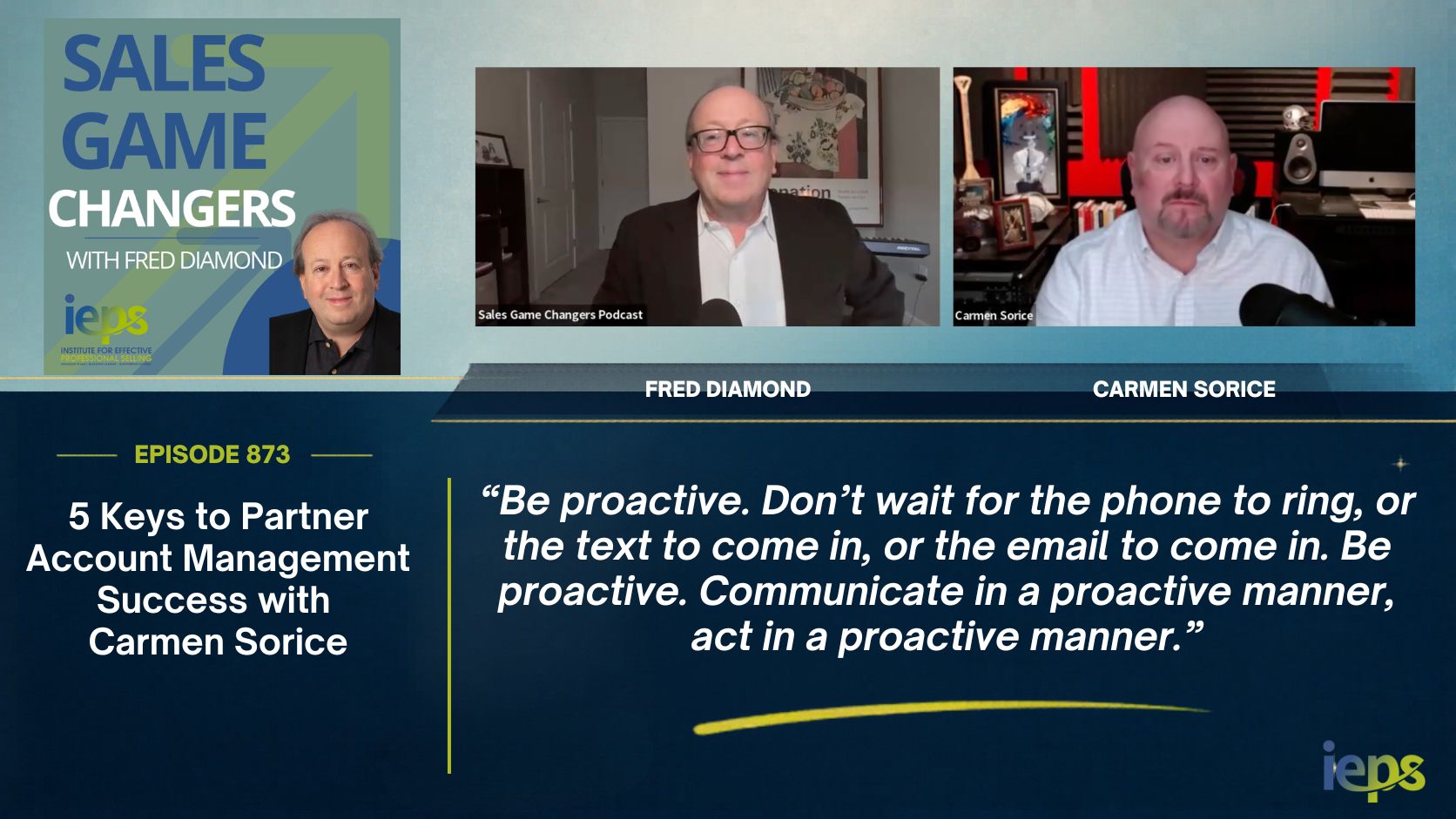
CARMEN’S TIP: “Be proactive. Don’t wait for the phone to ring, or the text to come in, or the email to come in. Be proactive. As an OEM partner manager, try and anticipate what your partners are seeing. Be proactive, communicate in a proactive manner, act in a proactive manner.”
THE PODCAST BEGINS HERE
Fred Diamond: The Institute for Effective Professional Selling is launching our first ever Partner Revenue Academy on October 2nd. It’s a six-session program. It’s hybrid, it’s also virtual as well, all around the globe. It’s for partner account managers who are looking to become what we call partner revenue architects. We’re going to be talking to Carmen Sorice here about how critical that is for partner account managers to build that better relationship between OEMs and their partners to generate revenue.
We’re doing today’s interview in September of 2026. Carmen Sorice, the world has changed over the last 18, 24 months for participants on the OEM, ISV side, distributors, channel participants, and obviously for customers as well. I brought you on the show. You’re a good friend of the Institute for Effective Professional Selling. I basically ask you, give us your five tips for partner success. It’s interesting because you’ve been on both sides of the fence. You’ve been on the OEM/ISV side, and now you’re in the channel. Carmen, give us an introduction and let’s get started. I’m excited to hear your five tips for partner success.
Carmen Sorice: I love the term partner revenue architects, because that is exactly what we need our partner managers to do. Real quick, I started my career as an engineer. I was on the technology side in Telcom. I moved into the channel side. For the last two decades, I’ve been managing, building, scaling large organizations on the vendor, the OEM side. I’ve worked for software companies, services companies, hardware and software infrastructure providers, managed service providers, cloud providers, and it’s always been on the vendor side. I’ve always been enabling my partners, getting my partners to do more. I’ve managed, over the last two decades, hundreds of partner account managers.
You’re spot on when you say things are changing. It is about revenue. The word architect is important because the partner manager has to help design, build, and execute that revenue growth strategy. Now, I’m on the partner side. I’m an EVP with E78 Partners. My responsibility is to go out and win business with new logos. I have dozens of vendors we do business with on the network side, cybersecurity side, UCaaS side. Now I find myself being in these executive reviews where vendors, OEMs, ISVs are telling me all the great things they do. I’m trying to interpret, how do I make that make sense for my partner business?
Fred Diamond: I’m excited to get your five tips. Just as a note, you also work closely with the woman who is going to be kicking off the Partner Revenue Academy, the great Rebecca Wetherly, who you worked with at AWS. We’re very excited to have her as part of the curriculum. Let’s get started. What’s number one?
Carmen Sorice: I worked with Rebecca when I was with AWS. That was my cloud reference. I have a lot of respect for Rebecca. You have some really good leaders lined up. It’s going to be very exciting.
What are my five tips? The first thing I’d say to a partner account manager is, know my business. By my, I mean, your partner’s business. The ticket for entry is that you know your business. You know your speeds, your feeds, your pricing, all of your strategy for your company, but know my business. Know my metrics, know my strategy, and at a personal level, when you’re working with a partner sales rep, sales leader, know their comp plan. How are they paid? I’m not saying everything should be driven solely by their comp plan, but it’s very important for you to know how your partner on the other side of the table is getting paid. How their company’s being measured. Are they private? Are they public? Are they trying to increase their valuation? Is recurring revenue worth more than just a one-time deal? Know all of that about your partner’s business. That’s number one, know my business.
Fred Diamond: A couple of things. One is, obviously, we talk a lot on the Sales Game Changers Podcast about what direct sales needs to do to be successful. It’s know your customer, the end customer, what is their mission, where they want to be in two years, etc. We talk about that all the time. The reality is your customer doesn’t need you if you’re not going to help them get there. Same type of a thing with your partner. Where are they going? How are they going to get there? How is your solution going to help them continue to grow?
Also, I like the point that you made about understanding how they get paid. We had John Carey, who’s the senior VP of global alliances at SAS. He’s been on the show a couple of times. We actually had him recently talking about AI and the partner channel. When I asked him for his final tip, he said exactly what you just said. He said, know how the person that you’re engaging with gets paid. Because at the end of the day, that really is the most important thing to them, especially in the business world, is how are they going to get paid to serve their customers, but also to serve their family and to help them achieve their goals and to grow. That’s a great one to get started with. What’s number two?
Carmen Sorice: Number two is, enable me. Yes, I’d like you to know my business, but I assume you know your business. Once you know my business, enable me to leverage your company to go qualify and win opportunities. There are a lot of tools you can use to do that. Of course, I, the partner, expect you to know your business, how you operate, what your key products are, but help me out with a battle card. How do you compare to maybe a couple of your other competitors? Where are your sweet spots? What are some use cases you can provide? If you have an ideal customer profile or two, that helps a partner.
I’m looking to be enabled as a partner to look for, qualify, and recognize opportunities that have your name written on it so that when I bring you into opportunities as a partner, I want a high win rate because I want your company to see me as a partner bringing opportunities that are qualified, that we win with, and that we’re not spinning a lot of wheels and cycles going down paths that don’t result in a win. Again, enable me, use those tools, those battle cards, the sweet spots, the use cases to make sure I’m enabled to qualify and win opportunities.
Fred Diamond: That is a great point. Actually, we do a lot of coaching at the Institute for Effective Professional Selling of selling professionals and more and more partner account people, hence why we created this program. I was interfacing with a mid-level, maybe a little bit on the junior side, partner account manager and they were seeking me for some coaching. They were talking about a negotiation that they had with one of their partners. They talked about how they achieved what they wanted to achieve. I said, “That’s great. But you have to remember, if you’re going to stay in this business, you’re going to be working with this partner possibly for the next 10, 15 years.”
One thing that you and I know with some of the great companies like AWS and the Oracles and the Microsofts, Cisco, they have relationships that have been going on for decades. Looking at a little win here ain’t going to help you. You need to figure out, I’m going to be with this person for the long term. It’s win, win, win. If you and the partner win, then the customer wins as well. I love that. What’s number three?
Carmen Sorice: Number three is all about accelerate and scaling opportunity generation and progression. It’s one thing to say, let’s do a joint account plan. Many times, those joint account plans sit on a shelf. Be active, actively manage the pipeline with me as the partner. Understand the opportunities I’m bringing to you, or you’re bringing to me, that we’re working together. Let’s actively, weekly, bi-weekly, whatever the right cadence is, let’s get together, review the pipeline, and make sure we’re moving them forward, we’re accelerating.
One thing, on this note, I talk about with my partner managers, don’t just come back and say, “Yeah, I had a good meeting with a partner. We have a joint account plan.” Do you have actions? Do you have owners? Do you have dates? Are there specific things that you and the partner are going to do that are going to generate these opportunities and progress forward? Because at the end of the day, it is all about revenue. It’s about revenue generation. Accelerate would be my next key thing that a partner manager needs to talk about.
Fred Diamond: I’m glad you brought that up because one of the reasons we created the Partner Revenue Academy is we go deep into that. One of the main goals of the program is shifting your mindset from a relationship manager to an active seller, to an active sales manager. That’s a different mindset that you need to come with. But as we’re talking about here, and as I’ve talked with hundreds of sales leaders in the OEM/ISV side and in the channel, if you, Mr. Partner Account Manager or Ms. Partner Account Manager, aren’t making that shift to understanding what you need to do to become a sales manager, you’re going to be struggling. Not only are you going to be struggling, you’re going to be out of a job because you’re not bringing what the company that you work with and the partner needs.
Once again, we’re doing this interview in September 2026, and the whole world has completely flipped. I was talking to a VP of sales the other day who said, “We’re almost in kindergarten with a lot of new things that we’re having to learn and understand.” Exactly what you’re talking about here is going to be playing out in the Partner Revenue Academy that’s going to be kicking off October 2nd. Carmen, number four.
Carmen Sorice: Number four is, I need my partner account manager to be a champion for me inside their company. Be a champion, be an advocate. That includes simplifying the partner experience I have working with you. I don’t need to know all the complexities about your business because I work with dozens of vendors. Simplify it for me, be my advocate. This really becomes important when there’s a channel conflict. I’m a partner out there selling, maybe I run into a direct sales rep from my vendor’s company, my OEM’s company. In order to mitigate that channel conflict, I need an advocate inside the company to help me get to where the win is. Being a champion and advocate is number four.
The priority of number four increases or decreases depending on where we are in the deal cycle. Sometimes it’s just a given, other times it’s very important. Does the partner manager know someone in finance, in product, in direct sales, who can help us get through this conflict we’re facing and get to the other side? Being a champion is my strong number four.
Fred Diamond: One thing that we talk about a lot is if your company has adopted a channel strategy, and almost every company that we deal with has at this point, you need to understand how are you making your partners as successful as possible. We still see, unfortunately, Carmen, contentious relationships. That may happen sometimes when it gets really down to the nuts and bolts, surprising, yada, yada, but the reality is your partner is closer to the customer. There’s the reason why you’re engaged with them and there’s a reason why you need to give them the opportunity to be as successful as possible.
One thing that we’re seeing a lot, which is one reason why we created the Partner Revenue Academy and are doing all these podcasts with channel leaders like you and partnership experts, is because there’s so much more dependence on the channel for being a success for a whole bunch of different reasons that we’ve gone to in previous shows. These are great, Carmen. Let’s round us up here with number five.
Carmen Sorice: Number five is, it has to do with speed. You mentioned we’re here in 2026 and the world’s different. One of the ways it’s different is we all have to move faster. What I found is the only way a partner and their OEM, their ISV vendor partner are going to move fast is if you build trust. It’s so important that you build trust with each other, person to person, company to company. That involves open and transparent communications. Don’t be afraid to let me know there’s bad news. I didn’t get the lead reg. I didn’t get the discount I needed. I can’t get into that account because your direct team has it as a do-not-call account list for a national account type company. Be open with me. Tell me bad news if you have to and let’s talk about it and how we’re going to work through it.
The other thing is we both need to do what we say we’re going to do. That is so simple in business. Do what you say you’re going to do. But how many times we leave a QBR and someone says, “Yeah, yeah, I’ll get you that battle card. I’ll do this. I’ll do that.” Then time goes by and nothing happens. Again, in order to move fast, we have to trust each other. Building that trust is the foundation. I left it till number five, but without it, nothing else happens. Nothing else happens fast. Sometimes not much happens at all if you don’t build that trust with one another. That would be my fifth and anchor factor.
Fred Diamond: That’s really well said. As we’re talking here, we need to think about the word partner. It’s not enemy account manager. It’s partner account manager. At the end of the day, the reason why our companies, the OEMs and ISVs that we work with at the IEPS, have these partner relationships is because you need to build your business. You need to scale. You need to grow. Obviously, companies have been doing this for 40, 50 years, in a lot of cases, that we work with. But even if you’re new or if your company is growing, it’s the fastest way to scale at the end of the day. Think about that, listeners. What does partner mean?
Partner means you both have something you want to achieve. You’re going to work together to achieve it. What we’re doing with the Partner Revenue Academy is putting some skills behind that and putting some regimen behind that, and putting some working with you, partner account managers, to help you become more effective so that your company can drive more revenue and achieve the goals that your company has set up to achieve.
Carmen, great five tips. I love them. They’re all very, very beneficial and helpful. Give us one final action step. Give us something that you recommend either partner account managers or anyone listening do today to take their sales career to the next level.
Carmen Sorice: You look at those five keys we just went through for partner account managers, and for any sellers really, the one word I would say is be proactive. Don’t wait for the phone to ring, or the text to come in, or the email to come in. Be proactive. As an OEM partner manager, try and anticipate what your partners are seeing. If there’s a news blurb out there about some acquisition by your competitor, assume they’re going to want to know what the heck is going on. Be proactive, communicate in a proactive manner, act in a proactive manner.
If you think your partner is going to need a steeper discount because they’re in a very competitive situation, maybe do some homework with product before they even ask you, and say, “Hey, what is the floor? If they come and ask for three more points, five more points, is it possible? What would I have to do to get that?” This way gets back to speed. When the partner does engage, you have an answer for them because you’ve done that proactive work. That’s just one example of being proactive. That’s what I would say, Fred, and hopefully this helps you. I think it dovetails nicely into the curriculum you’ve put together and the speakers you’ve put together for your program.
Fred Diamond: Absolutely does, be proactive. I love that. I recommend that to everybody. Sense the needs of the people that you’re supporting and serving and your customers and your partners and your leadership. The most successful people are the ones who definitely think that way and are proactive.
Once again, I want to thank Carmen Sorice for his five tips. The Partner Revenue Academy begins on October 2nd. Hope to have you there. My name is Fred Diamond. This is the Sales Game Changers Podcast.
Transcribed by Mariana Badillo