
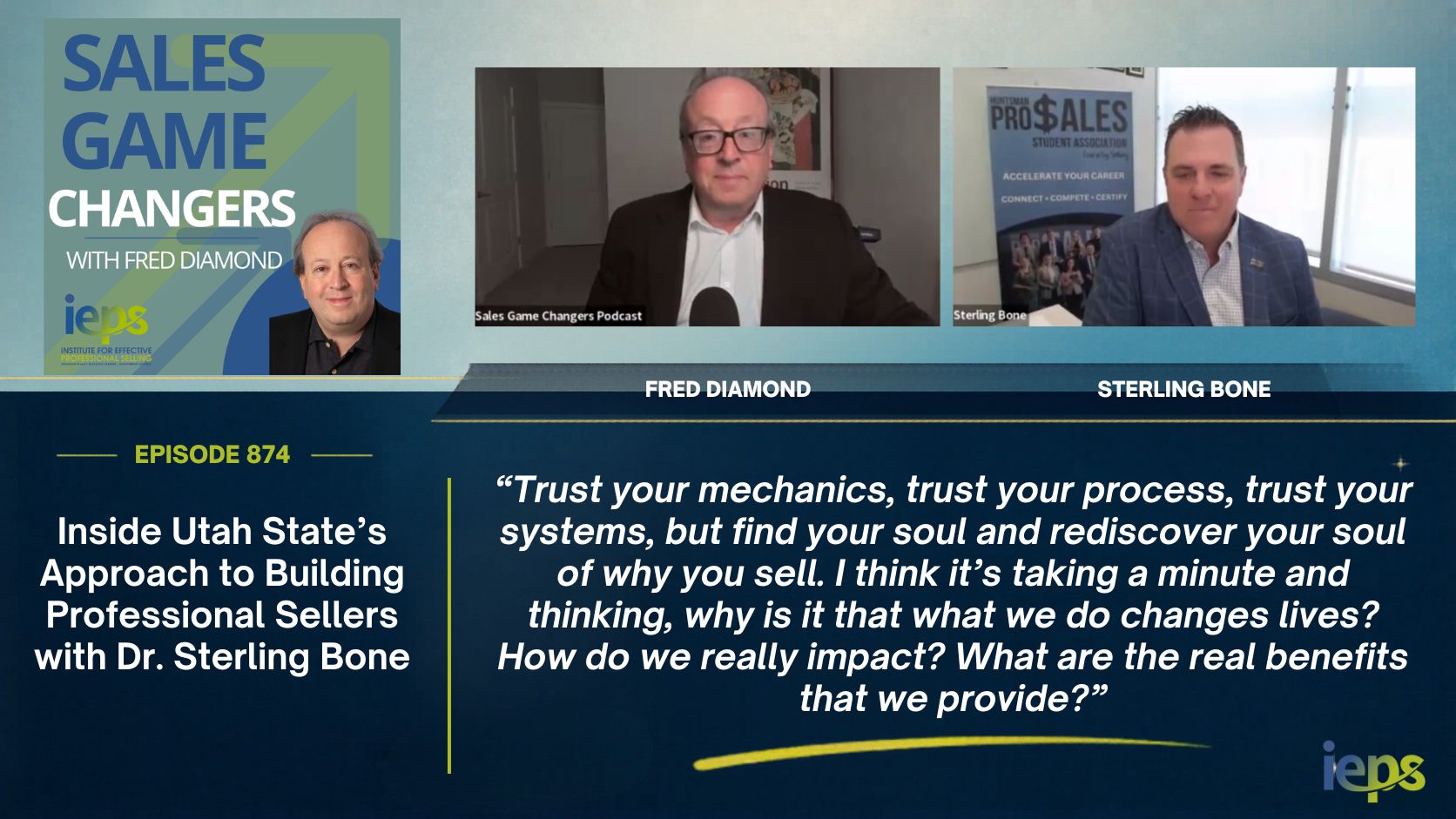
This is an Office Hours: Sales Professors Unplugged sub-brand of the Sales Game Changers Podcast.
Watch the video of this podcast on YouTube here.
The Sales Game Changers Podcast was recognized by YesWare as the top sales podcast. Read the announcement here.
FeedSpot named the Sales Game Changers Podcast at a top 20 Sales Podcast and top 8 Sales Leadership Podcast!
Subscribe to the Sales Game Changers Podcast now on Apple Podcasts!
Purchase Fred Diamond’s best-sellers Love, Hope, Lyme: What Family Members, Partners, and Friends Who Love a Chronic Lyme Survivor Need to Know and Insights for Sales Game Changers now!
The Institute for Effective Professional Selling has launched the Partner Revenue Academy for partner account managers who are looking to become more effective active sellers. The next 6-session cohort launches on October 2nd.
Learn more here.
Today’s show featured an interview with Dr. Sterling Bone, Professor and Director of Huntsman ProSales at Utah State University – Jon M. Huntsman School of Business.
Find Sterling on LinkedIn.
STERLING’S TIP: “Trust your mechanics, trust your process, trust your systems, but find your soul and rediscover your soul of why you sell. I think it’s taking a minute and thinking, why is it that what we do changes lives? How do we really impact? What are the real benefits that we provide?”
THE PODCAST BEGINS HERE
Fred Diamond: I’ve done about 25 interviews, Dr. Bone, with professors like you who are running programs at universities. We post them on YouTube, we post them on Apple and Spotify, and we also post a couple of times on LinkedIn. Every time I do a LinkedIn post, three to four people will always comment, “I didn’t realize that there were professional selling programs at universities.”
I’m talking today with Dr. Sterling Bone from Utah State. I’m very excited to get deep into this. We’re going to talk about a lot of interesting things that you’re doing to prepare your young adults. Before I get into my formal questions, give us a brief introduction to you and to Utah State and what you got going on.
Sterling Bone: Thank you, Fred. It’s really truly an honor to be with you. This is an honorable profession, and I’m so glad to be connected with those that are advocating for the profession and the opportunity. To all the listeners, thank you for caring about the state of professional selling in today’s world.
My journey started in professional selling. It goes back to my early days as a kid doing those fundraisers door to door. Didn’t see myself as a seller early on, but I grew into that. My first job was in retail, and later I served a church service mission where I was in Columbia in the jungles, evangelizing and teaching religion and faith. But even then, I didn’t see myself in sales. I saw myself in the duty of service.
But it was after my journey abroad that I returned to my educational roots, which are Utah State University. I got two degrees here, and along the way was a real estate and financial service professional. Then I saw myself clearly in sales at that point. Then pursuing advanced studies realized that, wait, we’re not teaching sales in institutions of higher learning like we should. I would have benefited, as many of I’m sure the listeners would have, knowing that there was professional selling training. It became part of my early career and now my mid-later career mission to build great programs of excellence to train the next generations to sell with integrity and to sell with impact and sell in the ways that we hope that they do.
Here at Utah State, I’m in my 15th year building a program from the grassroots. We like to say here in the state of Utah, we’re sitting on a goldmine of talent. We have some amazing young people across all of our institutions of higher learning out here in the West. We have a pioneering spirit that is really deeply rooted, and I’ll talk a little bit about that and how we harness that pioneering spirit in today’s seller. It’s really truly an honor to be with you. Excited to have this conversation. Thank you for bringing awareness to this honorable profession.
Fred Diamond: You’re welcome. When we got to learn more about what the University Sales Center Alliance, the USCA, was doing, we felt such an affinity at the Institute for Effective Professional Selling with you and your peers whose mission was to help young adults go to companies. The great thing about the programs like yours that we’ve learned is you’re preparing young adults to hit the ground running. They may need to learn about the technology or the product that they’re going to be selling, maybe the marketplace, but time and time again, the companies that are sponsoring the corporations that are partnering with you guys tell me that these young adults that we’re hiring, their retention is higher, their ability to start is quicker, their ability to grow into management comes along with it as well, because the education that you are giving is so amazing.
You mentioned you’ve been at Utah State for about 15 years. What excites you most about where the university’s sales programs are headed?
Sterling Bone: I think it’s a great thing that we’re part of these programs. I pay tribute to my peers across the country. None of us are working alone. We’re not in competition with one another. We’re really collaborating to really build upon a state of abundance that we have. We have great young people. We have great mid-career, later career. We teach non-traditional students as well. When I say young people, we’ve got great students across the board, let me just say that.
I’m excited that there’s been a lot of efforts over the last, I would say two or three decades, if not longer, teaching good sales mechanics. I’m glad that we have a foundation laid on understanding and teaching and knowing how to teach and instill in junior sales professionals the mechanics of how to sell. What I’m excited about is that we’ve, I wouldn’t say we’ve graduated from mechanics training and teaching, but I think we’re thinking out of the box a little bit. It’s not just about mechanics. It’s about character building. It’s bringing the human side of selling back in. It’s bringing that personal authenticity, that genuine voice.
I think today generationally, students that I interact with, they want to be creative. They don’t want to be put into a box. They don’t want to be conforming to a model. I think it’s great that we give them those mechanics and those models, those systems, those processes. But I’m excited about the opportunity, is to unleash the human potential that is in these students and in all professionals.
I’m currently working on a book that is couched against the importance of human persuasion in the A of AI. I think that technology is fascinating. I’m excited about the technology advancements. I had the unique opportunity earlier this summer to be in the same room with the Artemis II crew. When I say in the same room, I was in a large auditorium in Ottawa, Canada. My travels with some of my research and other involvement took me to Ottawa, Canada. I was in this room, and I’ve been fascinated with this mission to orbit the moon, as I am fascinated with lots of amazing technology and technological advances.
It was interesting, from the crew’s perspective, while they had been trained on the mechanics of the orbiter and all of the mechanics and technologies that they were needing to execute upon and to have hopefully work, an obviously very dangerous mission, but what they reflected on most at the end of that mission was humanity. It really struck me that as technology advances, we start to question and think about, what is the role that humanity plays in this? Our perspectives change. I’m excited about this next age of sales training that we can really return to the human and really focus on the human side, what I refer to as the soul of selling.
Fred Diamond: We’re doing today’s interview in August of 2026. Obviously, AI is huge, and the tools. We spend a lot of time at the Institute for Effective Professional Selling talking about that, but at its core, the selling professionals who are exceptional, and I’ve met a lot of the young adults who are coming out of these programs at the USCA universities. They have a lot of the rigor of the process, but they’re also passionate. You’re teaching them about the passion that their customers have. Everyone that they’re trying to sell to B2B, B2G, advanced B2C, whatever it might be, there’s a customer at the other side who has committed their career to whatever it might be, to building better houses, to creating better devices for people to sell, for creating technology that’s going to improve healthcare, whatever it might be, that is what their passion is about. Yeah, they’re interested in what is your technology going to do, but they’re really interested in, why do you care, and show me why you care. I appreciate your saying that.
I’m just curious, you talk to a lot of students who you want to bring into your program. What might be some of the biggest misconceptions some of these students may have about a career in professional selling? One thing I just want to state is we’re all about effective professional selling. Sales isn’t about, what do I got to do to get you to buy this pen? It’s not about getting people to do something that they don’t want to do. It’s about helping them achieve their mission, etc. Talk a little bit about some of the things that some of the students may not understand that professional selling is all about.
Sterling Bone: I’m glad that you emphasize professional. I think a lot of students enter the art program and enter programs across the country, and for that matter, the world, thinking about sales from an amateur perspective. They’ve seen individuals that have sold, maybe in stereotypical negative ways, that have maybe violated some of the most important laws and norms of integrity and honesty, etc. I don’t want to promulgate all those misconceptions, those negative stereotypes. We hear about them all the time.
I think a lot of students see sales as a drudgery, a place of lots of rejection. But in reality, what they need to know and what they need to see is how selling is really the engine of the organization, especially when we talk about these professionals. A professional seller has a well-engineered system process. We call that mechanics. With that engine, it’s got all the pistons going. But we need to teach those young junior sellers to recognize that a professional has to be practicing and constantly adapting and evolving and learning. You can’t stay status quo in how you approach your selling. I love how you brought the perspective of the customer. The knowledge and the responsibility to put yourself in that customer’s world and to really be able to think critically on your feet, is so important.
I think a lot of students see it as drudgery. They worry about the rejection. They see maybe sales as not being a career that they can have the values of integrity and high character. A lot of that is hung up in the amateur model. But when they recognize that, hey, wait, professionals do this for careers and do this by choice, and love this and are excited about this, and well compensated, well rewarded, and advance and grow in their career, then the students are all over it. They see true professionals and they’re all over it. We constantly have to overcome some of those negative stereotypes. I don’t want to promulgate them more here, but I think a lot of it is just helping them recognize that there’s amateur sports and there’s professional sports, and we want to train them professionally.
Fred Diamond: The reality of companies is there’s no finance department, there’s no logistics, there’s no operations, there’s no legal if there’s no sales. I remember once I worked for a very large software company. I remember sitting in a room with me and two of my closest friends and the CEO and he said, “The last person out the door is our worst sales person.” He said, “That’s what keeps the engine going.” I’ve appreciated that my entire career.
A big part of your program is working with employers. One of the great things about these university programs is you’re training professionals to go work at blue-chip brand name companies. What are the companies asking you for? What skills do they want to see in the students who they are hiring from the schools like yours through your program?
Sterling Bone: It’s interesting, I get to, at the Huntsman School, work with amazing corporate partners. They’re the thought leaders that come in and provide a real-world perspective for our students. The longer I’ve been an academic and away from my own professional sales career, I really lean heavily on this type of conversation. I’ve asked directly, even just over the last few months, of our corporate partners, what are you seeing? What are some of the blind spots? What is the edge that we need to give our students?
They repeatedly talk about the need for students to be able to think outside of just the role of selling, to be able to see themself as revenue leaders. Really understanding how the revenue engine and the revenue operations, and how that interacts and interfaces with all the disciplines or the functions or departments of a company. Being able to recognize that as a seller, you’re not the only part of the engine. You’re not the only important piston that’s needing to fire in its way. You need to think beyond just your vantage point, seeing it from a finance operations standpoint.
One of the things that we’re doubling down on is putting our sales students in situations where they need to interact with individuals from different departments or different functions of the business, that they need to think about that. They need to be able to work in a team of revenue-minded leaders and to think critically about the entirety of what they’re doing. Not that they’re necessarily going to do that in their first job or their first role, but having that perspective that, hey, we’re all one team and we need to be able to work in tandem with one another and how can I support, and how can I be more supported through the other functions and departments of the organization. Really cross-disciplinary, breaking from some of those silos.
I was born in the area of sales during the age where sales and marketing were at odds. I think that’s silly. In today’s world it’s like, how can one exist without the other? Even in terms of a branding standpoint, I’m really trying to have my sellers think about them as revenue leaders. I have to share this with you, Fred, because this summer I was in France. I lead a program in France, which is unique.
My first experience going into the classroom and teaching students in France, and I teach my students from Utah State also in France as part of this exchange collaborative opportunity, it struck me. I wanted to make a big splash in my first lecture. The French, culturally, they’re a little bit more reserved and they’re skeptical, especially with an American coming into the classroom. I came in and I said, “There’s one thing I appreciate about French, and it’s that you have instilled in the business language so many important words. The most important word is revenue.” If you think about the word revenue, in French, when you say welcome to someone, you say bienvenue. It’s welcome, come back, return.
Thinking about sales from a revenue perspective is how I sell, I want to build a returning customer opportunity. It really changed the discourse that I had with those students in that classroom in France. But it’s really shaped a lot of what we do here at Utah State University with our sales program, is we want our students to sell in a way that they’re such valuable resources and important partners of their customers world that they’re invited back into those conversations.
Fred Diamond: That’s great. I never thought about the history of the word revenue. You just touched on Utah State. A lot of people listening probably are unaware of your school maybe, but you’ve built a respected program. I think you told me you were recognized as the Associate Member of the Year by the USCA. The USCA, for people who are listening, University Sales Center Alliance, is really about the elite programs, legitimate elite programs with leaders and corporate involvement and things like that. Tell us a little bit about Utah State. What makes your approach unique? What are some of the lessons that other universities maybe could learn from it? Your students also are unique as well. Give us a little perspective on that.
Sterling Bone: Thank you. I appreciate the plug. Thank you for these great organizations like USCA that helped us grow and spawn. A lot of what we’ve learned is we’ve gleaned from other peer institutions across the state. But we recognized in our population base that we serve, and we have students that come from all over the country, but we are a school that has the mission and the vision to become the premier undergraduate institution in business and economics. Of course, I’m trying to do that in sales first.
One of the things that we really pride ourselves here at the Huntsman School is that we are not just training great sellers, but we want them to also be great citizens and great humans. We have our pillars where we want to give a rigorous market-driven curriculum. That’s where our corporate partners come into play and help shaping the direction that we go. We have extraordinary networking opportunities. We’re in the Mountain West. We showcase when our partners and employee recruiters come in, and we showcase the mountains and the skiing and the fishing and all things Rocky Mountain-esque. But we really want to give our students that genuine opportunity to interact with our professionals in a unique and less formal way. I think that’s generationally very important to our students.
We obviously have a competitive national presence. Being a part of USCA and out on the circuit, our students go to competitions and we do our own internal competitions. But I think what makes us unique is that we’ve really instilled and doubled down on our fourth pillar, and that is transformative social impact. We want our students to be in a mindset that they are preparing to give back to society. This is not just a give me, give me, take, take opportunity in sales. There’s going to be opportunities to serve, opportunities to volunteer, opportunities to mentor and bring and uplift the profession.
We have some programs that are unique in that we go back into the high schools, some of the high schools that are underrepresented and maybe limited in some of the training and resources that are provided. We do this here in the state of Utah. We actually piloted this in Los Angeles with a group called the Brotherhood Crusade, which is an incredible not-for-profit organization that takes students of color and gives them opportunities to advance in their preparation to go to college, go into career. We take our students down as peer mentors. We take them in there, and you’re going to provide some workshops and training. You’re going to rub shoulders with these individuals that are remarkably unique and different and incredibly gifted. But then our students find that they walk away from that having had the reverse happen, that they’ve walked away with the training, the ability.
We want our students to give back. We want them to be in that mindset of giving back before they leave. We’re not going to try to convince them otherwise down the road. They need to recognize that they’re part of a legacy of sellers across the globe that are professionals, and the best sellers are philanthropic. The best sellers know how to get back and mentor and lift another. That’s one of the things that we’ve really doubled down. We work with our corporate partners to do that, but really it’s led by our students, which I’m really excited about.
Fred Diamond: That is great to hear. I’m reflecting back on a number of the Office Hours – Sales Professors Unplugged shows that I’ve done. That comes up sometimes, maybe not to the level where you guys are doing it. I remember my interview with David Brauer at West Virginia University. He had his students working on special projects for the Boy Scouts, for example. It goes back to something that has been a theme through this conversation, but also in the world that I live in of professional sales, and that you live in, is that it’s not about the transaction.
If you’re a sales professional who’s only about the transaction, you could be successful, you could be hugely successful, but you’re going to hit a point where it’s just going to stop. A lot of the great sales professionals that I’ve worked with, and we’ve worked with tens of thousands of them at the Institute for Effective Professional Selling, they are passionate about their customers’ business and their customers’ industry.
For example, we’re doing an event. We’re doing this recording in August of 2026, but at the end of this month, the Institute for Effective Professional Selling is bringing five of our B2B corporate member partners to do a day of volunteering at the Capital Area Food Bank, which is the fulcrum for 700 different food-related services in Washington, DC. I reached out to about 15 partners. They all responded that, we want to send some people, and I can only cap it at 20, but the selling professionals who truly are exceptional are the ones that understand that it’s not just about selling my product to a customer, it’s about being involved.
I’m in DC also. We work with a lot of people who’ve sold to the government for most of their careers and they’re committed to the warfighter. They’re committed to the veteran. They’re committed to service to the citizen. I love the way you couched that and it makes a lot of sense from where you came from as well.
Think about some of the students that have gone on to have great success. Again, 15 years, congratulations. That’s pretty remarkable. Good for you. What are some of the characteristics? Give me two or three of the characteristics that you’ve seen in the selling professionals who’ve gone through your program who have had nice, successful careers.
Sterling Bone: Really, we’re student-centric, student-focused, and that’s something that I’ve really found to be the fuel in my engine as a professor, is working with amazing students. Our students are unique, and I’ll talk about some of the output, but let me talk about the input. Our students are unique in that many of them have served missions for the LDS Church, not all. Again, we’re a public university and we welcome students of all faiths and races, ethnicities, all different backgrounds. But a high percentage of our students have had that time from high school to college where they’ve done something.
Some students maybe will take a gap year or two, go off to the Peace Corps or do missions or other types of outreach. That’s a big part of our cultural makeup of our students. They really want to have those lived experiences. Then we build upon that as part of our program. But the mantra that I take personally is I don’t want to mess them up. These are good people. Thanks, mom and dad, and all grandmas and special aunties out there that have trained these good people of men and women of character.
As they launch, what I’ve seen is one of those that are the top performers maybe year one, three, five, 10, 15 down the road. I think a characteristic is that you have to be extremely curious and continuous in your learning. Something we really preach a lot is you need to be constantly adding to your knowledge base, to your expertise. Professionals do this. If I’m a golfer, I’m going to study grass. I’m going to study all the different elements of my playing surface. Similarly in sales, you need to understand your grass. You need to understand all the different elements, and that changes, and climates and things change, and everything else. That curiosity and that continuous learning mindset.
I think our students, the top performers that I’ve worked with here in our program that have gone to high levels, have been very adaptable. They’ve been adaptable to different economic wins and shifts to different situations where maybe they’ve had to change their channel or their vertical, their industry, what have you, being able to be flexible and adaptable during that, and being open to change, open to technological advances. Those are some of the characteristics of those top performers. I think a lot they bring innately to us in our program, and we just try to make sure that we don’t do damage to what’s already good and turn them loose to the world in a good positive way.
Fred Diamond: Dr. Bone, if you had an opportunity to be on an elevator with a possible corporate sponsor, all the universities are looking for corporate sponsors for a whole bunch of different things, give me your 30-second pitch on why corporations should consider sponsoring the Utah State sales program.
Sterling Bone: We love our corporate partners. Thank you for even considering. The model I think is changing and shifting. I started building a partner sponsorship program. What I found is those that have been highest engaged, most engaged, I should say, and that have had probably the biggest ROI to their investment in our program, have been ones that have been able to insert themselves into our team, their thought leaders.
As a corporate partner, yes, we value your resources. There’s one thing that I found as I’ve interacted with my partners at other universities. There’s not a single one of us where we’re all lacking in resources of some way. If they’re telling you that they’ve got it all, they’re lying to you. Every university wants more faculty, better facilities, whatever it might be, but what I found is that corporate partners, you are really the close-the-gap where there’s resource constraints in higher education, bring your expertise, bring your time, your talent, your treasure. All of that is welcome, but don’t be afraid to raise your hand and say, “I’d like to offer some thought expertise or thought leadership in this area.”
I know my classroom is wide open for our corporate partners. We open up all of our events to our corporate partners because we know that we don’t have the full body and knowledge base that is out there. We really need that and want that. Yes, it’s your money. It’s your time. Yes, you’re going to hire and recruit good talent and great talent, we hope, here from Utah State. But the more that you’re able to roll up the sleeves and share and mentor students that way, that’s the best recruiting pitch. It’s not necessarily the info session telling you all the great things about your company, but it’s role modeling and showing what that is in a training session.
Offer up your services to universities in your area and say, “We’ve been tackling the AI integration within our company. I’d like to come share some of the lessons learned, some of the things that we’ve seen from top sellers,” and all those topics are frankly going to be well received in university sales programs because we don’t have all the knowledge base. If anybody professes to have that, I would like to take them up on that, but I see there’s a need for that growing involvement engagement with corporate partners with universities.
Fred Diamond: I say this to companies all the time, a lot of companies reach out to me and say, “We’re looking to hire people, but we’re struggling,” for whatever the reasons might be. I say, “Go partner with the local university.” There aren’t a ton of them. There’s only about 70 or 80 that are in the USCA that have bona fide valid programs. I know the Sales Education Foundation said there might be a couple more, but 70 or 80 premier, they could always use corporate support. They could always use corporate help to help grow. It’s a great resource for you companies locally to find some great talent and to give an opportunity to communicate more about your company.
Dr. Sterling Bone, thank you so much. Let’s wrap up here. Just give us a final brief thought, an action step or a thought that people should do right now to take their sales career to the next level.
Sterling Bone: That’s a big, big question. I think a lot of it is trust your mechanics, trust your process, trust your systems, but find your soul and rediscover your soul of why you sell. I think it’s taking a minute and thinking, why is it that what we do changes lives? How do we really impact? What are the real benefits that we provide? Really ground yourself in that, what I call substance in the foundation of who you are as a seller. Then return to those lessons that you learned early on in your childhood that we sometimes forget, those virtues that were instilled upon us, and allow those to come forward.
I talk about the service, the humility, the acting with courage, bringing that spirit back into what you do. Find your soul. Something I’m taking really seriously, I’m at my midlife crisis, if you will, as a career professional. I want to find my soul and I want to make sure that my students are able to leave our program, and professionals across the board are truly selling with a soul and bringing their soul forward. That would be my advice. Find your soul, find your why, and then double down on those virtues that you know that are truths that will transcend throughout your career and across any situation that you’re dealing with your customers and industries.
Fred Diamond: Those are definitely essentials for success. I’m reminded, one of our good friends, Larry Levine, wrote a book called Selling from the Heart, which has got a lot of attention. I’m not sure if you’re aware of the book, but it talks about topics like that. A lot of the selling professionals that I’ve worked with, and we work with tons, from junior SDR-type roles, to AE, to senior VP of sales and CROs at some of the top companies in the world, they’re constantly searching that. They’re constantly trying to figure out, how do I bring more value? Because once they realize that it’s not about them, it’s about the customer, then things shift. But sometimes you fall back into thinking about yourself. It’s like, “If I don’t hit my quota, I can’t pay my rent this month,” or whatever it might be. Then it does come there and then you’re in a state of desperation, etc. Then your performance becomes scripted.
Once again, Dr. Sterling Bone with Utah State, thank you so much for being on today’s Sales Game Changers Podcast Office Hours. My name is Fred Diamond.
Transcribed by Mariana Badillo