
Watch the video of this podcast on YouTube here.
The Sales Game Changers Podcast was recognized by YesWare as the top sales podcast. Read the announcement here.
FeedSpot named the Sales Game Changers Podcast at a top 20 Sales Podcast and top 8 Sales Leadership Podcast!
Subscribe to the Sales Game Changers Podcast now on Apple Podcasts!
Purchase Fred Diamond’s best-sellers Love, Hope, Lyme: What Family Members, Partners, and Friends Who Love a Chronic Lyme Survivor Need to Know and Insights for Sales Game Changers now!
The Institute for Effective Professional Selling has launched the Partner Revenue Academy for partner account managers who are looking to become more effective active sellers. The next 6-session cohort launches on October 16.
Learn more here.
Today’s show featured an interview with Heather Harlos, Global Vice President of Marketing, Programs, and Enablement at Coro.
Find Heather on LinkedIn.
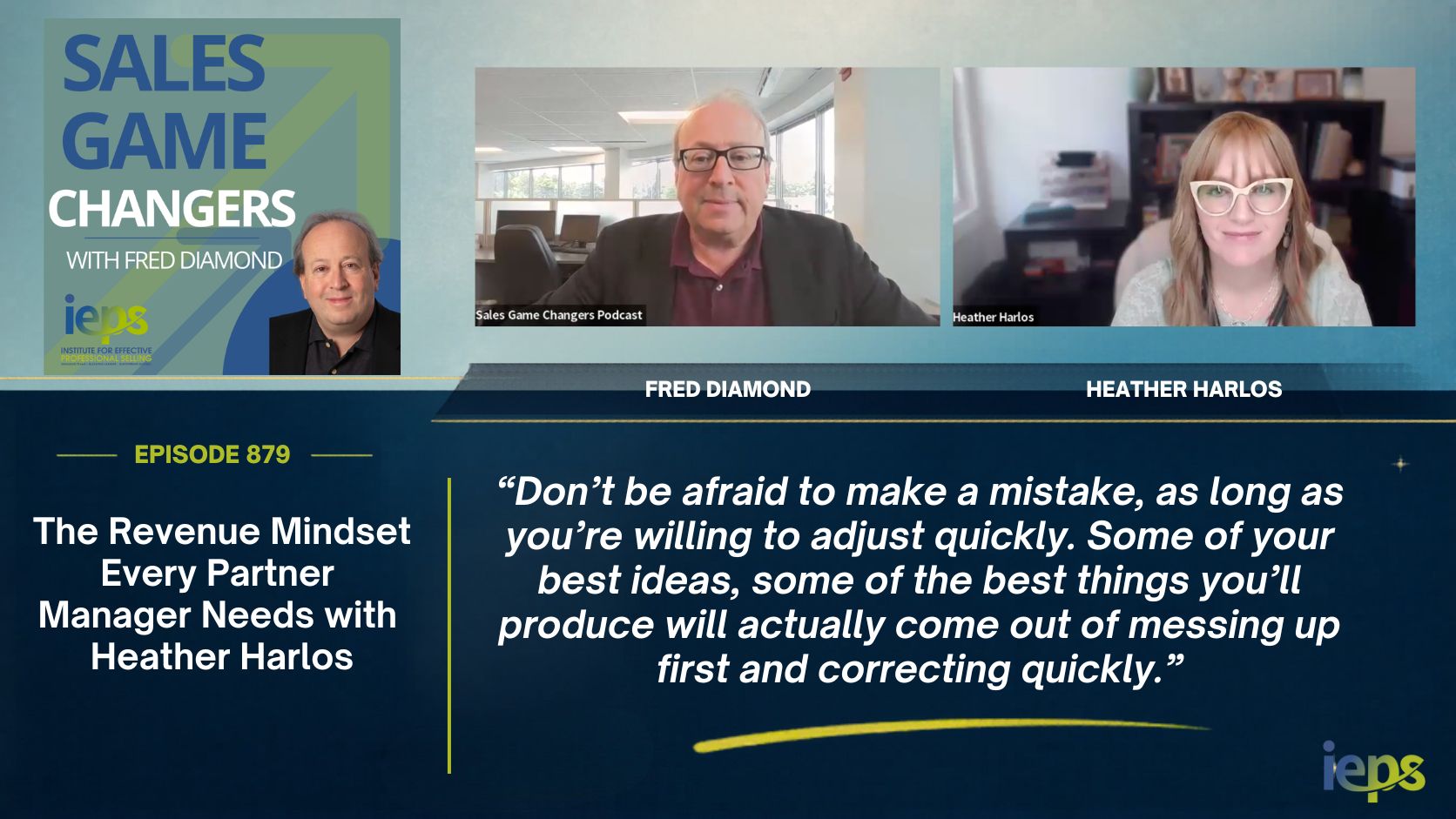
HEATHER’S TIP: “Don’t be afraid to make a mistake, as long as you’re willing to adjust quickly. Some of your best ideas, some of the best things you’ll produce will actually come out of messing up first and correcting quickly.”
THE PODCAST BEGINS HERE
Fred Diamond: We’re talking today with Heather Harlos from Coro. I’m excited to talk to you. Coro has experienced tremendous growth in a very competitive cybersecurity marketplace. Talk about your role and channel strategy has played in that growth and what you have learned about building a partner ecosystem that scales? We’re doing today’s interview in August of 2026, if you’re listening sometime in the future. Heather, get us started here.
Heather Harlos: I’ll start with my role here at Coro. I am the VP of programs and enablement over here. Really, what my job is, is to figure out at a high level, the go-to-market strategy and what tools and how do we support both our internal and our partners, all the way down to their customers. When I think about how we’ve been successful and how you actually scale, I think where most companies fail is they build things for the ecosystem and not with the ecosystem. It’s a nuance, but a lot of times you have an idea and you’re like, “This would be great. They’re going to love it. I’m going to build it. They’re going to be on board. It’s going to be perfect for them,” they never take the time to ask, “What do you actually need?”
From my perspective, that’s where I always start, is, “Okay, I’ve got an idea. Let’s validate it first. Let’s see if it scales to more than one person.” Then we can go and go, “Okay, the idea works. We’ve embedded it. They like it. It’s what they want.” Most of the time they actually come back with revisions that make it better. Then you figure out how to operationalize it and you go to market with it. What you end up then is with people that end up being your champions because they know you’re working with them and you’re not just throwing something at them and asking them to accept it.
Fred Diamond: Some of the great hyperscalers or cybersecurity companies are spending more time there because so much has changed. We’re doing today’s interview in August 2026. Economy, obviously, AI has made a lot of things change. Marketplaces like public sector have been completely flipped because of reduction in force and administrative challenges. What’s the biggest shift that you’re seeing today in the channel? What do you think every channel leader needs to understand?
Heather Harlos: It started a while ago, but I think it’s more prevalent now, which is nobody is one thing anymore. When you really think about it, people used to be a marketplace. They used to be a distributor. They used to be a reseller, an MSP. Now, when you actually look at the business model that people have, almost everybody is a hybrid of that. Giant resellers are buying MSPs, and now they’re a hybrid MSP reseller. That changes the way you go to market with those partners and it changes their operating model that you have to adjust your systems to accommodate.
Fred Diamond: That’s all through tech. I recently took a walk through one of the top tech companies’ summits and every company looked the same, how they were describing themselves, AI solution provider. These are companies that have been around for 20, 30, 40 years. It used to be, 20 years ago, it was very clear, you sold this or you sold that. Now there is a mushiness.
That being said, partners have more choices than ever. They can make a lot more decisions. What makes them to decide to invest in one vendor over another? Is it a buyer’s market or is it a seller’s market? What are some of your insights on that?
Heather Harlos: One thing that doesn’t change with the channel is the channel is relationship driven, and how you treat people as a company or as an individual carries with you everywhere you go. I think that’s something you have to remember and be very intentional with. If you say something and you don’t do it, they don’t just experience it. They tell everybody else, because again, it’s a small world and people talk and they talk to each other about, who should I trust to work with? Who is the sales rep that I like? If he goes from one company to another, I’m going to move with them. I think even with vendors trying to get resellers or MSPs or hybrids to work with them, that’s where it starts, is, do I already have a relationship with you? Do you have a strong relationship in the channel that we can trust? That’s what gets them on board.
Fred Diamond: Let’s be specific, what does your ideal partner look like? You mentioned some interesting things, a great sales rep may go somewhere else and then you have to make a decision, do we follow the rep or do we stick with the partner? What is a great relationship? What does that look like today?
Heather Harlos: For me, I look for a partner that is curious and thinking about the future. Especially if you’re coming in with new technology, there are certain partners that are very comfortable with what they have and they’re very comfortable with the model they have, the customer base they have. For somebody that’s new into the market, I think it’s looking for companies that are looking for what’s next and not what’s now. That’s something that has to come from the top down with the partners you’re working with. But when I think about who to invest in and who I want to grow with, it’s those people that are comfortable being uncomfortable in a way. Because I think those are the ones that also are going to grow the fastest, and they’re going to take some of the ones that are just following the same path, they’re going to take market share from them over time.
Fred Diamond: Those are also probably the partners that are providing the most value to their end customers. They’re finding new things, finding solutions. I’m curious. This is a question that I see all the time posed. When a new channel leader comes in, a lot of times they just want to rebuild type of a thing. Let’s start from scratch. Let’s find new entities that we might not be working with. As compared to, well, let’s dig deep into the ones that not just have been historically committed to us, but are showing that they are committed to growing with us. I’m just curious on your theories on that and your thoughts.
Heather Harlos: I am famous for breaking things when I go into somewhere new. I think that’s how you make them better. But I do think everybody needs to take time when they go into a new company or where there is something established to evaluate what’s working and why, and what’s not working and why. Because if you just come in like a wrecking ball and you’re like, “I’m going to build it my way,” one thing you may do is actually kill some really strong relationships or really strong sales motions in the process that you just didn’t understand yet.
If you take time to, and it doesn’t have to be a year, it’s like that first 30, 60, 90 days to evaluate what’s there and why it’s working, what’s there and why it’s not working. Then you can strategically go, “Okay, I’m going to keep this, I’m going to toss this, and we’re going to build something brand new over here.” Then you figure out how to integrate the old into the new where it makes sense.
Fred Diamond: I want to get specific on that. I’ve worked for a couple of large technologies in my career, worked for Apple, worked for Compaq, and we all had channels. I remember thinking a lot of times the decision is made in a cube somewhere in Houston or Silicon Valley, or New York, or Boston, whatever it might be, that was dictated to someone running channel strategy because they had to save costs, or they had to think about a different strategy with new partners. Meanwhile, that decision made in a cube totally destroyed companies, or ecosystems.
Let’s get specific. What is your advice for channel leaders listening to today’s Sales Game Changers Podcast on how to make the right decisions? How to not make a decision from a cube somewhere, or maybe now because people are working from home, from someone’s basement, that’s going to totally destroy a channel, it’s going to ruin things potentially. How do you be successful really understanding what’s happening in the marketplace?
Heather Harlos: The one mistake leaders make a lot of times is, and I don’t think it’s intentional, I think you get to that level because you do have confidence in yourself and you trust your vision. However, sometimes that can be a blind spot where you think your vision is right and you don’t take the time to actually talk to the people with the feet on the ground, having the real conversations. Anytime I do anything, the first thing I do is I ask my team, or the other teams that it would impact, what do you think about this? Poke holes in it. I want you to come back to me with a better version of what I’m presenting, or just tell me it’s awful and we’ll start over.
I think that’s where I would recommend everybody start. It’s the same thing, if you’re getting something from the CEO, as an example, he’s giving you direction, but I don’t take that a lot of times as I have to do exactly what I’m told. I need to interpret what he’s telling me and understand what outcome he’s looking for. If I take the time to understand the outcome, I can go back to him and go, “Okay, I understand where you’re trying to go, but I think this will get us there faster, or this will be less destructive.”
I think a lot of people are just sort of knee-jerk when they get that call, like, “I’ve got to do it now,” versus taking time to understand the why they’re asking for it. Pushing back is okay if you’re pushing back with a solution.
Fred Diamond: I remember when I used to work with a lot of channel managers or partner account managers, they would also say, “Well, let me take off my OEM hat and put on my partner hat now and communicate to you where the challenges are there.” Sometimes it could be quite conflicting to what some of the direction is from your company.
Heather Harlos: Especially with people that are new to the channel, or a company that’s new to the channel, I think people think the channel is this magic entity that’s just going to grow immediately. Like, “I’m going in there and it’s going to be successful.” I don’t think a lot of people understand the investment, both in people, time, money, to actually make it work. If you don’t at the highest level have that commitment, I would say no to the role as a channel leader. If they don’t actually understand what it takes and are willing to invest in what it takes, you’re never given the opportunity to be successful because you’re not given the resources to be successful.
Fred Diamond: Very few things are magical. Well, I was going to say, I wouldn’t mind taking a pill to lose 30 pounds right now, but there are solutions right now. But you’re absolutely right, a lot of times things operate the way they operate. Then the channel also has the partners, they have things going on, and in their local markets, things are changing. There needs to be the sensitivity.
Speaking about that, what are some of the standard things that you recommend channel managers, partner account managers must be doing right now to be effective?
Heather Harlos: One thing that I’ve seen in a gap is understanding what your role is versus what it should be. On paper, you’re responsible for getting people to sell things for you. But really, if you actually look at how to successfully do that, you’re a business consultant. You’re actually a sales manager at that point, and you’re somebody that’s there to help actually build a plan to get it done. A plan isn’t saying, “Our goal is this number and we’re going to reach this number.” That’s a target that you’ve put on the wall.
If you can’t effectively actually run a business plan and know, “Okay, if I’m doing an event with somebody and my goal is to get here, how many leads do I need to get from this event? What’s the conversion rate on those?” Because if you do the wrong things, it doesn’t matter how many activities you do, you’re never going to hit the number. This is something that, when I was actually teaching a team to do this, that was glaring when we went through an exercise with the partner in the room where we were building a business plan, they were like, “Okay, my goal is two million in the first quarter.”
My first question was like, “Okay, great. What’s your sales cycle?”
“Six months.”
“Okay, how much do you already have signed now that you’re planning on closing?”
“None.”
I’m like, “Well, how do you get here if you have a six-month sales cycle and you don’t already have something?” I think that’s something, if you don’t go through that process, again, you’re building an idea, you’re not building a plan.
Fred Diamond: You make a great point there, partner account managers. By the way, I’m trying not to use the word channel, although I’ve used it many times in today’s interview. The effective partner account managers today need to understand that they are sales managers. The mentality of a sales manager is different than someone who’s just purely looking to build relationships. There’s nothing wrong with that, but every company I talk to, Heather, is challenged with revenue. Because especially, again, the world’s changed. It’s the number one thing right now. Relationships are important, and I’m not minimizing that by any means, but a relationship that doesn’t generate revenue right now is valueless and will be looked at from your leadership as, “Why are we even working with them?”
That being said, do you feel there’s new pressure on partner account managers? Do you agree with me with the premise that they have to be sales managers right now and they are responsible more than ever for generating revenue?
Heather Harlos: I completely agree with that. Honestly, I think the good leaders of those teams, it’s been that way forever. I don’t think that’s something new. I just think the economy today is bringing it to light. But if you actually look at the people that were the best sellers, they weren’t the best at selling. They were the best at being a consultant and the best of managing a team that didn’t report to them. That’s really what you’re doing. It’s an art to do it and do it well and maintain a good relationship while you’re doing it, but if you can’t figure that out long term, you’re not going to be successful.
Fred Diamond: It’s always been about revenue. But even now in the last couple of years or 18 months, it’s just come stronger and higher up on the table as everyone’s looking more judiciously. We’re about 20 minutes into the interview and we haven’t mentioned AI. talk a little bit about AI, how AI is changing the relationship between OEMs, ISVs, and partners. Where are you seeing the biggest opportunities?
Heather Harlos: When I think about the channel ecosystem and AI, where I think the biggest opportunity that not a lot of people are investing in now is agent-to-agent communication. Every single partner, pretty much, has their own internal AI chatbot. They have their own internal AI systems that all the people at their company are using to get information. If you can build an agent that can train their agent on your stuff, what you’ve done is you’ve taken it to where people historically had to go into another system, log in to get the information, if they were even willing to do it, then dissect that earlier before they were even on the call that they needed the information for, to a point to where you’ve trained an agent that answers on demand. Now you actually become almost like a virtual employee right beside them, or a virtual sales assistant. My personal take is that’s where I would focus my efforts, is building that out.
Fred Diamond: Most of our listeners are selling professionals at OEMs and ISVs and sales leaders. We do have a lot of people who do work in the channel. I’m just curious on your thoughts. What do you think partner account managers at OEMs or ISVs don’t know about the channel? Give us some of your inside baseball, if you can, of what, if you were to talk to a first-time partner account manager on your team and they said to you, “What do partners think about every day?” Give us some of your insights into what’s going on there that we may not be conscious of.
Heather Harlos: That’s a tough one. It depends on the day, what they’re thinking about, quite honestly, but they’re just like us. They all have a number to hit. They all have people asking them a million questions, and they all have multiple vendors asking them to do the same thing, and how do they pick, which one to focus on. I think the biggest thing is approaching it with grace, and what I mean by that is understand that you’re not the only person asking for this, which means that you’re not always going to be the first priority, and you don’t know what the urgency of something else is. I think you need to approach the relationship and really the way you interact with them, with that in your head from the beginning so that you get the response you want.
Fred Diamond: Most of the partners out there, they’re dealing with dozens, if not hundreds, in some cases, maybe even thousands of vendors. All the vendors, the OEMs and the ISVs, they all have someone who’s calling on them who has an expectation. That is a great point on where you fit in and how do you fit in more specifically.
We talked a number of times here today about how this is a tumultuous time and how the economy has affected a lot of change. There’s been a shrinkage in certain parts of the industries that we all cover. Give us some of your advice on leading through change as you’re managing partners. What do you tell your people who are managing organizations?
I was talking to someone the other day. We had about 20 sales professionals in the room at an IEPS, Institute for Effective Professional Selling, event. A couple of them said, “People aren’t buying things right now.” That’s a generalization, people are buying things, but there was a perception that things are really tough no matter how much we’re doing right now. It’s a challenging time, and there’s always been challenging times. What is your advice as a leader? How do you lead through tumultuous times like this?
Heather Harlos: The first thing, and this comes back to something my grandfather told me, and he said, “You never stop learning until you’re dead,” which seems very harsh, but if you really think about it, it’s back to, you don’t always know the answer. Or if you aren’t willing to adjust to what’s happening in the market, what’s happening in the economy, maybe the inner dynamics of what’s happening with a partner you’re working with, if you aren’t willing to learn, adjust, and change to match that, you’re not going to sell anything.
Yeah, it looks like nobody’s buying, but it’s because you’re still trying to do the same thing and you’re still leading your team down that same path. I think your ability to adapt is more critical than ever in times like today. When you’re willing to adapt, you can take the time to go, “Okay, why aren’t they buying?” Or, “Why are they not buying me and why are they buying somebody else?” Once you understand that, it gives you a path to go, “Okay, I need to adjust this.” Or maybe it’s going back to your product team and going, “Hey, what we sell today needs to evolve for what the customers look for.” Or you go to your marketing team, and the way they’re talking to them or the way they’re putting stuff in front of them, isn’t the way people want to engage anymore. I think that’s really where I would start.
Fred Diamond: Actually, something you said before about giving grace and stuff, accepting the fact that things might be different. One thing that we’re seeing is over the last couple years, a lot of people have left their jobs, and not just in the ISV and OEM side or channel, but at the customer. New people are coming in, so we have to develop relationships with new people, and they’re still trying to figure out how they go about making decisions. I’m just curious, what did your grandfather do for a living?
Heather Harlos: He actually was the VP of marketing and communications for his last stint before he retired at BellSouth. I think they got bought by AT&T at some point. His first job was actually routing money for the government right after he got out of the military. He was a wealth of knowledge. One of the best people in the world ever. He was the epitome of treat people better than you want to be treated. When he did finally pass away, even his mailman showed up at his funeral. I’m like, “Who treats people to the point where your mailman wants to come to your funeral just because you cared about him that much?” I try to take that with me.
Fred Diamond: He seems like a wise man, and may he rest in peace. As you’re talking, I’m thinking about what things my grandfather might have shared with me. One thing he used to say was it’s a short walk if you run like hell. It’s a similar type of a thing. Thanks for bringing that up. I appreciate that. I’m glad that you learned from him.
If someone just accepted a job as a VP of channel or partner management, what would be your number one bit of advice for them?
Heather Harlos: I already said it earlier, but the first thing is making sure your leadership team understands what it’s going to take from the investment to grow in the channel. If it’s new, if they aren’t already in the channel, make sure you have that understanding, and then figure out what reasonable KPIs are so that you’re upfront with who you’re reporting to on what they can expect and how long it’s going to take to grow that business, because it isn’t overnight. It takes time. But once you get it right, it is a multiplier that can’t be replaced.
Fred Diamond: We talked today with Heather Harlos with Coro. Thank you so much for your insights. I appreciate it. Give us a final thought, a specific action step that people listening to today’s Sales Game Changers Podcast should put into play to take their sales career to the next level.
Heather Harlos: What I would say, and it’s somewhat theoretical, but don’t be afraid to make a mistake, as long as you’re willing to adjust quickly. Some of your best ideas, some of the best things you’ll produce will actually come out of messing up first and correcting quickly.
Fred Diamond: At least you’re doing something. I’m not a big believer in keep doing the wrong things, obviously. We have an expression where if you’re trying to improve your free throws in basketball, you don’t stay afterwards and shoot 300 free throws the wrong way. Learn how to shoot them and then keep practicing the right things. A lot of things you said have been very, very good. You got to be graceful. You have to accept the fact that you don’t know everything.
Sometimes people, especially in leadership, they got to that point because they know a lot of things, and a lot of success. But I’ll tell you, man, the last 18 months that we’ve had in the marketplace, those have been different. There are different challenges. I think one of the big things has been the reduction in force of people who knew a lot of things. Now there’s new people coming in who have different types of tools to make decisions, but they don’t know the history and they don’t know why things have happened, and things like that. You need to be open to those ideas and creative in finding solutions where things may go astray.
Once again, Heather Harlos, thank you so much for your insights today. My name is Fred Diamond. This is the Sales Game Changers Podcast.
Transcribed by Mariana Badillo