
Watch the video of this podcast on YouTube here.
The Sales Game Changers Podcast was recognized by YesWare as the top sales podcast. Read the announcement here.
FeedSpot named the Sales Game Changers Podcast at a top 20 Sales Podcast and top 8 Sales Leadership Podcast!
Subscribe to the Sales Game Changers Podcast now on Apple Podcasts!
Purchase Fred Diamond’s best-sellers Love, Hope, Lyme: What Family Members, Partners, and Friends Who Love a Chronic Lyme Survivor Need to Know and Insights for Sales Game Changers now!
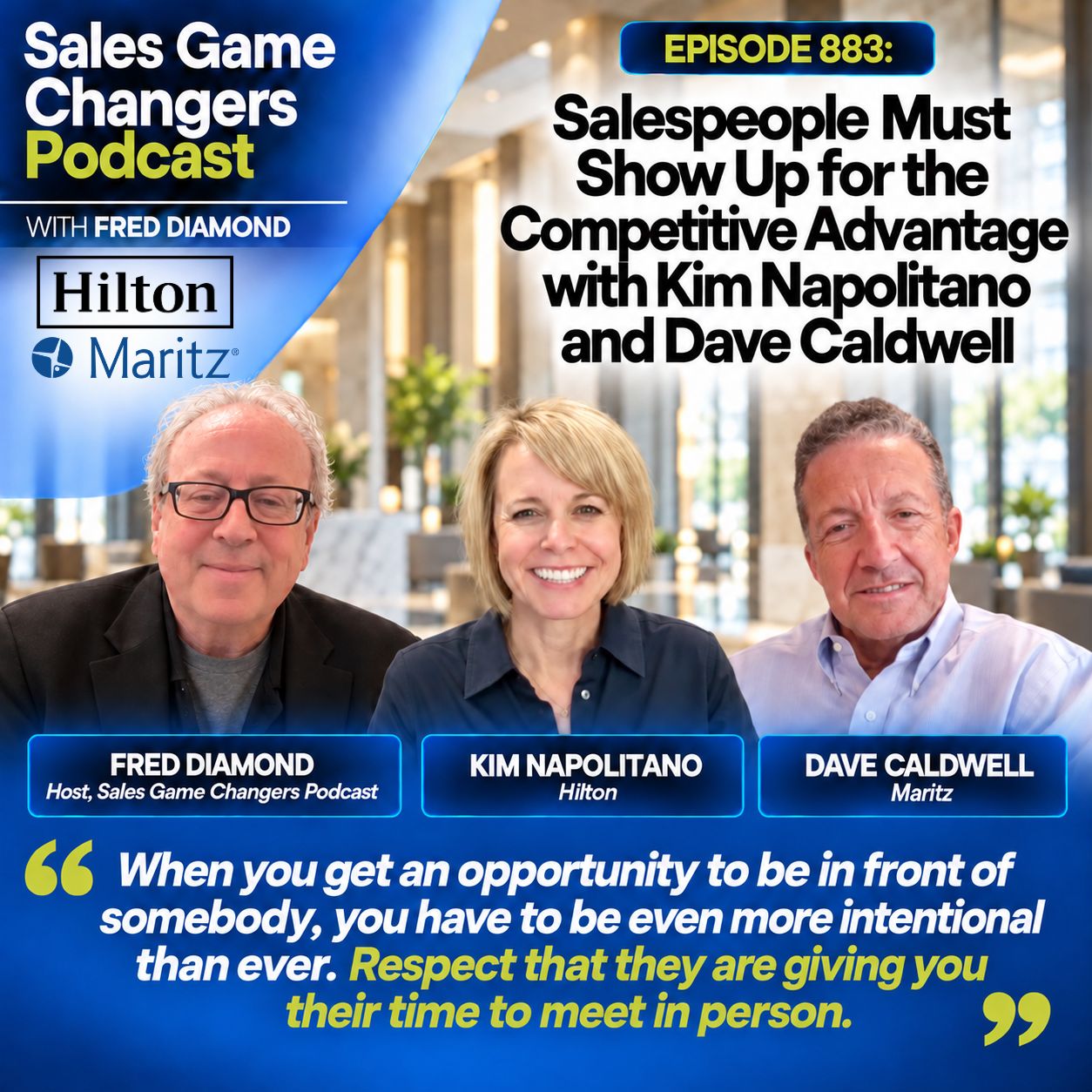
Today’s show featured an interview with Kim Napolitano, Executive Director of Global Industry Relations at Hilton; and Dave Caldwell, Managing Vice President of Sales at Maritz.
Find Kim on LinkedIn. Find Dave on LinkedIn.
KIM’S TIP: “Be fully engaged with that person in that moment in time and take a genuine interest in them. Relationships are what move business forward.”
DAVE’S TIP: “When you get an opportunity to be in front of somebody, you have to be even more intentional than ever. Respect that they are giving you their time to meet in person.”
THE PODCAST BEGINS HERE
Fred Diamond: I’m very excited because when I spoke to Dave during the podcast, he gave a clue into something that I’ve heard you, Kim, and Frank Passanante mention a number of times. I ignorantly said, “Do you guys work with Hilton?”
He said, “Of course we do. We’re super partnered with Hilton.”
Then I said, “Hey, let’s do a show together.”
This is one of the first shows we’ve done where we’ve brought two of our good friends from the IEPS to sales leaders. What we’re going to be talking about today, and this, Kim and Dave, is a huge topic, why being physically present has become a competitive advantage for sales professionals.
Gina Stracuzzi, who runs the Center for Elevating Women in Sales Leadership, talks about that all the time. You got to get out of your house. You got to get out of the apartment. You got to be not just in the office, but where people are. Of course, Hilton provides some of the most amazing physical locations for those events. We’re going to get deep into that.
Why don’t you both introduce yourself, share some thoughts on why being physically present has become that competitive advantage. Let’s just do that first and then we’ll talk a little bit about how Maritz and Hilton work together. Kim, since you’re our reigning Partner of the Year, why don’t you go first?
Kim Napolitano: I’m the executive director for global industry relations in Hilton Worldwide Sales. My role focuses on connecting Hilton with the organizations and leaders shaping the meetings and events in the business travel industries. Thinking about this conversation, Fred, today being physically present, to your point, is a competitive advantage because relationships have become a differentiator. I think that’s the big nuance here in this conversation, because technology and artificial intelligence, they’ve made communicating so much easier, but they haven’t replaced trust. That is what happens. That’s what builds when you are face to face with people.
There was a recent survey and research launched by the US Travel Association where they shared the findings of their research and they found executives view in-person meetings as critical for building trust, for accelerating decision making, and strengthening relationships. Just one last point here because there was a lot of great data that came out of this, and one point really resonated with me, where they identified that 90% of the executives said in-person meetings positively influenced their careers. I felt that that was such a big exclamation point because it really did underscore that this is about building careers, but it’s also about transforming industry for whatever purpose that meeting is about.
Fred Diamond: No one’s ever said, “Do you remember on that Zoom call three years ago?” No one ever says that. Maybe they’ll refer to a cat walking past the screen.
Kim Napolitano: Yes, they’ll refer to it on that type of stuff.
Fred Diamond: Yeah, but before today’s call, we were talking about trade shows that you guys go to regularly, and people that you’ve met, and years and years of going, and that’s what leads to the trust. I’m glad you brought in some of the data, which I know we’re going to be referring to later on.
Dave Caldwell, you were recently on the Sales Game Changers Podcast. It was a very highly listened to and downloaded show. Give us some of your insights as well.
Dave Caldwell: First and foremost, obviously everything that Kim said, I very much agree with. There’s no way to build the degree of trust on a Zoom or a Teams call that you can when you’re in-person. It’s an old cliche, but cliches become cliches because they’re true, and people buy from people they like and they trust. It’s just really impossible to try to make that happen virtually through any technology. I’d agree wholeheartedly with Kim of why being physically present, being in front of your customers and prospects is a differentiator.
What I would add to that, however, is you can’t assume that just being there is the differentiator. You still have to make sure that you prepare. Whether you are going to a trade show or a convention, and it’s a shame now, we get to do a little bit less of this than we used to, but I can remember the days right up until COVID you could get to a client’s headquarters and you could roam the halls and stop in and see people and all those things. Not everybody’s back to work yet or returned to the office, so that’s harder to do.
What it means is when you are getting an opportunity to be in front of somebody, whether it’s a trade show, a convention, or in their office, you have to be even more intentional than ever. You have to respect the fact that they are giving you their time to meet in person. You have to go in with a plan. You have to go in with an established way of showing that you understand what their needs are, and essentially make really good use of their time.
One of the things coming out of COVID, because there is less of a chance to be together, people value their time much more, I think, than they used to. You have to be very intentional. Make sure you are using good use of their time. That’s the first way that you start to build trust and confidence.
Fred Diamond: I tell a lot of junior selling professionals, your company is also spending five to ten thousand bucks for you to go to a conference in Orlando, New York, Dallas, Chicago, Vegas, whatever it might be. There’s a big investment in you going. I love the way you just said that, Dave, that you need to have a plan. It’s got to be a smart plan. You got to make sure that you’re able to execute.
I’m just curious, bringing together Hilton and Maritz, give us some insight into how you work together. Obviously, everybody is familiar with Hilton and a bunch of people, like I said, Dave, had downloaded the podcast that we did. But why did I bring you both together? Give us some insights on how you both have worked together.
Kim Napolitano: This is a fun question to answer because I feel like it really defines relationships and how they can be more than just supplier-customer. Because here where we get to work with Maritz and they book their amazing customers to any one of our hotels around the world every day, which we value. Dave, thank you for the business. But we too are a customer of Maritz because we host our own internal meetings and some of them are exceptionally large that require resources and services that Maritz can provide us. There is this balanced relationship, which allows us to take the conversation, in my view, to a whole different level and a much more meaningful level because we’re supporting each other’s success in a variety of different ways.
Dave Caldwell: Very true. I would add to that. It’s one of the fun things about the business that Kim and I have chosen to be in, is Maritz and Hilton work together, and of course, there is a client-supplier relationship, but at the end of the day, we are working in lockstep to serve a combined client effectively. The clients that Maritz has sold an event to and now we’re working with Hilton to get right into the perfect hotel and the perfect destination and create amazing experiences for their guests and attendees, we work very closely on that.
The fun of it is that the people in the global sales office and at the property level at all the Hiltons that we work with, more often than not, we are going to those customers and having conversations where everybody’s in the room. Not only does that forge a really strong partnership between Maritz and Hilton, but it also gives that end user customer confidence that they’re going to get an amazing experience, see value, have an effective meeting when they see the way that Maritz and Hilton work together on their behalf.
Fred Diamond: Some people listening to the show today have never really had going to things as a part of their career. If they’ve been selling for the past five or six years, we’re doing today’s interview in September 2026, they’ve almost invariably been virtual. They’ve been in front of the screen. They’ve been able to work from home. I’m actually doing today’s recording in an office and there’s nobody here doing it on a Friday afternoon.
A lot of people listening may be saying, “Well, we’ve proven that we can sell virtually.” Why do sales professionals need to be in the room? I want to ask you both to touch on that, but, Dave, I want to ask you specifically, have selling professionals become too comfortable selling from behind the screen? What are they potentially giving up? Then, Kim, what happens when customers, prospects, and partners do get together physically, that doesn’t happen on Teams or Zoom?
Dave Caldwell: When you make the statement that sales professionals may say, “I have proven that I can sell,” I would dispute that right out of the gate. That doesn’t mean you’ve never sold. But it does mean you haven’t sold nearly as much as you can. Especially, again, if you are in any service, business to business type of solution, can you have success on Teams and Zoom? You can, because the market has also changed, where now clients are willing to buy off of Teams and Zoom. But I can tell you that in our experience, since COVID ended and we all went back to work in this very new environment, I can count on one hand the number of worthwhile, sizable accounts that we have won, never having met the person face to face only on Teams.
At some point in the process, you need to get off your couch, out of your office, on the road, whether it’s finding a trade show, a convention, most importantly, if you can, getting to see that individual face to face. Admittedly, it’s more difficult because not everybody has returned to office and oftentimes clients are not working in the office. But much of a complex sale involves so many different individuals that you’re selling to within the client that there are always opportunities to get out and see them face-to-face.
We all have stories in this business. A few years ago, we had an opportunity to win an account. the first few rounds were typically this. Then the final round was we went in and it was old school and it was fun. We went in, we were in a conference room. There are four or five of us from Maritz, seven or eight clients. We made the presentation. We won the business. After we won the business talking to the clients about what had helped differentiate us, they talked about all the things, our solution, our value, all those things. But ultimately, what tipped the decision in our favor, they said, “When you all were in the room and the way you interacted together, we can tell that you all like each other.” That was really important to them. They saw our team together, engaging, little inside joke here and there, really supporting each other. They said the ultimate decision came down to, “That Maritz team, we saw them in-person, we can tell they like each other, we can tell they trust each other, and those are the type of people we want to work with.” That will never happen in a virtual environment.
Fred Diamond: One of the problems is, when you’re looking just at a screen, you only see what you see on the screen. There’s so much else that goes on in the room. I love the way you just said it. Maybe giving someone a tip, helping them with something that may not be on screen. But when the customer sees that great point, the customer sees that. Kim, what are some of your thoughts?
Kim Napolitano: Well, because you were asking me about the partners and our customers when we get together that simply don’t happen on Teams, and this is such a great segue, because the simple answer, and Dave, you said it, they see human connection. They feel human connection. They feel the energy between each other and the team that’s before them. I’ve always recognized that when we are together in person, we see the more authentic side of ourselves. To your point, Dave, they could see the joking and they could feel the camaraderie. Not only did they see it, but they felt it. That then was like, “Oh, wait a minute, this is good. Because they’re in a good space, I can trust them.” It’s all about building trust.
When they see that there’s a team that gets along, that just solidifies the fact that this is an organization I want to work with, I want to align with. They model or they mirror my company’s values overall. The conversation is more natural. We find that our customers are more open to sharing their challenges that they may never bring up in a virtual conversation. To me, these moments, these are the ones that create trust. From trust, you’re creating opportunity at the end of the day.
Dave Caldwell: Also, virtually, you miss body language. You miss non-verbal cues. If you’re in a room with multiple clients at one time, you’re seeing them all at one time. I’m looking at the screen here, and I see the three of us in the box at the top. If there’s eight people up there, there’s no way that we’re picking up on the cues from everybody, and who’s really engaged and who’s not, and where do we need to focus and who do we want to ask a question to to bring them back into the meeting. It’s incredibly difficult to do virtually, and it will never be as effective as being in the room and being face-to-face.
Fred Diamond: Talk about some of the other things too that happens that people listening to the show today or watching on YouTube may not understand, things that happen outside of the meeting. You have your meeting meeting, but like you were saying, you alluded, Dave, about the ways that people interact. But I’ve had a lot of conversations in hallways, or, “Hey, let’s extend the meeting. Hey, what are you doing? Let’s go sit in this conference room just me and you,” type of a thing.
Talk about some more of the nuance there, Kim, about what else happens, not just, we’re talking about on the screen, but even beyond the conference room or beyond a trade show booth, per se, whatever else might be happening.
Kim Napolitano: I think that goes back to what Dave was originally talking about, is intentionality. You talked about it at the beginning of the call too, Fred. We’re spending thousands of dollars of our company’s monies to go and attend these events, and then the question is, how do we determine ROI? If you have someone attending that’s not coming in with a game plan, I can guarantee you they are not going to see much success or return on investment by participating in that.
How are we as salespeople going in with a game plan? Who are the 5 to 10 customers I know I need to meet? Have I done an outreach to them? When I spoke to them, for example, maybe one of them was talking about artificial intelligence and driving greater efficiencies, they’re getting some pressure from their CFO, and I’m going through the agenda. I can then say, “Wait a minute, there are three breakouts on artificial intelligence. One of them specifically says, talking about problem resolutions for C-suite,” making this up, but maybe that’s one of the breakouts.
That salesperson, if they’re really thinking, should reach out to their customer and say, “Hey, during our last conversation, I know you said you were attending and then you also made this comment about this is a pressure point you’re dealing with. I found this breakout. I would love to sit together so we can exchange what we learned from it. Do you want to do that?”
The person says, “Oh my gosh, thank you.”
“Okay, great. I’m going to send you an Outlook invite.” For me, that’s a love letter. That’s one of my love languages, is an Outlook invite. Then depending on timing, “Do you prefer Diet Coke,” or is it a morning meeting? “Would you prefer a coffee or a tea? What type of tea?” That way the salesperson can come prepared. Now all of a sudden you’ve got the customer feeling totally taken care of. They feel valued, seen, heard, respected, and appreciated. Why? You listened when you were with them last. You have provided access to something that they may not have paid attention to, because we all have been to these events where there are way too many breakouts and they’re just skimming the agenda, whereas you’ve zeroed in on something that has great meaning.
Then to me, it’s about the follow-up too. So much of this is you’re not coming out of the chute with, “Here, let me tell you about my solutions.” You’re developing the relationship at the beginning, finding out what’s important to them, and acknowledging them, treating them like a human being. Then starting to connect the dots where you can. Then it’s what happens afterward, the follow-up. “Hey, here are the notes I took. Great to spend time with you. I saw this article. By the way, I was giving you some thought because listen, for what it’s worth, I’m happy to connect you to my chief technology officer who can speak a little bit more. You were fascinated about this topic. Let me connect you to that person, if you’re interested.”
It’s just how do we develop a relationship that isn’t about the sale. It’s about the person being better in their job and really strengthening relationship person-to-person versus your checkbook to my solution.
Fred Diamond: Dave, what are some of your thoughts on the concept of just simply showing up? It’s not enough, but not just attending, but also working the event as well. What can you add on to what Kim just alluded to?
Dave Caldwell: As I said in the beginning, intentionality. The work doesn’t just happen at the three or four days that you’re at that trade show or at that convention. The work has to start days before you get there, understanding who’s going to be there, understanding what prospects are going to be in attendance, crafting your message to those individuals, reaching out to them ahead of time in a way that’s appropriate and respectful to their time, to ask ahead of time if there’s an opportunity to engage. Then that’s where you ask for, people are busy, “Can we maybe grab a cup of coffee to talk about these AI challenges that you may be having?”
I think first and foremost, you have to understand that to be successful and get a return on investment, not only for your company who spent thousands to send you, but for yourself to bring in new business and make more money, you have to understand that the event is not three or four days. It is the days leading up to it in terms of preparation, knowing who’s going to be there, crafting a message, putting together a plan together and see those people. When you’re on site, you obviously have to have the flexibility to adapt that plan and you need to have a plan. If you see the person you’ve been wanting to get to and they’re in line getting coffee and you happen to come in line behind them, you have to be able to think on your feet and have a plan of how you’re going to engage in that conversation. Then there’s a ton of good follow-up that’s required. I would say if you’re at a three-day trade show or convention, the best salespeople, that’s probably a six-week process of work.
Kim Napolitano: I want to jump in on this because, Dave, adding to all of this is be that person that’s connecting people to people. Because sometimes we can go in so focused, “Okay, these are the five people and that’s it. I only want to talk to these five people.” Be open to make connections because you never know when that person may connect you to the person that you ultimately needed to get connected to. It really creates this beautiful community of lifting one another up.
Dave Caldwell: We tell our salespeople, especially the newer younger ones, that whatever the size of your network is, double it, because everybody you know knows at least one person they’re happy to introduce you to. If you can make those types of connections and make those things happen at an event, and then as Kim said, likewise, you become valuable to that prospect when you’re connecting them to people they may not otherwise know or have access to. None of that happens virtually.
Kim Napolitano: None of it does. I just liken it to you see that person who seems a little awkward in the reception, go right up to them, because you don’t know who they are and you don’t know who they’re connected to. But if you can make them feel comfortable in that space, there’s some beautiful magic that can happen from that.
Fred Diamond: Kim, let’s talk a little bit more about that. For a lot of the junior selling professionals who may be on the introverted side, give some of your insights, and Dave, you too, follow up on what Kim says. We talked about working the room and things like that. Give some of your insights into what they should be doing, how they should be doing, what kind of things they can say to someone in the coffee line, whatever it might be, I’m curious on your thoughts on that.
Kim Napolitano: For me, it’s come and be curious. It’s really that simple. Most of us who walk into networking events saying or thinking, “Who can help me?” I’m going to invite you to think of this a little bit differently. Who can I learn from? Ask good questions. If you struggle being spontaneous with questions, well, goodness, we have our dear intern called CoCo, aka, Copilot, or whatever your AI platform is. Just, “Give me some great opening questions that people may not know. I’m in a network reception.” Put it out there, get four or five really good questions that you can feel comfortable that it can at least get a conversation going.
Then listen very carefully. Don’t be distracted on your cell phone. Don’t be like, I know we’ve all experienced this, you’re talking to someone, but they’re looking over your shoulder trying to figure out who the next more important person is to talk to. Be fully engaged with that person in that moment in time and take a genuine interest in them. Try to find some common ground because that is where you start to develop a true relationship, because the relationships are what move business forward. The virtual component just keeps it going, but when you are face-to-face, it moves it much further and much faster because there’s trust being built, or you’re strengthening the trust that exists.
Fred Diamond: Dave, what are your thoughts?
Dave Caldwell: Same. I love Kim’s phrase of be curious. People love to talk about themselves. I do believe that one effect of more business and commerce and meetings happening virtually is it has given an opportunity for perhaps people who are more introverted to move into the sales arena. Whereas prior to that, you had to have the guts to walk up to somebody, you couldn’t be introverted and be in this space. Technology has changed that to a bit where now you can. But again, as we’ve been saying here, at some point, you have to be face-to-face, you have to know how to engage, and it’s all about being curious.
If you’re introverted, start asking questions. Even if you’re not introverted, don’t walk up and start talking about yourself and your product and your solution. Start asking them questions. Oftentimes, that person you’re talking to may also be introverted, and the easiest way to draw an introverted person out of their shell is start asking them questions. Don’t make them think of what to say. You give them the question and all things flow from there.
First and foremost, I love the way Kim phrased it, is be curious. Part of that intentionality, come armed with good questions. They’re going to illicit conversation. Not a yes or no question. Get people talking. Then that’s when you start to engage and build relationships.
Kim Napolitano: Fred, there are some great resources available. For example, we’ve done research on the world’s most welcoming events, and through that, we learned that networking is a big pressure point for many people. We created training around networking with confidence, I hate to have this be a sales pitch, but it is available on our Hilton EventReady Playbook, and it’s networking with confidence. We created a 30-minute presentation that we delivered to our internal attendees for a 4,000-person event. 1,800 people attended networking with confidence. This is a much bigger conversation than I think we’re really present to, but I just share that we have a 10-minute video there. But go on YouTube. Networking with confidence, just put that in there. If you are that person that I would say is an extroverted introvert, or you are introverted, it’s okay. You can still have an incredibly successful career in sales. In fact, you’ll probably have a more successful career because you are that person that will ask the question because it relieves you of having to answer. What a great place to be, where you’re then guiding the conversation through the questions you’re asking.
Fred Diamond: We actually had a guest on a couple of years ago called Matthew Pollard who wrote a book called The Introvert’s Edge. Basically, the point was that introverts make better selling professionals and you need to be comfortable with the outreach. Asking the first question, showing curiosity, being interested in what people have to say.
Kim Napolitano, Dave Caldwell, thank you so much for all the great insights. Before I ask you for your final action step, is there anything we missed? Anything that you want to bring up that we might not have covered today?
Dave Caldwell: I don’t know. We’ve covered a lot. I think we’ve hit the high points.
Fred Diamond: We did. We like to end every show with a final action step. Give us one thing that people listening to the show today must do to take their sales career to the next level.
Dave Caldwell: I will stay on topic here of being present with your customers and your prospects. I would go back to the very beginning, that is to prepare. Do not assume that because somebody has agreed to see you in-person that you suddenly have an advantage or that you have differentiated yourself over those who are only talking to them on the screen. Because if they give you the gift of that time, you have to show up with value, with a thought process, and with an approach that is going to show that you respect them, you respect their time, and you’re genuinely interested in building a level of trust in a relationship, not just selling them a thing.
Fred Diamond: One of the things that we tell junior selling professionals all the time is that for you to truly achieve great success in your career, you either need to know what you’re selling better than anybody, or you need to understand the customer’s challenges better than anybody. Also going to events is a great way to learn, but come to the event with questions you want to learn. Things that you want to learn as well. I love that answer, Dave. Kim, bring us home.
Kim Napolitano: Be intentional. Really do your homework before you go into the event or into any meeting. There’s a lot of information online that you can lean into. Reach out to colleagues or friends who may know the organizations that you are getting ready to meet. Remember that sales is a very noble profession. I think we get a bad rap, but frankly, we get a bad rap because there are many who have never made it about the person you’re engaging with. They’ve made it about the sale. To me, it’s uncovering, who can I learn from? Who can I help? That mindset is forcing you then to come from that place of curiosity to learn. We have two ears, one mouth. Listen more. Ask one question and listen, and follow up on that question. Don’t go from here to there to there to there. If you’ve asked a pretty deep question, go deeper into the question, because I found, people just want to connect. They want to feel heard. They want to feel seen. They want to feel respected. Nothing says that more than being asked a question and then possibly a follow up question, or a connection into that. Really just come from the place of human serving human.
Fred Diamond: As you and I both spoke about many times, sales is truly a noble profession. I know we’ve had that conversation a couple of times. We actually had it with Frank Passanante on the podcast about a year ago.
Once again, Dave Caldwell, Kim Napolitano, thank you so much for being on today’s Sales Game Changers Podcast. My name is Fred Diamond.
Transcribed by Mariana Badillo