
Watch the video of this podcast on YouTube here.
The Sales Game Changers Podcast was recognized by YesWare as the top sales podcast. Read the announcement here.
FeedSpot named the Sales Game Changers Podcast at a top 20 Sales Podcast and top 8 Sales Leadership Podcast!
Subscribe to the Sales Game Changers Podcast now on Apple Podcasts!
Purchase Fred Diamond’s best-sellers Love, Hope, Lyme: What Family Members, Partners, and Friends Who Love a Chronic Lyme Survivor Need to Know and Insights for Sales Game Changers now!
Today’s show featured an interview with Matthew Radomski, Regional Vice President of Federal Civilian at Harness.
Find Matt on LinkedIn.
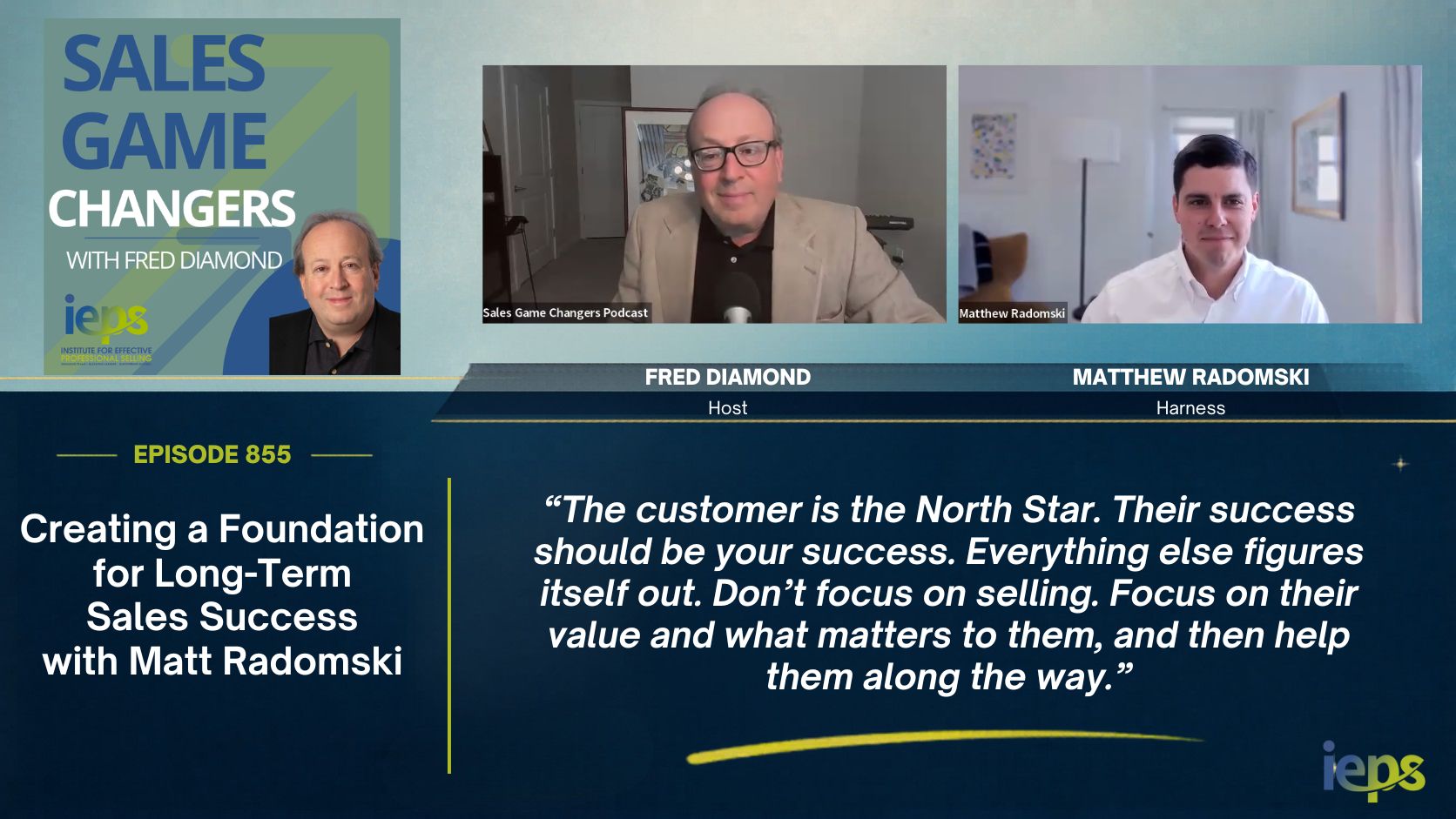
MATT’S TIP: “The customer is the North Star. Their success should be your success. Everything else figures itself out. Don’t focus on selling. Focus on their value and what matters to them, and then help them along the way.”
THE PODCAST BEGINS HERE
Fred Diamond: Matt, a lot of our loyal listeners know that about a year ago, we started doing a sub-brand of the Sales Game Changers Podcast. I’m talking with Matt Radomski with Harness. I’m excited because we started doing a show called Office Hours – Sales Professors Unplugged where I interview directors of selling programs at major universities. As a matter of fact, we just had our 16th Annual Sales Excellence Award event. We gave our first Sales Educator of the Year Award to Brian Collins with Virginia Tech.
You and I have known each other for a couple years on LinkedIn primarily. Harness had come up a couple of times in conversations with other people. I went back out and connected with you again and turns out that you went to Clemson and that you also participated on the sales team and had done competitions. You didn’t necessarily go for a sales degree per se, but it was great to talk to you. You’re a VP at Harness, but it was nice to see the connections there. You introduced me to the leader of the Clemson program there and we got him into our loop as well. A couple of our worlds are coming together and it’s great to see how you’ve grown in your career and how your experience at Clemson, taking sales classes and participating in competitions, etc., framed you for where you are now.
Tell us a little bit about yourselves. Tell us about Harness. Tell us what you do there. Give us a little brief introduction to your journey.
Matthew Radomski: I run the federal civilian business at Harness. I have lived and worked in the DC Area in federal software sales. I think this is year 14 for me, so becoming a veteran slowly in the industry. Started my career at Oracle, worked my way up from the BDR world of cold calling, setting up meetings, to inside sales at Oracle, up to the field, and really owning an account.
Then from there, pivoted to Salesforce when they were becoming a mature sales organization in the federal space, supporting the Department of Veterans Affairs under Joe Markwordt, who I know has been on your show in the past. Worked there for five years, really expanding that account out, and then wanted to go smaller and wanted to be on the ground floor of creating a federal organization. I went down to a pre-IPO company, Harness, to help the build that they had started. It’s been a really exciting journey.
Fred Diamond: Tell us a little bit about Harness. Tell us what they do.
Matthew Radomski: The easiest way to think about Harness is it’s the easy button for what is historically a very messy and complicated world of software delivery. You think about after a developer or an AI agent writes code, the process from building that into an application and deploying it safely is extremely difficult in most organizations. It’s why we see government and highly-regulated industries take months or even quarters to deploy something new, because they need to do it with security and compliance built in. Harness takes all of those things and at an enterprise level automates everything after code commitment to make sure that all the innovation can be done at the speed of light without any issues of worrying about downtime or security or compliance issues once something gets to production.
In the world of the Anthropics and OpenAIs of the world doing a lot of the coding for us, there is just this giant influx of code, but there needs to be a way to get those pipelines automated out to deployment. That is what we do and that’s what we’re helping some of the biggest companies in the world and some of the largest federal agencies in the world do.
Fred Diamond: 30 years ago, I was a product manager for what was then known as automated testing. It was with a company called Compuware in the late ‘90s. We were inventing automated testing actually, had done a lot of it on the mainframe and then of course on client server in the late ‘90s. I was deep into that space and it’s amazing how far we’ve come in 30 years. It’s great to have gotten caught up on what Harness does, etc.
As we get into this next part of the conversation, you’ve participated in sales competitions when you went to Clemson. Having started your career at Oracle and then to Salesforce, those are two heavy hitters. I’ve had a bunch of sales leaders on the Sales Game Changers Podcast from Oracle. I’ve had a bunch on the show from Salesforce in the public sector and commercial side. You don’t become a VP of sales at Salesforce or Oracle just because you say you want to be. There’s a lot of competition. They’re hard environments. We’re doing today’s interview in April of 2026. 2025 was a very challenging year. 2026 is still challenging, a little bit more open. Give us some insights about how your college, the competitions, and studying for sales, how they framed you for where you are right now.
Matthew Radomski: That’s a great question. I know you were introduced to Dr. Ryan Mullins. I remember taking his class. When I was in college, this was the age Mad Men was on TV, and I thought I wanted to go into advertising. I was like, “I’m going to be a marketing executive.” I took Dr. Mullins class, along with Carter McElveen and some other professors there in the sales organization, and it really changed and molded what I wanted to do into, “Okay, I think actually sales and being on this side of the business makes more sense for me.”
I think the first and foremost was taking the fear out of pitching and out of being in front of people. I always liked presenting, but the thought of picking up the phone and calling someone I don’t know was a daunting task for a college kid. Getting through that and learning the tools of how to add value and deliver value on your first 10 seconds, 15 seconds, I got through that before I ever graduated. I remember walking into Oracle and there was a class of 60 people that all had just graduated college, getting into their first job, and being two or three steps ahead of people because I had already gotten past that fear, which I think most new sales reps, it’s what they struggle with the most. I could just hit the ground running. It was really impactful for me to have some of the basic tools from graduating college going into that first role at a cutthroat sales environment like Oracle.
Fred Diamond: That’s a great answer. One thing we talk a lot about that we’ve learned on the Office Hours – Sales Professors show is that they’re preparing the young adults to be a couple of years ahead than the average student. I like the way you just described that. When you graduated, you got past the fear that everybody goes through, even those who are very successful and seasoned. As we say, there’s a 99% chance you’re going to be rejected. Even with a customer, especially now, people don’t have to answer their phone and they don’t have to reply to you, even if you’re an existing customer and you’re bringing them more value. I like the way you said that you were a couple years ahead of the competition. For the companies that are investing in the young professionals, young adults who are coming out of colleges, either with a major, minor, or just having taken a couple of classes and getting exposed to that, there’s a huge advantage for the companies that are doing that.
We mentioned blue chips, Oracle and Salesforce. Like I said, I have a lot of people who have been leaders there historically. Of course, Salesforce was created from Oracle, or at least some of the leaders, one in particular, Benioff, the leader. But give us some of your lessons from those two companies. For people who don’t know who are listening to today’s show, that’s kind of like the New York Yankees and the Dodgers of technology, and good for you for getting a job for both of those companies early in your career. What are a couple of things that you took away from them that have stayed with you that have allowed you to progress your career?
Matthew Radomski: I’ll do lessons from two people who I know you know as well. At Oracle, when I was trying to go from inside sales to the field, I tapped Lee Fisher, who at the time had just gone into leadership for the first time at Oracle. He had a really, really successful field career as a field AE. I was just asking him like, what is the difference in going from this inside role that’s a little more transactional to trying to build up these enterprise and really transformative type opportunities for your customers? What did you do differently that other people missed?
Lee told me this story about staying with a customer. If it wasn’t overnight, maybe it was like till midnight or 1:00 in the morning, trying to stand up a new system, maybe an engineered system or a new deployment they were doing, because his whole thing was that the customer’s success was his success. Even though the deal was done, the sale had been made, his job was to make sure that his customer was successful and that he helped them every step of the way.
I think he told me, he was like, “There’s nothing I could do technically. I’m not an expert. But I showed my commitment to their success and I was there if they needed something. If there was a lever that needed to be pulled, I was legitimately right there next to them.” What Lee taught me, which was really impactful, was the customer is the North Star. Their success should be your success. Everything else figures itself out. Don’t focus on selling, focus on their value and what matters to them, and then you’ll help them along the way. That’s my Oracle lesson.
My Salesforce lesson is Joe Markwordt. Papa Joe, the AVP when I was at Salesforce, he had a quote that I actually have written down. I pull it when I talk to my team, which is, “If you don’t have a plan, you become part of someone else’s plan.” He taught me, and he ingrained it in me, which is you have to come to every meeting, every week, every day with a plan, or you will just get caught in the motions. It really helped me structure not just maybe an opportunity, but a big part of my career, which is just having a plan and trying to execute on that plan the best you can.
Fred Diamond: Those are great stories. Actually, Lee and Joe have both been on the podcast. Joe has been on twice. He was actually the very first person at Salesforce that I interviewed. We originally got him through a guy named Anthony Robbins, who ran NVIDIA public sector for a number of years. He had a guy working for him named Rick Simmons. Rick said, “You need to meet this guy named Joe.” We do regular events every month at the Carahsoft Conference & Collaboration Center, where we bring a panel of three to four great sales leaders. Lee was on one of our panels in 2025.
I’ve heard stories from some of the sales leaders, that are legends in my mind, who have called on customers at 3:00 in the morning. The story that you just told is a great one in that the sale doesn’t end with the sale, especially in the types of companies that we’re talking about here, because you want to grow the accounts and you got to prove that you’re successful to go. Even if you’re doing great in an agency or a big corporation, maybe you’re hitting 5%, 10% in a lot of cases. You want to keep growing. Show me the customer that you’re going to be there with them till everything gets up and running. Those are great lessons from two great sales leaders.
You came out of college and you went right into the federal vertical. I talk about this all the time. When salespeople ask me, young sales professionals, I say, “You need to be very, very knowledgeable in one of two things, either the customer’s marketplace, or your product and technology,” but you got to be leagues above everybody else to get to the elite level. You’d made a decision earlier in your career that you’re going to focus on federal. For people who are listening, who don’t know, there’s an expression that federal, even with DOGE and cutbacks and federal employee layoffs, etc., it’s still Fortune 1, and use the analogy of Fortune 500. I was on a session today where they talked about how the federal IT budget is about 137 billion. That’s just not all going to the Oracles of the world. Give us some insights on why you made that decision to focus on that vertical market.
Matthew Radomski: This is a funny one. I have to actually peel this back a little bit to tell you the background. I got to Oracle through cold outreach. Out of college, Dr. Andrea Dixon at Baylor, her daughter was a friend of mine growing up and interned at Oracle. I basically did Google research and said, “What are the top 10 best paying software companies for software sales?” I knew I wanted to be in tech, I had interned at a Series A tech company, but I wanted to start big and I wanted to start somewhere with a good foundation.
I reached out to Taylor Dixon and I said, “Hey, you’re an intern. Can you give me some names of these people who are hiring?” She name-dropped the director of their BDR program, I cold called him, got an interview. I’m going through the interview process and I am five steps behind everyone that is a pipeline out of college to these programs, and I’m doing everything I can to stick out. One of the questions they asked me was, “If you were hired here at Oracle, where would you want to be?” They were hiring 90% of the people for Austin, Texas. I had already been looking at apartments. I just thought I was moving to Texas. But in my back pocket, I said, “Well, Larry Ellison founded Oracle by creating Project Oracle,” which was the database for the CIA. I said, “I think it’s really, really cool that Oracle started in DC in the public sector. I’d love to be anywhere Silicon Valley, where headquarters is, Texas, where this new sales organization is, or even DC in the public sector.”
I thought that was a great answer and I thought that would just help me stick out. When I got hired, they told me you were so passionate about the public sector business that we’re sending you to DC. I had to call my dad and say, “Scrap the plans. We’re not going to Austin. I got to pack up and go find an apartment in the DC Area.” It happened by accident and then ended up making a career out of it, and I’ve loved every minute of it.
Fred Diamond: That was how we actually reconnected. When I did my post for the Office Hours – Sales Professors Unplugged, I interviewed Dr. Andrea Dixon. It was a great show. She is truly one of the top two or three leaders in education for young adults in colleges at Baylor. Did a great show with her. Then I saw you had commented and it didn’t hit me at first, and then I realized and reached back out to Dr. Dixon, she had some very nice things to say.
What advice do you have for young sales professionals? You’ve done very well so far in a relatively short amount of time. We’ve talked about the journey to get there, but give us two or three things that you advise young sales professionals to get to the level where you are.
Matthew Radomski: I would say first and foremost, be extremely curious. When you’re in an inside role or you’re in a BDR role, you have this very structured responsibility. “Hey, I’m responsible for outreach,” or, “I’m responsible for closing deals up to this threshold.” But if you don’t intend on your career ending at that role, you should be really curious about the role that’s next.
What I talked about earlier, what I did with Lee, I knew that even if I wasn’t going to be promoted or get to the field, I needed to know the things that he did over the others in that industry that were successful to be prepared. I remember as an inside sales rep, I was mapping up to Josh Miller and Jay Smith, who was the leader at Oracle. I asked anytime I could be in the meeting for a deal I wasn’t a part of, but it was out of my scope, “Could I just sit in the corner? Could I be a part of it? Could I see how the deal structure was made? Can I be added to this spreadsheet?” Those things, even though I was not maybe participating, soaking it up like a sponge was really, really impactful. It helped me when I was trying to get prepared for that next role, have some insight and hit the ground running when I got the opportunity.
Fred Diamond: That is a great story. I’ve told the story many, many times. Early in my career, when I was working at Apple Computer, I was working in marketing. My boss said to me, “We’re all going to be valuable if we help in the sales process.” Apple was of course one of the top marketing companies in the history of business, but I did the same thing. He said, “I want you to go into every sales meeting.” I would sit in the back and listen. In the beginning, they were wondering, “Why is Fred in this room?” Then I paid attention and I would ask good questions when I felt it was right. Then they started noticing that I was doing a little bit of extra homework and giving some insights and eventually I noticed I was sitting at the table.
I wasn’t taking over the meeting because that wasn’t my place, but for the young sales professionals, and even if you’re listening to this and you’re in marketing, think about the value that you’re adding to the sales process. The only way that you can understand that is by doing what Matt just suggested, by having as many conversations with the sales professionals as possible. I love the way you keep bringing up some of these great sales leaders that you soaked up knowledge from and you learned. You know what? They want to share. People ask me this all the time. It’s like, “How would I approach someone who’s 20 years older than me to ask them questions about their career?” I say, “Reach out to them and say, can we meet for coffee at 9:00 at Starbucks?” or the local town square, wherever it might be. They’re going to say yes. Come prepared with the questions. Ask them things that they can answer. Just don’t say, “How can I get better?”
Matt, you’re obviously a thoughtful guy. What are customers telling you these days? Federal marketplace was challenging 2025. It’s still challenging, a lot of cutbacks, etc., but it’s still a humongous marketplace even with continuing resolutions and things like that. It’s still 137 billion in IT is going to be spent in 2026. What are customers telling you? What are customer engagements looking right now? What do customers want from selling professionals?
Matthew Radomski: I think there’s two routes to go here. Route number one, from what they’re looking to move towards organizationally or structurally is there seems to be these shifts. You see these shifts in technology where it’s like, we want all these best-of-breed solutions and we’re going to start putting them together and start molding them and customize things. We’re seeing a shift towards we want consolidation. Having 100 contracts, 1,000 contracts, 10,000 contracts, depends how big the organization is, is becoming a burden on these organizations. Consolidation, standardization, having a single platform, single policy is really, really a move that we’re seeing, not just in the private sector but in the public sector. It is funny to see how that has shifted and there’s these ebbs and flows and we’re coming back to centralized platforms, a single pane of glass is helping organizations stay structured and stay organized, especially in a compliant-heavy world.
Number two on the technology side, also these shifts, they almost always come back to how do we get services and technology and systems out to our customer? It could be a constituent, it could be a veteran, it could be a warfighter in my world, or it could be a consumer customer here in the commercial or enterprise space. It is about getting those out effectively, easily, securely, and getting those services to the people that need them. We saw a lot of this be customized 10, 15 years ago. Then we saw this shift to no-code, low-code, the Salesforce days of being able to say, “Hey, we have this platform where we can get out these tools and these applications really quickly and securely with drag and drop. Might not need a developer.”
Now we see this shift back where the creating code, and being able to develop software, is becoming faster than ever because of Claude and because of OpenAI and all these new dev tools coming out. We can customize things really, really fast, but we need to make sure it gets to the consumer in a secure way. We need to maybe pump the brakes on areas where AI is coming in and creating chaos, so it’s adding structure around that. It’s really interesting that no matter what the end result is, how do we get our solutions out to a customer and how do we serve the customer, but how organizations are doing it continues to change depending on what the technology landscape looks like in front of them.
Fred Diamond: Matt, I want to thank you for being on today’s show. You brought back some great names, some great lessons that we share. Also, it was great to be able to tie in the fact that you took some college classes in sales and that you were able to deploy that while you were in college, proving what we’ve been saying for the last year, is that the young adults who are getting trained on sales, and your degree wasn’t in sales. What was your degree in again?
Matthew Radomski: I was a marketing major, minor in business administration or some other business piece. Then I got a sales certificate. I think that was the accreditation at the time.
Fred Diamond: Before I end today’s show, I’m going to ask you for a specific action step. Just give us two habits, two things that you do that you can attribute a lot of your success to. Then I’m going to ask you for your final action step.
Matthew Radomski: The first one is I am a Sunday night planner. I like to organize my week on Sunday night. My wife and I do this in our personal lives, because we have two little kids, and then I do this with work as well, of getting my week ahead of me and figuring out like, what does success for my week look like, before that week actually starts. Number two is I always try to have very realistic goals, but I set the benchmark really high at the beginning of the year. I start every fiscal year the same way by mapping out my knowns and unknowns and trying to figure out the gap to the goal that I’m setting. I think those things at a very tactical level week to week and then a very strategic level for the year have helped me along in my career.
Fred Diamond: Once again, I want to thank Matt Radomski with Harness. This is a great show that we tied in a lot of things that we’re talking about on other Sales Game Changers Podcasts, and of course, the Office Hours show. Thanks for that and congratulations for the success you’ve had so far in your career.
Give us a final thought or a final action step that you recommend selling professionals do right now, maybe even to your team, to help them take their sales career to the next level.
Matthew Radomski: I’m going to repeat one that I did earlier, which is the Joe Markwordt quote, is if you don’t have a plan, you become part of someone else’s plan. My number one action is always, always put together a plan and be organized and structured. If you create those tools and the structure for not only your day to day, but your week by week, quarter by quarter, everything else will roll into place.
Fred Diamond: Once again, I want to thank Matt Radomski. My name is Fred Diamond. This is the Sales Game Changers Podcast.
Transcribed by Mariana Badillo