
Watch the video of this podcast on YouTube here.
The Sales Game Changers Podcast was recognized by YesWare as the top sales podcast. Read the announcement here.
FeedSpot named the Sales Game Changers Podcast at a top 20 Sales Podcast and top 8 Sales Leadership Podcast!
Subscribe to the Sales Game Changers Podcast now on Apple Podcasts!
Purchase Fred Diamond’s best-sellers Love, Hope, Lyme: What Family Members, Partners, and Friends Who Love a Chronic Lyme Survivor Need to Know and Insights for Sales Game Changers now!
The Institute for Effective Professional Selling has launched the Partner Revenue Academy for partner account managers who are looking to become more effective active sellers. The next 6-session cohort launches on October 16.
Learn more here.
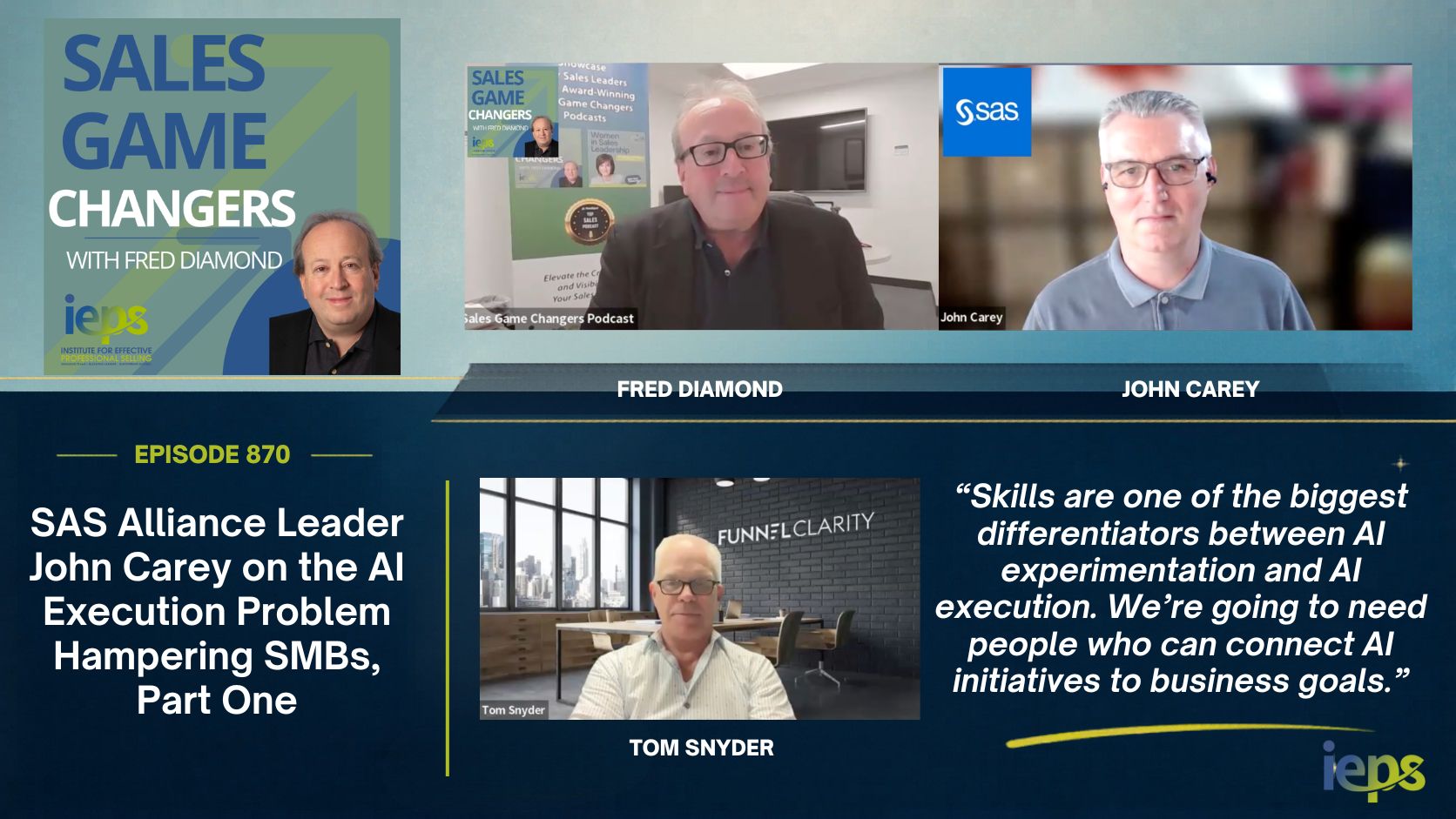
Today’s special two-part show featured an interview with John Carey, Senior Vice President of Global Channels at SAS, and Tom Snyder, Co-Founder of Funnel Clarity.
Explore the IDC report mentioned in this episode.
Find John on LinkedIn. Find Tom on LinkedIn.
JOHN’S TIP: “Skills are one of the biggest differentiators between AI experimentation and AI execution. If we’re going to move AI into the business, we’re going to need people who can connect AI initiatives to business goals. They’re going to be able to prepare data, manage change, and measure outcomes.”
THE PODCAST BEGINS HERE
Fred Diamond: Tom Snyder, we’re doing two shows here, a part one and a part two. We’re going to be talking in a second with our good friend John Carey from SAS about a really interesting report that SAS funded that was done with research from IDC. I’m talking to Tom Snyder here, Funnel Clarity. You’ve been on the Sales Game Changers Podcast numerous times. You’re a member of an exclusive group that we call the Selling Essentials Marketplace from the Institute for Effective Professional Selling. I know that you’re working with a lot of companies on how to implement AI in the sales process. We’re going to be talking with John in a second here about some of the research that they’ve done.
This is going to be a two-part show. Part one, we’re going to be talking about the discoveries that John and his team found. Then in part two, we’re going to be talking about solutions, what companies can be doing to implement and better utilize AI to improve their sales processes. Tom, before I bring on John, how are you doing and what are some of your thoughts about these two shows that we have teed up here?
Tom Snyder: First of all, I found the report information that John and his team put together absolutely seminal. I think it’s probably the most interesting such research I’ve seen in a number of years, and it comes at a very timely moment. The tectonic level changes being forced into many industries by the AI capability have in some ways been great and in some ways been a problem. As John goes into talking about what those data say, I think people will be fabulously shocked in a very positive way, because it’s a great, great, the best I’ve seen of uncovering what is required in today’s professional selling.
Fred Diamond: John Carey with SAS, it’s great to see you again. You were on a previous Sales Game Changers Podcast episode and you gave probably one of the best final bits of advice that we’ve ever had. I’ve repeated this many times, I ask you for your thoughts on what selling professionals should do to take their sales career to the next level. I’m sure you remember you say, understand who you’re talking to, who you’re selling to, who you’re partnered with, how they get paid. That was such a brilliant gem that I’ve used many, many times. It’s actually helped me understand, as I’ve worked with selling professionals around the globe, on how they can be more effective.
Your team reached out about this report that SAS funded by IDC. I really want to get deep into this. I want to remind people that we’re doing today’s recording at the end of August of 2026, if you’re listening sometime in the future. John Carey, it’s great to see you again. Give us a real brief intro so people know who you are. Give us the intro and then let’s get right into it. Everyone’s talking, of course, about AI adoption. SAS funded a special report by IDC. What did the IDC research tell you? What about that surprised you the most?
John Carey: Fred, first of all, it’s great to be here again. I’m so glad that that comment landed. It was actually given to me by my mentor, Steve Garside. I use it daily as well. Tom, great to have you with us.
Now, when we talk about AI, gosh, everyone’s having the conversation. There are as many opinions as there are blades of grass. What was really interesting in our work with IDC and the results of their research was to find out that when we think of small and mid-sized businesses, less than 10% had really fully embedded AI into both their strategy, operations, and decision making.
The second thing, we are definitely at a time when AI is no longer a distant concept. We are seeing cycles accelerating. Our partners are dealing with their customers needing a result in a shorter cycle than ever before. To do that, organizations are going to have to move past the early stages of AI maturity in order to scale and see a real impact in their businesses. I think the net that really struck me was that SMBs don’t have an adoption problem. What they’re actually experiencing is an execution problem. They definitely need help from partners and help from vendors to navigate an effective way to execute.
Fred Diamond: You’ve observed that there’s a readiness reality gap. What exactly is that? Why should business and sales leaders care about that?
John Carey: Great turn of phrase. The readiness reality gap. It’s basically where AI ambitions outpace the ability to execute. We know that the organizations we deal with are seeing AI’s potential, but they’re really struggling to turn that into a repeatable business outcome. Why should business and sales leaders care about it? Well, because it shows that they do not need another big idea about AI. What they really need is a plan to deploy AI at scale and deploy it in a way that has value to their business. Even though many SMBs have moved past awareness, maturity has to be the goal.
Fred Diamond: Tom, you’re doing a lot of work with one of our other Selling Essentials Marketplace partners, Zeev Wexler and his team. What are some of your thoughts right now?
Tom Snyder: Boy, did you say it right, John. McKinsey put out a study about four months ago of AI adoption across a breadth of industries and discovered, to everyone’s horror, that 87% of those corporations who implemented a corporate-wide AI initiative discontinued it because it was making things worse. Not because there’s anything wrong with the LLMs, not because there’s anything wrong with the technology itself, but it directly related to what John said. You just have to have a plan of adoption that allows those people to execute according to what is best practice.
The problem is AI is an extraordinarily efficient operator of whatever you are training it to do. If your internal processes are not aligned with best practice, you create a world where you are highly efficient at doing the wrong thing. That efficiency creates less performance. You have to have a plan to lay out, are we actually employing best practice? Do we know what that is prior to just launching a tool? It’s not about AI-enabled tools. It’s about getting the right process.
Fred Diamond: John, I didn’t really give you the right opportunity to introduce yourself. For people who haven’t gone back to your previous show, just give us a brief introduction. I’m curious, how many partners do you work with?
John Carey: I’m the SVP of global channels here at SAS, I joined four years ago. We have about 1,300 partners globally, and that has grown during my tenure. We have partners from strategic technology partners, Microsoft, AWS, Google, Intel, Red Hat. We have our GSIs working with us with our Fortune 100 accounts, Deloitte, Ernst & Young, Accenture, KPMG. Then we have a broad pool of regional solution providers and service providers who are focused on helping our clients realize the value of their SAS investments and tackle their most difficult problems and answer their most empowering and profitable questions.
Fred Diamond: Let’s talk about the sales side of those partnerships specifically, which a lot of the information from the IDC report came out. Where are sales organizations? What have you seen with your vast array of partners? Where are they getting stuck between experimenting with AI and actually generating measurable business value?
John Carey: I think this is fairly common and it crosses customers as well as partners and vendors. Sales organizations are adopting AI, but they’re not operationalizing it. What does that mean? Organizations are running pilots, they’re testing tools, they’re experimenting with use cases, but they’re not necessarily building the foundations needed to scale those efforts for the entire business. It’s being used in pockets rather than as part of a coordinated strategy tied to specific documented goals and outcomes that align with what businesses need to succeed. Many organizations, to be honest, lack very clear success metrics, making it difficult to prove value and actually scale what does work.
Fred Diamond: Tom, you’re working with a lot of sales organizations around the globe. We’re doing today’s interview in late August of 2026, why is there still the disconnect between seeing true measurable business value?
Tom Snyder: I hate to sound heretical here, but it seems in our experience with our clients, boards of directors are racing around quick, go get some AI. What people don’t seem to understand is AI, when done correctly, is actually an entity, it’s not a tool. Think of it as you need to hire someone. This someone doesn’t get a salary, doesn’t go to bed, works 24 hours a day, but it needs to be trained. Therefore, that training is not happening when you just go out and buy quick, let’s go get the AI application in XYZ tool. Now you have a plethora of tools operating independently using an LLM without any structure. It’s not about the tools. It’s about if you’re a salesperson, you can have a never-sleeping, always-on, always-learning research assistant, never-sleeping, always-on strategy guide, sales coach, all these things.
But if you don’t have those things structured and you’re just getting tool after tool after tool, you have great risk of moving backwards, and a bigger risk of not optimizing what AI can do. I often liken it to saying, “Okay, let’s let our four-year-old drive the car.” Not a good idea, you know what I mean?
Fred Diamond: John, one of the things that came out of the report as well is the whole concept of fragmented data as being one of the biggest barriers. Of course, we’re talking to the VP of channels at SAS, one of the leading data companies in the history of technology. Why does an AI strategy often become a data strategy so quickly? That’s probably one of the reasons why a lot of companies aren’t really in a position to best utilize the AI process to be successful, to get these results that we’re talking about.
John Carey: Look, we’ve been around long enough to know that it’s always about the data. AI is only as good as the data behind it. If you have fragmented data, you’re going to limit the ability to get the most out of the AI that you deploy. When information is spread across disconnected systems, your AI solutions are going to struggle to deliver consistent insight. This is why you want to use a partner who can take that step back and say, “On your journey, what is the best first step?” That means that even though we may have to slow down initially, we’ll actually get you to your outcome much faster than if we try and go too fast right now. To respond to Tom, how do we not put the four-year-old in front of the vehicle? How do we put them in the right seat in the back so they can see who’s driving that vehicle on a very straight road so that when we do want to teach that teenager to drive a car, they’re already aware of the context of what a road is, what a car is, and where to go? Then they’re going to get better at it a lot faster.
Fred Diamond: You talked about partners. Tom, I’m going to ask you this question. Then, John, I want to come back to you. In part two of today’s podcast, we’re going to get into real detail about what you can be doing. Tom, you mentioned the four-year-old and John just took it to the teenager. Do SMBs that you guys have come across, do they actually have people who know how to move AI from experimentation into the business? One thing I think that we’ve all learned is that it really is a skill, not just a skill that a person needs to happen, but truly skilled professionals who need to understand how to utilize the AI processes, the mechanisms to get to results to make them happen.
Tom, why don’t you give us some of your thoughts? I know you’re working with one of the elite providers around, Zeev Wexler and his team, to understand some of this. Then, John, I want you to tee us up a little bit for what we’re going to be talking about in part two.
Tom Snyder: We have yet to encounter an SMB that is doing the right groundwork to implement AI and make it a real force multiplier. I don’t condemn them. I think there is a race to embrace this technology on the fear that their competitors will arrive first. The way most companies are going about it, it’s going to not produce the kind of outcomes you want.
I also think that there’s nothing magic about large companies because they’re lacking that same kind of thing. We have a client right now who has stopped, a very large multi-billion-dollar company, stopped their AI implementation, moved backwards, and are now going to, let’s first understand what processes and information integrate into a tapestry of performance, not just get disparate tools, all of which don’t talk to each other, and all of which take a different piece of the pie, and you end up with a mess.
I think there is a recognition increasingly that although the LLMs are updated at a frightening rate, they move so fast in terms of new capabilities, and it’s sometimes very exciting to have someone in the sales seat go, “I just did this on Chat, and Gemini just told me this, and Claude just told me that,” which is kind of cool, but oftentimes, if you don’t know how to do that, the AI agents and projects are performing in a way that you don’t understand. Even if you tell them don’t hallucinate, they wander off the rails, you have to have a real system in place to say, “Here is the foundation. Now let’s create the efficiency based on that foundation.” It’s not just SMBs, Fred. John will tell you, it’s almost everywhere.
John Carey: Tom, I think you’re 100% right. Skills are one of the biggest differentiators between AI experimentation and AI execution, and it really doesn’t matter the size of the organization. There was a great quote, I was listening to an interview the other day, when it comes to technology, we want to be the centaur. We want the human brain, the human body on top of the power of the horse. What we don’t want is the horse’s head on the human body. We’ve got all the wrong combination.
Tom Snyder: That’s beautiful.
John Carey: Not mine, completely referencing it from this interview. But this report with IDC shows that many SMBs are really now working to build the organizational readiness needed so that they can actually scale AI skills and build that expertise. If we’re going to move AI into the business, we’re going to need people who can connect AI initiatives to business goals, centaurs. They’re going to be able to prepare data, manage change, and measure outcomes. Frankly, I think this is where channel partners come into their own, never been a better time for a trusted partner to help customers navigate and close that skill gap. Close it for them in the short term by delivering while they build up into the long term the skills they need in their own organization.
Fred Diamond: John, as we wind down part one of today’s conversation, what do you want? You’re managing relationships with 1,300 partners, many of them are SMBs, small, medium-sized businesses. What do you need? Why are we having this conversation today with you? I’m going to tee it up like that. I’m not going to answer the question that I’m going to ask you here, but why are you so driven by the data by getting this report done? How critical is it for you for the SMBs to get two, three levels from where they are for your success?
John Carey: I think our success is intrinsically tied to our customers’ success. SAS is a data and AI company. We’re in our 50th year. We’ve done 50 years of trusted data and AI. We were doing AI back when it was called machine learning and neural networks. We’re heavily invested in helping our clients solve their problems through the use of this technology. The best way we can do that is by working with partners in the same geography, in the same region, in the same district, where they can understand their customers intimately, they can understand what success really means, what the pressures are that they’re experiencing, and use this information from this report to help to create the guide map to staying relevant.
I think that’s one of the things that’s probably keeping most SMBs up at night. Will I be relevant? I’m rushing into AI hoping it will actually maintain my relevance, give me an opportunity, help me grow at an accelerated rate, but they don’t know. With a partner, they can have a lot more confidence. Why we’re emphasizing this report, why we’re working with our partners, is we want SMBs to work with people who live their lives, partners, who themselves are SMBs, who are able to write that navigation map to help them get to the outcomes they need so that they can stay relevant in an ever-increasingly fast change cycle that they are forced to constantly react to so they can get out of reaction and into response.
Fred Diamond: We’re going to tee that up as we move on to part two, but Tom Snyder, I just want to ask you a couple of questions. The Institute for Effective Professional Selling is launching our Partner Revenue Academy, where we’re working with partner account managers, channel account managers at OEMs and ISVs. You are a faculty member for a number of the sessions. The same thing with AI as it relates to the OEM, ISV, Partner Account Managers, where do we want to go with that?
Tom Snyder: There are a number of things that I could comment on. I think the big picture there is that particularly in the world of VARs and folks like that, the customers have begun asking, what value are you adding? If I am a VAR and I represent an OEM and I have traditionally been a source for channeling that capability to you, the customers are now, I’m not getting a lot of added value. One thing that over the last 60 years in sales is that there tends to be a delay between the demand for something from a sales force and how that sales force is equipped to deliver it. AI has now accelerated that gap.
One of the books I wrote was about creating value during the sales process before you ever sell anything. What that basically means is being able to provide either insight, the benefit of expertise, or the benefit of experience from that sales team or that sales person, that sales organization, to the benefit of the potential customer before they ever buy something. Now with AI, if you know how to do it, you can be so far armed and it gives people so much forewarning. But the problem is, unproperly implemented, you have a huge deficit.
Channel management has always been a place where there has been a great dearth of what is actual best practice. You’re not just an encouraging motivator. You’re not just someone to answer questions. If you’re going to create value for your channel partners, it’s even more difficult because they don’t work for you. They aren’t your employees. You have to bring that expertise to the benefit of those VARs so that they can do the same for their customers. That’s what we’re really talking about in the channel manager program from the IEPS.
Fred Diamond: Once again, John Carey, thanks again for telling us about this IDC report. We teed up the situation. Like I said, we need to go into a second part of this. We’re going to get specific. We’re going to get deep. We’re going to be talking about how do companies, and particularly sales organizations, and their partners move from this experimentation, from this awareness, to measurable business results. Thanks again, John Carey. Thanks again, Tom Snyder. Join us again on part two of this conversation. My name is Fred Diamond. This is the Sales Game Changers Podcast.
Transcribed by Mariana Badillo