
Watch the video of this podcast on YouTube here.
The Sales Game Changers Podcast was recognized by YesWare as the top sales podcast. Read the announcement here.
FeedSpot named the Sales Game Changers Podcast at a top 20 Sales Podcast and top 8 Sales Leadership Podcast!
Subscribe to the Sales Game Changers Podcast now on Apple Podcasts!
Purchase Fred Diamond’s best-sellers Love, Hope, Lyme: What Family Members, Partners, and Friends Who Love a Chronic Lyme Survivor Need to Know and Insights for Sales Game Changers now!
The Institute for Effective Professional Selling has launched the Partner Revenue Academy for partner account managers who are looking to become more effective active sellers. The next 6-session cohort launches on October 16.
Learn more here.
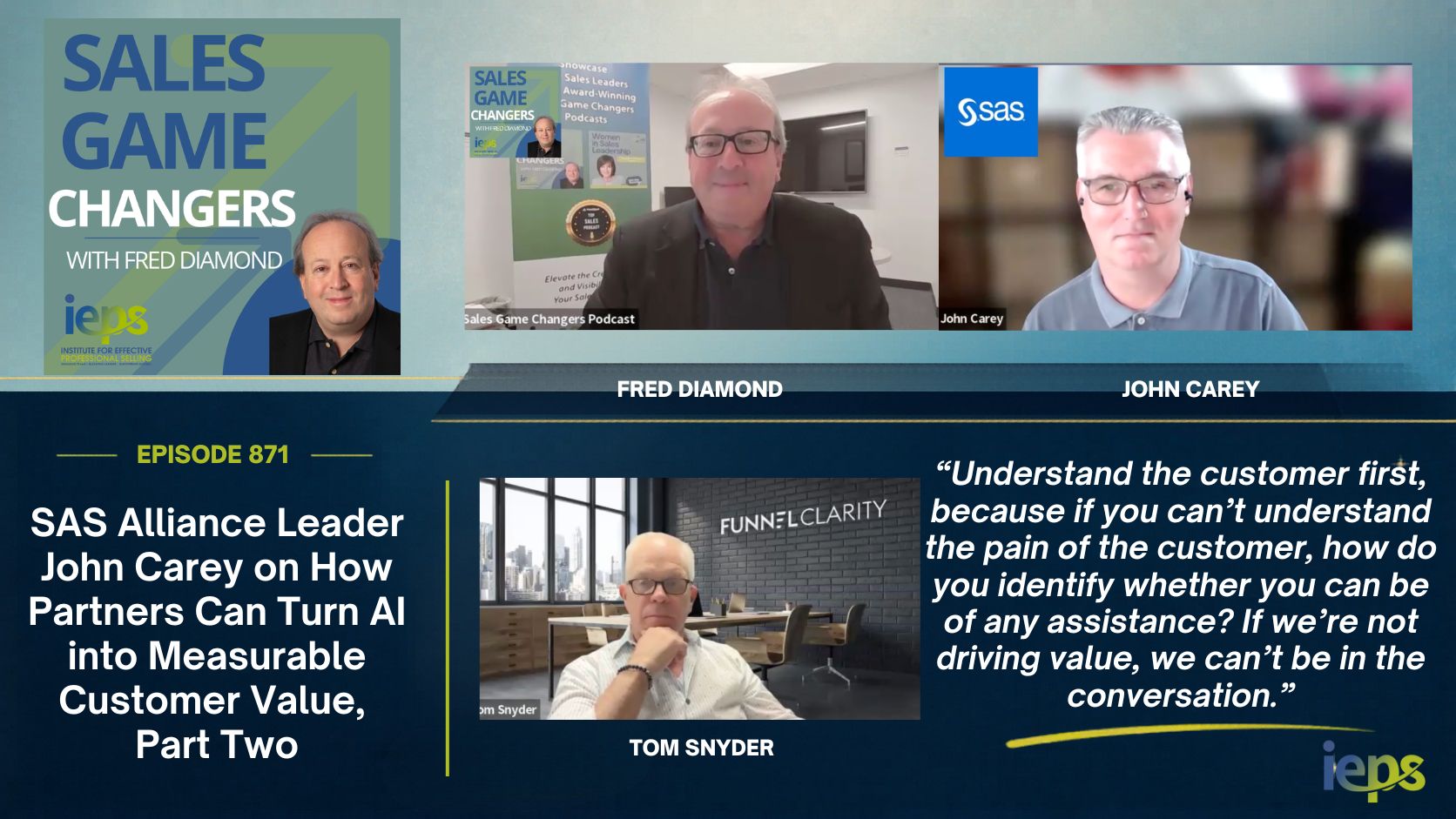
Today’s special two-part show featured an interview with John Carey, Senior Vice President of Global Channels at SAS, and Tom Snyder, Co-Founder of Funnel Clarity.
Explore the IDC report mentioned in this episode.
Find John on LinkedIn. Find Tom on LinkedIn.
JOHN’S TIP: “Understand the customer first, because if you can’t understand the pain of the customer, how do you identify whether you can be of any assistance? If we’re not driving value, we can’t be in the conversation.”
THE PODCAST BEGINS HERE
Fred Diamond: The reason why we’re doing part two is we were talking about a report that was funded by SAS that was done by IDC, research by IDC, talking about the disconnect between AI integration, AI use, and actual implementation in using it to truly drive measurable reports. If you go back to part one of this podcast, John Carey talks a lot about why SAS funded this report, the problems that we see with small and medium-sized businesses, SMBs, and even some large companies, John, that we referred to, that are still struggling with, let’s do AI, and then doing AI.
Today we’re going to be talking about how companies, particularly sales organizations and their partners, will move from experimentation, from maybe dipping their toe, to getting to true measurable results. Not to go deep into what we just talked about, but John, just give us a one-minute overview. Why did you bring this report together? Why did you fund this report? Then we’re going to get real specific into what companies, particularly partners, can be doing, and the OEMs and ISVs that work with their partners, to get AI implemented the right way to truly see measurable sales results.
John Carey: It’s really simple. AI is a huge promise, but it’s a promise that has to be realized. We felt that by working with IDC research, and specifically focusing on the needs of small and medium-sized businesses, we wanted to understand, what are the things getting in the way of executing on the opportunity of AI. We know there’s a lot of AI usage out there. We know there’s a lot of excitement, but how is that showing up in actually delivering customer outcomes? This report is all about understanding what’s getting in the way and identifying key areas to be able to actually successfully execute and scale AI to meet your business objectives.
Fred Diamond: In our first conversation, we established that companies don’t really have an AI adoption problem. Tom, on part one of this show, you talked about people are using it, they’re bringing in tools, that it’s not about the tools, it’s about the process and the management and the implementation properly. But there’s an execution problem. John, then Tom, let’s get started on fixing this problem. John, how do we fix this problem?
John Carey: The AI readiness report identifies four areas that matter most, planning, building, enabling, and executing. To begin fixing the execution problem, companies need to narrow the focus to one meaningful business problem. Make sure the right data is available, define what success actually looks like, and then prove that value before scaling.
Fred Diamond: Tom, we talked about this on part one. You’ve worked with thousands of selling organizations around the globe. I’m talking to Tom Snyder with Funnel Clarity. Funnel Clarity is an exclusive participant member of the IEPS Selling Essentials Marketplace. It’s a hand-selected group of a very small number of sales performance improvement vendors that we work with, at the IEPS, that we bring to the B2B and B2G sales organizations that we work with. Tom, talk about some of that gap that John was referring to.
Tom Snyder: I love those four things. Think about the four things that John just mentioned in the context of what most people are doing. What most people are doing is they have more or less the wild, wild west of AI implementation. There often is a complete lack of control or planning or thoughtfulness, and the sellers are racing out and doing all kinds of things. They’re having an AI engine write their emails, they’re prospecting ideas, just all of these things that AI can do poorly or do well. It all depends on planning, building, the kinds of things John talks about.
Ask yourself a question, if you’re a member of a senior leadership team in a small to mid-sized business, do you have a plan? Do you have a plan that says, this is the process by which we are going to implement AI? Do you know that one problem that you’re solving? Have you built AI to be that capable? What we see all the time now is that, for example, let’s use the AI application that the vendor of our CRM says, this will make magic happen. Well, isn’t that interesting?
First of all, if you’re going to use it as part of your sales function, are you certain that your sales process aligns with best practice? I work in the industry that presents that to people and trains people on it. I will tell you that the vast majority of the providers in our industry have a model, whether it’s MEDDIC, MEDDPICC, BANT, ANUM, SPIN, Counselor Sales, there’s a thousand models. The model is okay, but are we really enabling people to use it? Are we really giving them the understanding of how, and I love the word John uses, execution. Are we really executing against that best practice? Or are we putting people in training, they walk out, and they forget it.
If you are doing this correctly, the first thing is to plan around what are the best sales practices in our industry to do the best value creation job for our customer base? Number two, have we built that? Is that a capability that is built into the very fabric of our organization? Is it an inseparable part of our strategy? Or have we bolted on and expected great things to happen? If you are going to begin one of these processes, please understand, no matter what you have invested in in terms of your sales performance model, ask yourself, am I certain that this is a best practice? Is it research-based? Is there a plan to move people from training to adoption? Do they really know how to execute against the things they’ve been taught?
AI can make all that magic happen, or it can lead you down the path of destruction, because it creates huge efficiencies. If those efficiencies are associated with doing the wrong thing, you’re going to find out that AI is going to make your sales process worse.
Fred Diamond: John, I want to get a little deeper into that, on what you direct your people to do. I remember we had a conversation, you told me that SAS channel managers start by asking the senior executive, what’s the toughest challenge you have right now? What’s the question you can never get answered? Why should the AI conversations start there rather than with technology? For people listening, you have high quotas on technology you need to sell. Give us some perspective on that.
John Carey: This isn’t rocket science. Starting with the business challenge helps organizations focus on what resources they need, how they can prioritize a use case, and what the definition of success and the associated success metrics are much earlier. It’s the Simon Sinek’s, Start with Why. Don’t tell me what you do. Tell me why you do it.
I loved how Tom rattled through all the different types of sales methodologies. They all ultimately say, understand the customer first, because if you can’t understand the pain of the customer, how do you identify whether you can be of any assistance? If we’re not driving value, we can’t be in the conversation. That’s our approach. We actually have several sales plays available for our partners and they all begin with spending time identifying the business problem. That’s where the value for the customer is.
Fred Diamond: Let’s talk a little bit more about that. With all the possibility that AI presents, that we’ve talked about many times on the Sales Game Changers podcast, how does SAS help a customer identify the one problem most worth solving?
John Carey: You’ve got the ability to solve so many things with these data and AI platforms. In our experience and the research from the study shows, the best place to start is with a business challenge that has very clear value and measurable outcomes. Now, customers can then prioritize use cases where they have leadership support, accessible data, and a realistic path to measuring impact, all of which are tied together to get you to that milestone of qualifying value delivered, which allows a customer to feel that you’ve actually delivered on the promise of being a trusted partner.
Fred Diamond: I want to ask you both about what is expected of partners now in bringing value. But before we get to that, I just want to ask you a quick question, John. In looking at the IDC report, it identified data as a major obstacle. SAS is one of the top data companies in the history of technology. What does SAS mean when it tells customers and partners that their data needs to be AI ready?
John Carey: Great question. AI ready data means that the data is accessible, reliable, and trusted. When data is fragmented, AI is going to struggle to deliver consistent insights, and that’s going to undermine the overall value and trust in the system that you’re building. Getting it there, accessible, reliable, and trusted means you’ve got the right ingredients to deliver that.
Fred Diamond: Tom, during our prep call with John, John made the interesting point that SAS doesn’t necessarily need every partner to, let’s just say, arrive as an AI expert, that you want them to bring industry expertise. Tom, give us some of your insights, and then, John, I want your angle to this as well. What should partners be? Should they be technology experts? Should they be AI experts? We’re doing today’s interview at the end of August of 2026. Tom, what do partners need to be now to be successful?
Tom Snyder: In part one, I mentioned the result of a large research project we did around creation of value as part of a sales function, not relying on what the customer is going to buy from, but creating value before they buy anything. Oftentimes, when a seller is trying to get to the bottom of what troubles a particular potential client, what they often describe are symptoms. They often don’t even know what the actual root problem is.
Now, sellers generally have the capacity, if they’re trained to do it, to help provide that insight by understanding those symptoms as rooted in a particular problem. When you go to the doctor, you don’t tell them what disease you’re suffering from, you tell them the symptoms. We pay the doctor to figure out what the disease is. We can’t just simply chase symptoms. That research project revealed there are three major things that drive value in the interaction between buyer and seller when the seller is capable of doing it.
One, you help the buyer understand a problem they don’t see, or the magnitude of a problem they don’t realize. Number two, you help the buyer discover a solution they may not have anticipated. Or three, you broker in the full capability of your company, even if it’s independent or unrelated to what they are going to buy from you.
When you do that, magic happens. Price becomes less of an issue. You become a trusted advisor. You become a decision coach. You are not just reliant on your technology. Unfortunately, AI has compounded that requirement. Because if you use AI correctly, it can help you analyze in a way that no human being ever could in terms of those three things that drive value.
If you let it just write your emails and do a little research without guardrails, as John said, you can be wandering far afield as to where there is value to be created. If your sellers have the capacity to see themselves and can execute on being a decision coach, as opposed to a product expert, they will make magic happen. AI can help do that. But it won’t do that without the foundation of best practice.
Fred Diamond: John, you said you have 1,300 partners that you work with, the entire spectrum, from global ISVs, GSIs, etc. Here you are leading this mass organization. You’ve worked with tens of thousands, I guess, technology partners by this point in your career, not to age you or anything. But here we are in August 2026, you commissioned this report by IDC to prove something. What do you want out of partners right now? You see some that are doing great. You see some that are struggling. Give us your inside baseball on what you want.
John Carey: I love the way Tom just answered that question, because for me, context creates value. We want partners with industry expertise. That helps organizations find the AI opportunities that truly move that industry-specific business forward. A partner who understands industry challenges, they’re much better positioned to connect AI opportunities to measure outcomes.
If you’re a SAS partner, we want you to become trusted advisors that help your customers assess their AI readiness. Focus on what you do well and where your skills are. Customers need guidance on how to move their business forward. That just hasn’t changed. That’s been the sweet spot for the partner ecosystem since I started all those many years ago. What we want to do, we want our partners to use that proximity to the customer, that industry expertise to help their customers close their readiness gap by turning AI investments into actual meaningful business results.
Fred Diamond: John, if I’m a SAS partner with that industry expertise, but limited AI expertise, that’s something that the IDC report very clearly spelled out, what does SAS want me to become over the next year? Specifically, how will SAS help me get there?
John Carey: It’s real simple. We can give you the tools to become expertise in the architecture and deployment of AI. What you need is to know how to ask the right questions to get the customer to identify the value that is the most compelling for them. That’s going to differ by industry. There really is this panic around, it’s an easy button. It’s a singularity. It’s going to make everyone unemployed.
I’ll go back to an analogy we used in the first recording. We’re looking to build centaurs. We’re looking to put a human head and body on a really efficient horse’s machine. The best of both. What do we want to avoid? Horses’ heads on human bodies. We refer to it as human-in-the-loop decision-making. You do not want to give over to AI. AI is an augmenting technology. It is not a replacement technology. Some of the things we see go very wrong right now are organizations who push it as a replacement technology, as something that doesn’t increase the value of the humans in the organization, but somehow allows you to replace that balance.
When I think about what do I need from partners? I need them to understand it’s human value first. It’s human-in-the-loop decision-making. It’s doing the basics, understand the industry, understand the client, understand what value means to them, and help them navigate getting to that proof point. Because once they’re at the proof point, now we can have a conversation about scale. When you’re at scale, now you’re in the co-pilot seat with them. I love the decision coach phrase that Tom used, you as the partner are the decision coach. Once you’ve earned your right to that seat by helping them realize the low-hanging value that is measurable and demonstrable and creates the case for scale.
Fred Diamond: Tom, with this great conversation here, the one title we haven’t really spoken about on part two is the partner account manager. The partner account manager needs to shift. The Institute for Effective Professional Selling is launching our Partner Revenue Academy on October 2nd. You are a faculty member for that. We’re very fortunate to have you as a faculty member for that. I’m just curious on your thoughts, how does the role of the partner account manager need to change? Do they increasingly need to become more active sellers per se who help partners identify opportunities, develop use cases, drive the measurable customer outcomes by using AI more effectively in this process as well? Tom, where do partner account managers at companies like SAS and other OEMs and ISVs need to go? John, I’m curious on your thoughts on how you’re directing your people to help the partners become more valuable.
Tom Snyder: Big question. Let me see if I can do this in short order. First of all, one of the great mysteries in sales for a very long time has been what is best practice as a channel manager? If you think about it, if you’re doing that job correctly, you are enhancing the performance of your partners. You’re doing that by giving them the same kind of value you want them to give their customers. You’ve got to be coaching them out of, my technology is so spectacular you really need some, to, here are some issues that we can help you solve that are limiting your ability to grow as an organization. They don’t have to be AI experts. By the way, the world seems to be lorded with self-proclaimed AI experts, but it’s hard to find the real megillah.
But anyway, the idea is if you are employing the idea, the mindset of my job is to be a coach and a resource for our partners, not somebody who simply asks where you’re going to drive the business. It’s not about that. It’s the same trusted advisor. If you are a channel manager, and by channel manager, I know that when I interact with you, I’m better. I’m better at what? I’m better at helping my customers. I’m better at helping my customers make more revenue, hit the margin, grow, beat the competition. That’s what I should be doing. Not worrying about directly like, have you sold anything? When’s it going to close? It’s not about that, just like being a sales manager is. You are literally a higher order sales manager and they don’t work for you. You have to win the day by creating value for them.
Now, one last comment. When done correctly, AI massively accelerates that capability, because you can now coalesce enormous quantities of information and data that no human being ever could have before. As long as you know how to employ that with the idea of, I want to make our partners more successful, not just demand more sales of them. I think that’s the magic. That’s what we’re going to be talking about in the academy. That’s what I think most people will find tremendously exciting.
Fred Diamond: John, you got this report generated by IDC talking about where the gap is between what SMBs are doing with AI and where they should be. I just want to follow on to what Tom said. How are you directing a critical part of this puzzle, the partner account managers at SAS? How are you directing them? Then to wrap up, I’m going to ask you, if you had a minute to spend with a CEO of one of your SMB partners, what would you tell them? First question, you lead partner account managers. Critical role in this equation here. What are you telling them? How are you leading them?
John Carey: I agree 100% with Tom. I think they are strategy coaches to begin with. They are effectively communicating your intent as a vendor so that a partner can proactively choose to go on that journey with you, or choose not to, and both are viable decisions. I say this all the time, I’m not here to convince anyone to go on this journey. We’re here to point out the direction on what can be achieved and invite them into that journey with us.
If we’re trying to push a partner in a direction, it’s the wrong partner. It’s the wrong fit, and this can happen. You’ve got to do it every year. You come in and you go, “Hey, my strategy is now here. Your strategy is there. Are we still aligned? If we’re not aligned, let’s find a great way to part company,” just like we would find a great way to come together.
I think then once you’re in the organization, you’ve got to be the sales coach. You have to do that by leading from the front. I can tell you, I have a technology vendor, who is a strategic partner of ours, and there is an individual who spends more time on our campus than some of our employees. When I first came in, people were like, “Hey, man, what about that guy?” My response was, “I’d like you to be more like them.” That individual is so embedded in our success, it’s like they’re an employee. Understands our values, our objectives, reads our annual reports incredibly well. Understands what we want to do and how we can get there, and every engagement, that individual brings value to it. That’s the model. What can I do to bring value to this relationship today? Because when we show that, we’re showing those partner sales managers how they have to emulate that to their people, and then that’s how their people will interact with their customers. The culture has to be top down. How can I bring you value? As long as we’re doing that, we’re the vendor. If we’re not bringing value, why should you partner with us?
Fred Diamond: Once again, I want to thank John Carey, the senior VP global channels with SAS, for making us aware of this IDC report. The links are all over the show notes for both shows of our two-part series here. Tom Snyder, thank you so much, with Funnel Clarity, for providing some color throughout today’s interview, and also part one as well.
John, I’m just curious, just to wrap up the show, if you had the opportunity to talk to the CEO of one of your most important SAS partners based on everything we’ve been talking about, what are two things that you would tell them to help them be more successful?
John Carey: The first thing I’d tell them is we’re in this together. What can we do to be successful? I would like to focus with them on outcomes, use cases, available data, and simple measures, so that we can be a trusted guide for our client’s AI journey. That’s it.
Fred Diamond: Once again, I want to thank Tom Snyder with Funnel Clarity, John Carey with SAS Institute. Thank you both very much for being on this two-part special episode of the Sales Game Changers Podcast. My name is Fred Diamond.
Transcribed by Mariana Badillo