
Watch the video of this podcast on YouTube here.
The Sales Game Changers Podcast was recognized by YesWare as the top sales podcast. Read the announcement here.
FeedSpot named the Sales Game Changers Podcast at a top 20 Sales Podcast and top 8 Sales Leadership Podcast!
Subscribe to the Sales Game Changers Podcast now on Apple Podcasts!
Purchase Fred Diamond’s best-sellers Love, Hope, Lyme: What Family Members, Partners, and Friends Who Love a Chronic Lyme Survivor Need to Know and Insights for Sales Game Changers now!
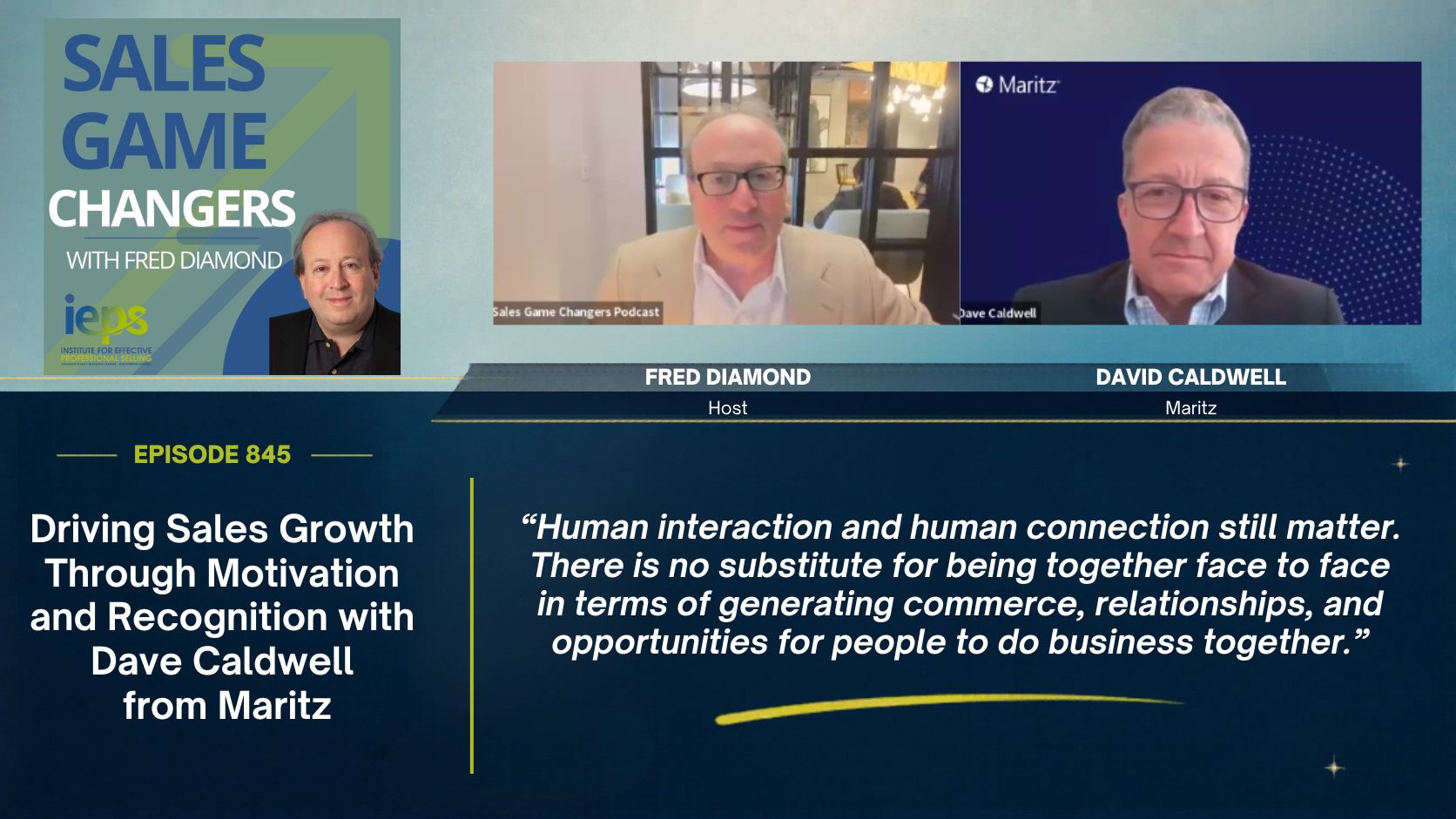
Today’s show featured an interview with David Caldwell, Managing Vice President of Sales at Maritz.
Find Dave on LinkedIn.
DAVE’S TIP: “At the end of the day, people are buying from people. Human interaction and human connection still matter. There is no substitute for being together face to face in terms of generating commerce, relationships, and opportunities for people to do business together.”
THE PODCAST BEGINS HERE
Fred Diamond: Dave, I’m really excited. I’m talking with Dave Caldwell of Maritz. As I talked to you in the beginning, when I was the Director of Public Sector Marketing at Compaq Computer in the mid-90s, it feels like yesterday, it doesn’t feel like 30 years ago, we did a lot of work with Maritz. We were talking about my sales rep who worked for you, who recently retired. We did a couple of incentive trips. I was working in the public sector side. We did a couple of really big trips to bring our top reseller reps to Cancun. We brought them to Bahamas. We treated them like royalty. I know Compaq, we did a lot of things, not just in public sector, but other markets. When we got reconnected, I was very excited to get reacquainted with this space.
I’ve never done a show, Dave, on incentives and recognition. I’m really excited for you to get us up to speed. Give us a quick introduction and tell us what you do with Maritz.
Dave Caldwell: I feel good that I can say that I remember those days when Compaq was a client back in the ‘90s, and the individual that you were referring to. The good news is, is that those strategies that worked for Compaq and your sellers 30 years ago work still today, and even more so. We’re excited to chat a little bit about that.
My name is Dave Caldwell. I work for Maritz. My particular role is I lead the corporate sales organization within the part of Maritz that we call business event solutions. That is the event design and execution portion of our business, where we design and execute all manner of corporate events, from product launches to sales kickoffs to customer events and obviously incentives across many, many, many different client sectors. We work in automotive, financial services, tech, from your background, life sciences, retail, and across the spectrum. Business is good, it’s still a very important part of what our clients do, and we’re thrilled to be able to support them and help them grow their business.
People will say, what is it that Maritz does? We really are a sales and marketing enablement company. We do that in a manner of ways. The tactic that we use within my part of the organization is the event experience. How do we help clients design effective motivation and reward strategies that integrate into their overall compensation plan? Those reward strategies can show up in all manner and form, whether it is an incentive trip, whether it’s a customer event, dealer, wholesaler, distributors as part of their sales and marketing strategy.
That’s the tactic that we use, but at the end of the day, our purpose is to help our clients grow their business through increased revenues, greater loyalty from their channels, greater loyalty from their salespeople, give them the tools to attract the best talent and keep the best talent.
Fred Diamond: It’s a very important topic for us today. We’re doing today’s interview in April of 2026. There’s still a lot of things that are coming out of the pandemic, or as a result of the pandemic. One of the big things that we talk to sales leaders about all the time is getting the most out of their people. Especially a lot of younger sales professionals who spend a couple years inside working from their house, not going to events, not being around other professionals. This is a topic that comes up pretty frequently from sales leaders, is like, what is working today? What should we be doing too?
For people who may not know Maritz all that well, what role do incentives and recognition play in driving sales effectiveness?
Dave Caldwell: They’ve always played a very important role. What we have found is, you reference the pandemic, even since the pandemic, they play an even more critical and important role. I think what we have found is most important is that sales leaders, marketing leaders, who are typically who we sell to and engage with, we also work with compensation leaders with our client’s organizations. That’s really key because the key to making an effective reward and recognition strategy is that it has to be integrated into the total reward strategy that this leader has in place for their sellers. Reward and recognition cannot be done in a vacuum. It really has to integrate into all the other things that you do to attract the best sales talent.
That’s salary, it’s variable incentive comp plans, it’s bonus plans, it’s commissions, it’s stock, it’s RSUs, all those other things that you might be offering to your sellers, your non-cash, whether that is a points based platform, merchandise program, incentive travel, incentive trips, all of that has to be integrated into your overall reward strategy. When the smart company is to take a holistic view of it, as opposed to looking at incentives as something different, those have the best success, they get the greatest return on their investment.
It’s even more critical today, coming out of COVID, so many places, either they have not had a return to office, or if they have, it’s somewhat loose, it’s three days a week. What we are finding is that because people are not in the office every day together as they used to be, it’s more important to bring them together when you can. Whether that happens to be a national sales meeting, a training event, customer event, or in reward and recognition travel.
Fred Diamond: We’re doing today’s interview in April of 2026. What’s the current state of sales effectiveness motivation? How really have things changed in the past five years or so?
Dave Caldwell: I think the biggest change that we have seen in the past five years really is in two areas. One is the effective use of data. That is data in terms of understanding what it is that motivates a sales organization. Ensuring that the objectives that you’ve set for that organization are objectives that those individuals actually can attain an impact. You want to set objectives for an incentive that are as close to the individual as possible so that they can have the greatest effect on their own performance and their own reward.
The use of data has become much more important. Coming out of COVID, companies took a much harder look at their events spend and is it okay? Is it safe to bring people back together? Should we be spending that money? The good news for our industry is that as sales leaders, chief financial officers, finance leaders, compensation leaders especially, looked at those strategies, they realized, you know what? There really is a return on investment. Rather than something that we might want to hold off on, this is something that we should be continuing to invest in and in some cases even grow that investment. That all comes from data. I think the biggest change we’ve seen is the impact of data, financial modeling, and ensuring that these programs and these strategies really do pay for themselves.
The second change that we’ve seen over the last five years is it’s really important given the different generations in the workforce today, the way that today people are much more selective about where they spend their time. You really have to understand how to engage with your sales organization, and that’s about personalization. The second biggest change we’ve seen is the use of behavioral modeling and design sessions to really understand the personas of your sales organization, the different generations, how different points in their life might affect the things that are going to motivate them and the experiences that they want to have. Personalization to make events that are more memorable, more engaging, thereby have more impact on performance, which then ties back to having effective data and using data effectively to ensure that you do have a return on investment with your incentive investment.
Fred Diamond: This may be a very broad question, but we have a lot of first-time sales managers, maybe in their mid to late 20s. We do a program at the Institute for Effective Professional Selling called our Emerging Sales Leader Program, where we take sales leaders who are either at the first level, maybe the second level as a people manager. I’m going to put you on the spot here. For those professionals, what would motivate the younger sales professionals who now work for them? I’m a first level manager, maybe managing inside sales or a team of SDRs or something, what have you found that truly motivates the people who are working for them?
Dave Caldwell: That’s a good question. It presupposes that that has changed over time. What we have found, it really hasn’t. Top sales people and people who want to be in sales and who relish that opportunity and want to succeed in sales have many of the same traits today that they did 5, 10, 15, 20, 30 years ago when you were leading a sales team at Compaq. Those are people who enjoy competition. They are people who are self-motivated. They are people who appreciate and want recognition and want to be recognized.
The basic human personality traits that would drive somebody into sales really haven’t changed over time. The way that sales occur today, especially in B2B sales, it’s much more difficult than it ever was. There are way more stakeholders involved. There are many more decision makers. I think when you and I were starting in this industry, you could find one or two people to talk to. You could find a VP of sales or a VP of marketing and you could build a relationship with he or she and sell your solution and you were off and running.
Now, there’s so many people involved in the sales process. There are the stakeholders. There are the financial owners. There’s procurement and a whole host of people in the organization. It’s become much more difficult, which now makes appropriate reward and recognition that much more important to make sure that you’re doing things beyond the comp plan to drive increased performance.
One of the basic tenets of our industry, and it still exists today, is comp plans get you the performance that you’re getting today. That’s not a bad thing, but it is what it is. Your comp plan, your bonus, your VIC, your variable incentive comp, that will get you the performance you’re having today. When you want people to escalate and push that performance up higher, it’s a proven fact that cash is not the be all and end all to make that happen. An effective reward and recognition program, an effective incentive strategy, will now push those A players even higher.
It’s the bell curve. You get C players to be B players, B players to be A, and then those truly top performers, that 10% that you’re going to have every year, you want them to be role models. You want them to be loyal to the organization and you want to retain those people and then use that strategy to attract the best salespeople from your competition and get them over to your team.
Fred Diamond: Who do you sell to? Who makes the decision for this? Is it the chief revenue officer or the global sales leader? Is it the VP of HR?
Dave Caldwell: It used to be one person. Those were the good old days, but in general, our key stakeholder is our heads of sales and marketing or channel heads. The genesis of this business really started, you talked about resellers at Compaq. These strategies are very effective with an internal sales force, but they are also equally, if not more so, effective when you have an independent sales channel. Whether you call them dealers, wholesalers, distributors, resellers, whatever those job titles are or those functions are, these types of strategies become very important to capture their mind share, their effort, their wallet share, their loyalty, their engagement.
We deal with channel heads, we deal with sales heads, we deal with marketing heads as the key stakeholders. But again, as I said, in today’s environment, and it’s not a bad thing, there are many other people who get a voice. Now procurement gets a voice, finance gets a voice, human resources often gets a voice. The sale has become much more complex. That’s in all B2B sales organizations, not just ours, which again, makes having a holistic, well thought out, strategic total reward strategy that much more important to be effective and grow.
Fred Diamond: When we did our programs, it was 30 years ago, it was designed to build channel loyalty. We took the top sales reps at Compaq’s channels to the Bahamas and to Cancun for four days, and it worked. We were in the room, we also did some presentations, but we had fun and we got to know them better. Ironically, some of the people, I’m still in a relationship 30 years ago. That was a great program.
What might separate incentive programs that create a short-term spike, maybe the loyalty for a quarter from those that drive sustained performance?
Dave Caldwell: These are great strategies, as you said, for a short-term initiative. If you’re launching a new product and you need a fast start, if you’re anticipating a difficult quarter or two quarters for some particular reason, these are great strategies to drive that short burst of performance. It can’t be in conflict with your compensation plan. It has to be designed to support that. You can’t have eight different competing product managers trying to get the attention of your sales force. That has to be organized at some level. Typically, in our clients, it’s at that compensation head level to make sure that those are all integrated. But again, through the right data, financial modeling, those are great strategies to get those short-term hits.
For the longer term, that’s typically where your compensation plan will come in. The annual incentive event is a great tool for not just driving behavior, but just as importantly, recognizing those top performers, and as I said earlier, making and creating role models out of them. The biggest compliment that we hear from our clients’ participants and their sellers is, once they’ve earned that first trip, they never want to miss another one. It goes from being a recognition event to them to becoming an incentive event for them, because they say, “I’m never going to miss another one.”
What’s different today to get that sort of engagement around an event to have those individuals say, “I’m never missing another one,” is the way that those programs are designed. I could probably guess that when you took your resellers to Cancun 30 years ago, it was probably typical activities and there was plenty of free time and receptions and so on and so forth. Today, those events have to be designed very intentionally to address many different wants, needs, desires of those earners. It’s harder today because you have to do the good work to figure out what ways can I really personalize this event. While that’s more difficult, it’s worth it because you’re going to get a much better rate of return and effectiveness of your incentive event.
Fred Diamond: We talk about the word value all the time on the Sales Game Changers Podcast and at the Institute for Effective Professional Selling Programs. One of our basic tendencies, the customer can get whatever information they need off of their internet, their GPT, whatever it might be. Great selling professionals are thinking of the value of where the customer needs to go in a year or two years. From your perspective, with what you do, how are you looking at the customer? I know you talked about data, but where do they want to go? Where are you helping the customer see that Maritz can assist, that they may or may not realize is where they need to go?
Dave Caldwell: I think it is ensuring that clients and companies know that at the end of the day, from a sales standpoint, people are going to have to make things happen for them. Listen, AI is a great tool. We’re using AI at Maritz in terms of how we manage some of our internal processes to be better, faster, more efficient. We’re using AI in some pretty cool and unique ways to figure out who are the companies that we want to target and prospect, and that’s really exciting. AI is a great tool for that, but I don’t believe that it’s ever going to replace this.
At the end of the day, people are buying from people. Maybe that’s naive of me to think that’s going to continue to be the case, but I believe that it is. Our business points out that it’s still about human interaction, and it’s about human connection, and it’s about being together face to face. For all the same reasons that being able to engage with another human is important for the effectiveness of an event, and again, not just incentive events, companies are still holding customer events. They are still holding trade shows. They’re still doing all of these things to bring people together face to face, because they know there is no substitute for that in terms of generating commerce and relationships and opportunities for people to do business together.
Fred Diamond: Can an incentive program make a difference with the middle of the sales pack? One thing we’ve learned a lot is the top 10% are going to be the top 10%. A lot of it comes down to their personal abilities, history, etc. But can an incentive program help someone who’s maybe second 20% get to the next level?
Dave Caldwell: That’s where they’re most effective. Every sales organization, you’re going to have a top 10%. Those are the individuals that wake up every morning, they want their boss’s job, they want to be CEO one day, and that’s great. You’re going to have that top 10%. Every sales organization is going to have a bottom 10%. That portion you wish worked for your competition, there’s going to be a bottom 10%, but that bell curve, that 80% in the middle, is by far where the greatest value and a return on investment comes from.
Designing your programs in such a way as to move C players to B, B to A, A minus to A plus is where you get the greatest financial value, because that curve has the greatest portion of your revenue. It has the greatest portion of your customers. When you can start to move them, that’s when you see really significant benefits.
Now, the way that you do that, it works differently. There’s a rule of thumb in our approach and in our industry that says twice as many of those who will earn will be engaged. Meaning if all you do is you say we’re going to take the top 10% somewhere at the end of the year, that’s not a bad thing. That’s a good thing as long as you do all the other things properly that we’ve talked about. But you’re probably going to engage only 20% to 25% of your sales organization because that’s the portion of the sales organization that knows, “I have a shot at this at the beginning of the year.”
You take other steps to get that next 20% and the next 10 and the next 10 to move up, and those strategies look different. It may not be the annual trip. It might be something regional. It might be something smaller. It might be a two-night getaway versus five nights. It might be other things that you do with cash and compensation and platforms and points-based rewards. That’s why, as I said earlier, you can’t look at any of this as a vacuum as one thing. It has to be part of a total reward strategy.
Fred Diamond: I’ve heard about your Design Studio team and I understand that’s one of the differentiators with Maritz. How do they help grow relationships in business?
Dave Caldwell: The Design Studio, we formed that, I’m probably going to get this wrong, I’m going to say it was about 10 or 12 years ago. It’s gone through various iterations and names. But ultimately what the Design Studio does is they help all of the Maritz companies, not just business event solutions, understand the latest in behavioral science and neuroscience and really staying at the forefront of what are the things that businesses can be doing to really engage with their key audience. That key audience could be employees, it could be an internal sales force, it could be dealers, distributors, wholesalers, and certainly customers as well, all of those individuals and those groups who impact the success of your business and grow your revenue.
What the Design Studio does is it supports us as the sales organization, certainly supports our clients in helping to understand from the latest learnings of neuroscience, what are the things that our clients should be doing within their program to make them more engaging, to make them more personalized, to make them more intentional. That’s a word we use a lot, is that your efforts have to be intentional at the micro scale, not the macro scale, to make your programs more effective. That’s ultimately what our friends in our Design Studio help us do.
Fred Diamond: We’re talking to Dave Caldwell here from Maritz. I want to thank you because it’s brought back a lot of great memories. 30 years ago, we did two of those reseller trips. My then wife and I got to do the site planning trip. We got to go to Cancun twice one year.
Dave Caldwell: Therein, Fred, is the proof. You remember it 30 years later.
Fred Diamond: I remember it very clearly. Now that we’re talking about this, I remember the mission was very clear. This was before we even knew that we were able to bring in Maritz to do this. The guy who was running our public sector business said, “In the federal government, a lot of the transactions happen July, August, and September,” and we had competitors. The question was, how do we motivate our salespeople at the channel to think about us, Compaq, before IBM or before, Dell wasn’t really that big then, but before the competitors. We said, “Let’s get them away somewhere.” Then we learned that we had this relationship with Maritz and we met our sales rep who was fantastic.
Now I’m thinking about the level of detail that they went into to make sure that every moment was crisp and every moment was designed, not just for the sales rep, but for our sales rep and the channel rep. To be frank, we took their spouses so that their spouses would remember and then I guess say, “Hey, is Compaq doing that competition next year?” I know they did it for a couple years after I had left the company.
If you were to talk to someone for the first time that definitely has a need, what are two or three things that you want to get across to a sales leader to help them understand the value that the incentives bring to helping them make their sales team more effective?
Dave Caldwell: First and foremost, it is these strategies are a proven effective tool, and have been for decades, to help sales organizations grow. By grow, we mean sell more, make more, through positively impacting and engaging with all of those audiences that are going to help you grow your business. The first thing is to know and believe that that is a fact.
Then the second and third really are then to dig into the details, have a clear understanding and objective of what it is that you’re trying to achieve, where you’re trying to get your sales organization to move to. It could be to hit a different number, it could be to change a product mix, maybe you want to change the product mix of what they’re focused on. It could be the rollout of a new product, it could be fast start, quick hit types of initiatives that you have. Secondly then is you need to have a clear financial objective to model the investment against to make sure that it’s going to work and drive your objectives.
Then thirdly, and this is where you had asked about the Design Studio, where organizations like our Design Studio can really come in and we help our clients, is then to really understand the personas, the mindset, and the wants, needs, desires of your sales organization at a micro level to help you put in place the right strategies that are going to motivate the widest array of people. If you have a sales force of 5,000 people, you’re never going to come up with something that motivates all 5,000. But you can come up with something that’s going to capture the mind share of 80% to 90% of that organization if you design it well. I would say those are the top three items.
Fred Diamond: Once again, I want to thank Dave Caldwell. Dave, give us an action step. You’ve given us a lot of great ideas, a lot of things to think about, especially right now with the state of the professional selling profession. Give us a specific action step for our listeners to help them take their sales career to the next level.
Dave Caldwell: If we’re talking sales leaders, first is having an understanding that sales is, I believe, more difficult than it’s ever been, and I’ve been doing this for a little while. Like I said, I know the guy who called on you 30 years ago, so this isn’t new to me either. I think the very first step is to decide what it is you want to accomplish, because it all begins with what’s the goal and what’s the objective. Once you know what that is, that’s the action step you need to take, and then you can work backwards from that to put together the model and the strategy and the plan that will help get you there.
Fred Diamond: Once again, I want to thank Dave Caldwell with Maritz. My name is Fred Diamond. This is the Sales Game Changers Podcast.
Transcribed by Mariana Badillo