
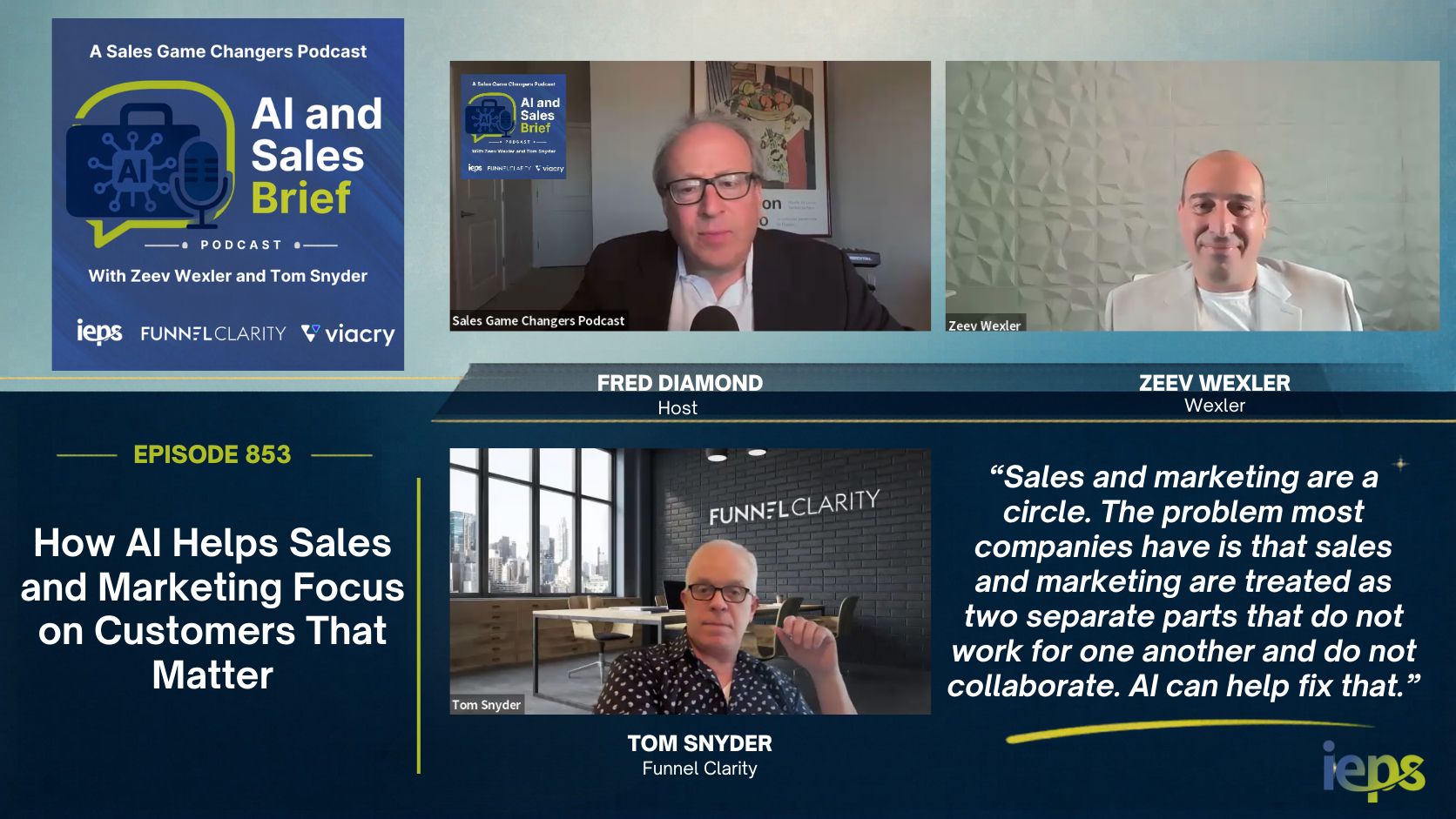
This is the fifth episode of AI and Sales Brief, a new sub-brand of the Sales Game Changers Podcast.
Watch the video of this podcast on YouTube here.
The Sales Game Changers Podcast was recognized by YesWare as the top sales podcast. Read the announcement here.
FeedSpot named the Sales Game Changers Podcast at a top 20 Sales Podcast and top 8 Sales Leadership Podcast!
Subscribe to the Sales Game Changers Podcast now on Apple Podcasts!
Purchase Fred Diamond’s best-sellers Love, Hope, Lyme: What Family Members, Partners, and Friends Who Love a Chronic Lyme Survivor Need to Know and Insights for Sales Game Changers now!
Today’s show featured an interview with AI expert Zeev Wexler, CEO at Wexler, and sales expert Tom Snyder, Founder of Funnel Clarity.
Find Zeev on LinkedIn. Find Tom on LinkedIn.
ZEEV’S TIP: “Sales and marketing are a circle. The problem most companies have is that sales and marketing are treated as two separate parts that do not work for one another and do not collaborate. AI can help fix that.”
TOM’S TIP: “This is the peace treaty of all time. Both objectives, marketing and sales, can be served, and everybody can get what they want. Instead of arguing about leads, both teams can align around understanding what prospects need to fix, accomplish, or avoid.”
THE PODCAST BEGINS HERE
Fred Diamond: I am joined by my good friends Tom Snyder with Funnel Clarity and AI for sales expert Zeev Wexler. I believe this is the fifth show we have done. Every Monday morning, we tackle a sales challenge, and it has been exciting to see people beginning to listen to and utilize the advice we are sharing.
Here is the challenge we are going to tackle today. It is a historic challenge in B2B and B2G sales. Much has been written about the eternal divide between sales and marketing, and we talk about this frequently at the Institute for Effective Professional Selling. Does weaving together sales science and AI do anything to finally answer and solve this conundrum? Tom, get us started.
Tom Snyder: I want to talk about the problem and give more time to Zeev on this one. The struggle you always hear in B2B and B2G companies is that salespeople believe marketing does not produce enough valuable resources or leads, while marketing believes it produces an enormous amount of valuable material and leads that salespeople do not use. What is wrong there? The thing they are suffering from is the lack of a natural intersection. That natural intersection is understanding the orientation of the total addressable market around something prospects need to fix, accomplish, or avoid. There are obviously various viewpoints on that at any given moment.
Producing a lead just because you have a phone number and a name is not adequate for a salesperson. If you can align marketing around the idea of finding people who are either suffering from a problem they need to solve but do not yet recognize that the time is right, or finding people who are looking for that solution right now, I will celebrate marketing all day long.
You can still deliver the brand promise. You can still do the other things marketing needs to do. But this is what sales needs. The problem is that, for a salesperson to do that on their own, it is arduous. You have to search all kinds of resources, identify clues and triggers, and most salespeople are not trained to do it. It is also not something they typically find rewarding. They want leads.
That is where the conflict begins. What I have learned from Zeev is that this is the peace treaty of all time. Both objectives, marketing and sales, can be served, and everybody can get what they want. Zeev, please take it away.
Zeev Wexler: I love both sales and marketing, but I think sales and marketing are a circle. The problem most companies have is that sales and marketing are treated as two separate parts that do not work for one another and do not collaborate.
There are a few solutions. The first and easiest one addresses a problem I have heard from many companies with sales teams: marketing is producing leads, but sales does not believe they are the right leads and does not want to waste time on them. Then, habitually, sales leaves those leads alone.
If those leads are more top-of-funnel or not yet ready, AI can help figure that out and determine which leads should go to sales. It can also explain, ‘This is why this is a good lead for you.’ The number of leads may go down, but the quality of those leads goes up. Now sales can build a habit of looking at them.
In addition, you can use the data that AI collects from sales and bring it back into marketing. Now it is not just anecdotal. It is not simply, ‘This salesperson said something, but I do not like him,’ or ‘I believe something else.’ Now it is facts.
Now you can say, ‘This is the data that shows what our clients say when they buy and when they do not buy. Let us use that in our marketing. Let us take that data and turn it into something the actual buyer wants to hear.’ Then the salesperson knows, ‘If this person said yes to this, they are interested.’ It is no longer just a phone number and an email collected through an email marketing campaign.
In those two ways, you can do so much. Again, at the end of the day, I am a humans guy. AI is great, but this is about habits. We habitually do not trust one another in sales and marketing, and AI can help fix that.
AI can take the burden of evaluating weaker leads and funneling them into better leads. It can also take data from sales and give it to marketing so marketing can produce better campaigns and better messaging. Tom, I would love to hear your thoughts on this, but this solves so many problems by using data that was simply hard to use before.
Tom Snyder: I genuinely get so excited when we talk about these things. To make it quick and simple, at any given moment, a snapshot in time on any given day, five different studies by five different companies have come to the same conclusion: 3% of your total addressable market is looking for your solution, or something like it, at that moment.
Another 56.5% of the total addressable market is completely satisfied with the solution they have. Whether they should be satisfied is another argument. The remaining 40.5% of the market is frustrated by something you can solve, but they are not yet looking.
Imagine if you could give sellers the 3% and the 40.5%, along with information about how to approach each group differently, and then put the 56.5% into brand marketing. And imagine if you knew you were doing it right. That is what Zeev and AI can do. It is unbelievable.
Zeev Wexler: Absolutely. It is not 100% right off the bat, but once you start doing it, it gets better and better. The more you use it and the more data you have, the better the AI becomes and the better everyone gets at identifying the 3%, the 40.5%, and the 56.5%.
You can determine which people should receive brand marketing so you remain in their minds, and which people salespeople really need to work with and why.
Tom Snyder: I would submit that, from day one, even before it learns a lot, it is better than what is happening now. From day one, it is better, and it just gets better from there.
Fred Diamond: Absolutely. On the sales side, we often say things like, ‘Marketing is not giving us the right leads, the right events, or the right opportunities.’ One of the historic problems is that marketing often does not know. There are many smart people in marketing, but they may know market trends or what the industry looks like, not necessarily what is happening at the customer level.
They may not know where customers are going, where they need to go, or how they need information to be communicated to them. Utilizing a solution like this can solve a lot of problems by getting the right information to sales professionals so they can communicate more effectively with customers.
Tom Snyder: Exactly. The exact numbers are not the most important point. The three unequal segments of the total addressable market are what really matter.
Zeev Wexler: Think about a sales force with 200 people, where each person has three prospect calls every week. That is 600 calls a week that AI can analyze. Over a couple of months, you are talking about thousands of calls that can produce actual data for marketers, who love data. Now you can create much better marketing that is specific to what the sales organization is trying to achieve.
Fred Diamond: Tom, one of the things we are most excited about at the Institute for Effective Professional Selling is our Selling Essentials Marketplace. We have hand-selected about a dozen companies, including Funnel Clarity and Wexler. You both have come together to bring a great solution to the market that solves many of these problems by combining AI, sales performance excellence strategies, Zeev’s AI expertise, and your sales performance expertise. Tell us a little bit about that offering.
Tom Snyder: I have been in the sales performance improvement industry for more than 30 years, and this is absolutely the most exciting major change I have seen. From my perspective, it may be the most significant change in 70 years, and I suspect we may still view it that way decades from now.
The business world has heard the phrase ‘sales best practice’ so many times that it has become trite. People have also heard that AI is the new tool so many times that they are scrambling to implement AI as quickly as possible.
If you think about those two ends of the spectrum, then ask: what if we really had scientific proof that a set of practices were true sales best practices? That is the sales magic. The label may be boring, but what if you really could separate wheat from chaff?
What if you could put together a corporate initiative that says, ‘Yes, everyone is scrambling to use AI, but in some cases, handing AI to teams without the right structure is like handing a sharp knife to a four-year-old. Let us not do ourselves harm.’
When you bring these two things together – the power of AI as a core corporate initiative and the reality that there is a science of sales – you create an accelerant that has never been seen at this magnitude before. I do not say that casually, and I do not believe it is hyperbolic. That is what this offering is about. At least give yourself a chance to talk to us about it.
Fred Diamond: Absolutely. Reach out to me, Fred Diamond, Tom Snyder, or Zeev Wexler.
Once again, this is the AI and Sales Brief Podcast. Every Monday morning, we tackle a sales challenge.