
This is a Women in Sales Leadership sub-brand of the Sales Game Changers Podcast.
Watch the video of this podcast on YouTube here.
The Sales Game Changers Podcast was recognized by YesWare as the top sales podcast. Read the announcement here.
FeedSpot named the Sales Game Changers Podcast at a top 20 Sales Podcast and top 8 Sales Leadership Podcast!
Subscribe to the Sales Game Changers Podcast now on Apple Podcasts!
Purchase Fred Diamond’s best-sellers Love, Hope, Lyme: What Family Members, Partners, and Friends Who Love a Chronic Lyme Survivor Need to Know and Insights for Sales Game Changers now!
Find Elisabeth on LinkedIn.
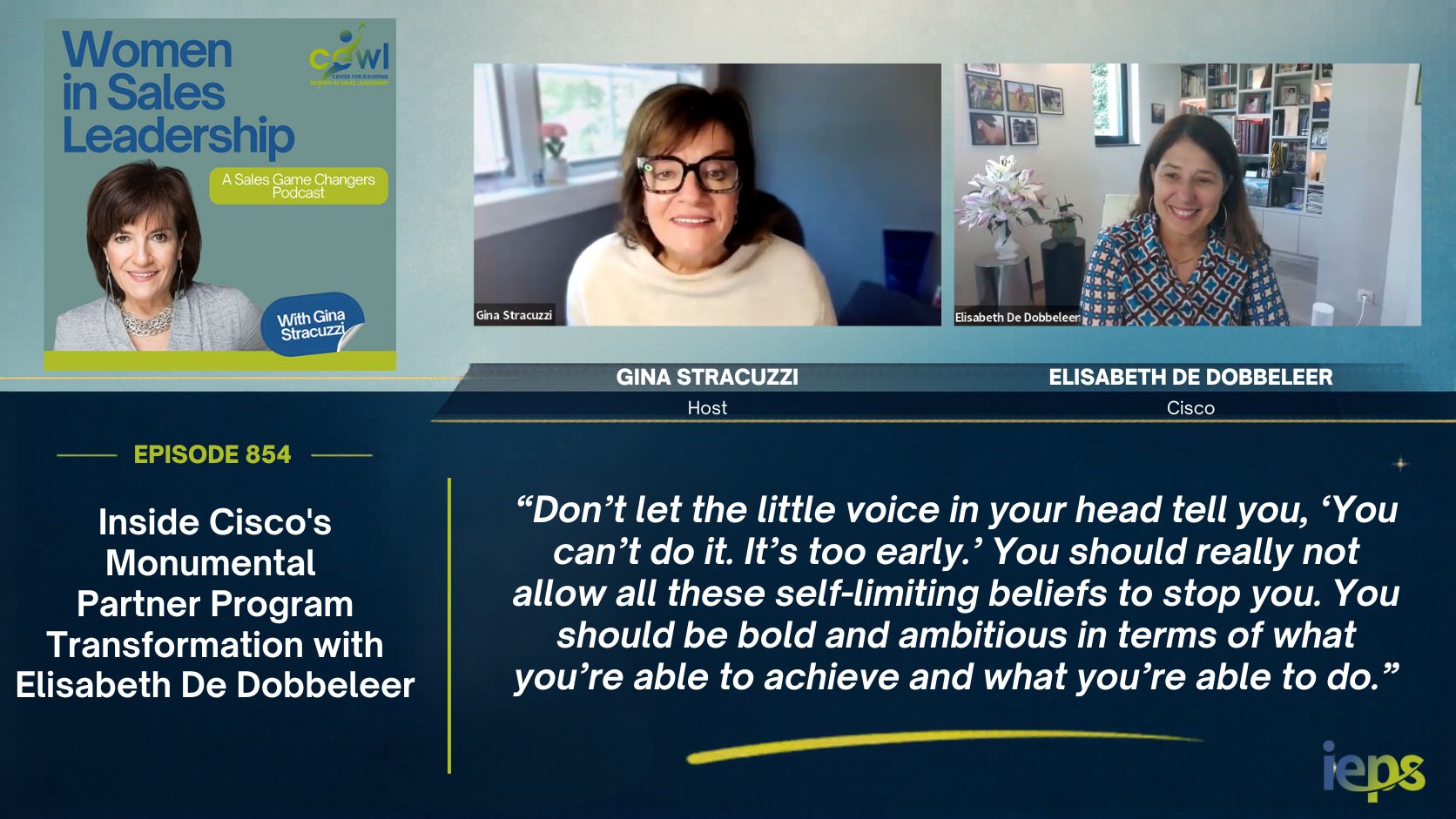
ELISABETH’S TIP: “Don’t let the little voice in your head tell you, ‘You can’t do it. It’s too early.’ You should really not allow all these self-limiting beliefs to stop you. You should be bold and ambitious in terms of what you’re able to achieve and what you’re able to do.”
THE PODCAST BEGINS HERE
Gina Stracuzzi: Hello everyone and welcome to the latest installment of the Women in Sales segment of the Sales Game Changers Podcast. I am really excited to have my guest today, Elisabeth De Dobbeleer, all the way from Belgium. She is the senior vice president of Cisco Partner Program. It’s taken Elisabeth and I a little bit of time to get this all together. Welcome, Elisabeth.
Tell me a little bit about yourself, and the audience, how you got to where you are today and a little bit about your career journey, and then we’ll go from there.
Elisabeth De Dobbeleer: You already mentioned a couple of things and maybe for those of you who can recognize accents or even family names, I live in Belgium and I was born in Belgium as well. I’m actually from what we call the Flemish part. I speak Flemish, which is the same as Dutch, which is the north of Belgium. I was born and raised here and then I went to study in the US, I went to study in Germany, etc. I’m actually a lawyer by education. I studied law and I started my career as a legal trainee in all kinds of commercial work, so I did a lot of negotiations.
Around the time just before Y2K, and I’m mentioning that because my career was very much shaped by those early years around, well, first the internet bubble bursting and then Y2K and all of that. I spent a lot of time in tech, in commercial law. From there I was contacted by a client who had just moved to Cisco and he asked me if I was willing to join as a company lawyer and join Cisco. That happened in 2000. I joined Cisco in 2000 as a sales lawyer, at the time working on legal negotiations in the Netherlands and Belgium.
Then I had multiple roles in the legal team until somebody asked me whether I wanted to join at the time channel operations because we saw the first fake products popping up in China. I was asked to join a team called Brand Protection, which was part of the channel organization at the time, to do something about that, which I did. That actually brought me to Hong Kong. I moved to Hong Kong. I spent a few years there working on a range of activities going from explaining to our customers and partners on how to recognize fake products, how to recognize genuine products, but also working with manufacturing to make sure we tighten up any scrap leakage procedures and all of that, so very different activities.
Then I missed the sales environment, and that’s actually a common theme. I think I’ve always really enjoyed working in sales and the adrenaline of trying to make numbers and working with customers and partners and the negotiation piece as well and the activity of selling. I applied for a role in Middle East and Africa, sales operations. It was a little bit crazy at the time. I just had my first child, I think he was probably one year old at the time, I was living in Hong Kong, and I applied for the role. I got the role.
I moved to Egypt as the sales operations leader for Middle East and Africa, which was really interesting because I did strategy and planning, sales operations, but we were also investing in offices across Africa. We were implementing Salesforce. We were defining growth strategies, etc. I learned a lot.
Then from there, I moved back to Hong Kong, back in the legal team, negotiating some huge contracts in the region. Then for personal reasons, I came back home. That’s now probably about 14 years ago. Then I had more legal roles, but this whole appetite for sales and working with the sales teams and with customers and partners always felt close. I volunteered for all kinds of projects as I was the head of legal in Europe, Middle East, and Africa, I was an executive sponsor for different customers across the region. I was in charge of competitive campaigns and all kinds of things.
One day, the regional channel sales role came up and I applied for it and I got the role. That was in March 2020, which you probably know by heart what happened that week. I went back into sales in an executive role, and in the same week that I was told I had the role, I was super happy, I think the next day we were told we were all in lockdown. I spent a year and a half in that role from this office. That was really interesting. From there, I joined a corporate transformation team and then back in the global partner sales. Then I led the transformation of the Partner Program over the last two years.
Now I’m part of the global partner sales organization in Cisco. Cisco is very partner-centric and partner-led. 90% of our business is sold through and with the ecosystem. I’m in charge of the entire value proposition of us as a vendor to the ecosystem. Most of my career with one company, but different countries, different roles.
Gina Stracuzzi: That’s very exciting. You seem to have made a lot of the right decisions. I always love hearing women talking about they basically raised their hand for different opportunities or committees or whatever the case is to really get themselves out there, which is something we talk about a lot in the Women in Sales Leadership Forum that I run, because it’s so critical to your career goals to do that, and look at all the places that took you. That’s fabulous.
Elisabeth De Dobbeleer: I always say it’s the advantage of growing older, that you can actually look back and there’s still some lessons learned and understand better why you did what you did, or didn’t do what you didn’t do. But when I look back, I think a common theme is that I am someone who enjoys change, I’m quite adventurous as well. Obviously, more adventure when I was younger than as my kids were there and then they grew older and all of that. But I think this motto of, yes, you can, is really important.
Very early on when I was asked to join that Brand Protection team, I was so nervous because I was trained as a lawyer, I worked like a lawyer. It was my education and my identity, let’s say. I was asked to join that other team and I was very nervous. I asked an executive that I admired at the time, and he said, “Well, at this age,” but in the broad sense, he said, “It’s all about learning and getting more experience.” He said, “You should take as many jobs as you can, one year to learn, one year to deliver, and one year to move on.” Still today, that was excellent advice, because it’s true. You can’t really go wrong.
Even if you take on a new responsibility or a new role and six months later, you think, “Well, that’s not quite it,” which happened to me, I went back to legal and then I missed sales. Still, it’s all experience. You can’t really make any mistakes. If you have that mindset, it’s all one big journey and growing and experience. To my point, the beautiful thing about growing older is that you get to know yourself better and better. You get to know your strengths and typically what you’re good at is what you enjoy most. What you enjoy most is what you typically get better at. The more you get to know yourself, then the more deliberate you can become in picking and choosing the right roles for you. Of course, the more senior you become, the better that is. I think that’s a really important theme.
Gina Stracuzzi: I really like to coach women to think about lateral moves as well, because when you learn as much as you can about the business, one, it opens your eyes to the unlimited possibilities, perhaps right in your own company. But it just makes you a more well-rounded leader in the end. It can be scary, especially if you’re already taking time off for maternity leave or helping elderly parents or something. Then you think, like, “Ooh, this is just lateral. There’s not an increase in title.” But I think your point is just keep raising your hand. Anytime you’re learning, you’re growing.
Elisabeth De Dobbeleer: I’m a very firm believer. My team and I, we just let this huge transformation of Cisco’s Partner Program, the biggest change in the last 20 years. I think there are multiple reasons, but one of the reasons I was able to do that is precisely because I had such a broad experience, operational, strategic sales, legal finance, compliance, everything really. All of that together meant that I knew a lot, and I had a huge network, so to learn something that was so impacting across the enterprise.
Gina Stracuzzi: That’s great advice. That’s a key word too, the network. Your network inside of your company and outside your company in the industry are so critical to career growth. You hit on all points without me even coaching you. What are some of the lessons you’ve learned along the way in all of those really pivotal roles for your career?
Elisabeth De Dobbeleer: There’s a couple. I think the first is the one we already said. I think don’t be shy, lean in, don’t let the little voice in your head tell you, “You can’t do it. It’s too early.” We have a tendency to be, “I first have to study all these things. Then I have to try all of those. Then I have to prove all of that as well. Then maybe five years from now, I’ll be ready.” You should really not allow all these self-limiting beliefs to stop you. I’m not saying that you should be arrogant, of course, not. But I do think you should be bold and ambitious in terms of what you’re able to achieve and what you’re able to do.
I am convinced that you can apply yourself to anything really. That’s the next lesson. You need to always be open to learning. People often tell me, “Well, how is it possible that as a lawyer, you managed to now be a leader in a global partner sales organization?” Then I always say, “Well, it’s not like I woke up yesterday morning and I said, ‘Let me now go and do global partner sales.’” Obviously, all along the time that I was a lawyer, I was always very curious and interested in the business. I always volunteered for things in the business. I was always very close to my colleagues in the business. It’s not like I made some kind of day and night switch or I suddenly came up with this idea. It was a journey where I’ve always been considered as a lawyer who was extremely curious and interested and engaged in the business.
When I said, “Well, I would like to move into the business,” all the people said, “That makes a lot of sense.” I think being open, being humble, always willing to learn. I would argue, I used to say this years ago, but even more now, the world is changing fast. It will only go faster. We should all just accept that, the role of AI, all these things. That’s something else one of my mentors said years ago. At the time, I was going to work on marketplace and cloud and all of that. I said, “Well, I don’t really know much about cloud or marketplace.” He said, “I didn’t hire you because you know a lot about marketplace and cloud.” He said, “I hired you because of your character.” Meaning it’s not about everything you know, because everything you know by tomorrow is outdated, or after tomorrow, it’s not anymore about that. Plus, knowing things, you can catch up, you can learn, you can study, you can teach yourself, train yourself. But it’s about this ability to adapt, this ability to be very open minded, to be humble enough that, “Gina, what you just said, I don’t quite understand. Can you explain it to me?”
I see a lot of people are, especially at senior levels, people may take on new roles. Then they are, I think it’s probably misplaced, they think that saying, “I’m sorry, I didn’t understand what you just said. Can you explain that to me?” it shows weakness, but it’s not. Showing vulnerability and an appetite to learn, first of all, it will get you to understanding and knowing very fast. Second, it makes you more human as well. I think that’s really critical also.
Gina Stracuzzi: Honestly, you’re saying everything I want women to know and to hear. We’re naturally curious by nature, I would say, and yet, and this is what I see, the higher women go, the less likely they are to say, “Wait a minute, I don’t quite understand that,” as if they’re supposed to have all of that knowledge walking in. To your point about the gentleman who didn’t hire you for knowledge, he hired you because of who you are. You’re naturally curious and you don’t mind saying, “Wait a minute, I don’t quite understand that.”
When you do that, it also shows the people that work for you that they can say it too, like, “I don’t understand this,” or, “This is new to me. Can you explain more?” That is such a brilliant thing because it allows everyone to feel that and it gives you the opportunity to grow. I could use you all the time in the forum, come in and talk.
Elisabeth De Dobbeleer: Again, talking about when we designed the new Partner Program, I made it a point, and this is how I lead as well. I’m picking up on something you said. I believe strongly in the wisdom of the crowd and I believe that the answer is always somewhere. Somebody knows the answer. It’s all about putting your ear to the ground and listening to it. If you create an environment where I can say, “I’m sorry, can you repeat? I didn’t quite understand what you meant.” You can call it the Socratic Method. We are doing a lot of that because there’s always something that somebody was thinking that then leads to something else that leads to a really, really great idea. If you didn’t do that or you don’t allow for that, you miss all these great ideas. I’m a very strong believer in that.
I’ve always said also, it’s not about, when I had managers doing these performance reviews and say, “You’re doing a great job.” I said, “Well, I’m not here to do a great job. I want to do an excellent job. I want to be the best lawyer you’ve ever had. I want to be the best Partner Program leader you’ve ever had.” I use the word excellence, I’m here to do something extraordinary, not to do something mediocre or something safe pair of hands and all that. I want to do something extraordinary. If you want to do something extraordinary, you need to go and look for the extraordinary ideas, and they’re always there.
You just have to allow people to say it, like, “Gina has something she’s been thinking about for years, but nobody ever listened,” and maybe her idea is like 60% there, but if she is allowed to express, then somebody can say, “Hey, but if you do this, Gina,” then we actually solve it. A lot of the things that we are doing in my team come from those kinds of discussions. Then people are starting to enjoy themselves because that’s a very natural human need. We all want to feel like we’re doing something useful and interesting and impactful. Then it adds fun and job satisfaction and then suddenly you have a highly-motivated team that is striving for excellence.
I’m also very focused on identity. I do it with my kids as well, like, this is who we are. We are the team that delivers excellence. We are the team that respects each other. We are the team that goes looking for these nuggets and these ideas, and people are picking up on that. I believe that’s how you can deliver extraordinary results.
Gina Stracuzzi: I love everything about that, Elisabeth. Even a few seconds earlier when you were talking, I was thinking that it’s very much like when you were in grade school and you were learning all these new things and everyone was just looking around, little kids like, “Oh my God, I don’t understand.” As soon as one person was brave enough to raise their hand and say, “I don’t get this,” then everybody was like, “I don’t get it either.” You open up the floodgates of thinking and understanding when you actually ask for clarification or more information. To your point, you can just extract some extraordinary thinking when people feel like, “Okay, this is a safe place. I can share what I don’t know and then add what I do know.” That brings you to extraordinary, I think. I love that.
Let’s switch gears a little bit, and let’s talk about what you see happening in the industry. Yes, AI is everywhere and now it’s how can sales teams really engage AI in a way that is a little bit uniform so everybody’s not going off in different directions using things differently, but really to advance what they’re doing and how they’re approaching sales. Certainly, I’m not telling you anything that you don’t know, the customer is a different animal today. They’re much more educated. They don’t need you to come in with a glossy PowerPoint and try to tell them what they need. They know what they need and they have lots of ways to get it. How are you working with these changes and how are you guiding your team?
Elisabeth De Dobbeleer: An excellent and a pretty philosophical and strategic question also. There’s a couple of things. First of all, the basic human value of if you want to deliver something that the customer needs, you have to listen. The basic human principle is still very much standing. Again, I’m not so much selling to customers than I’m selling to partners. That very basic first thing about what does the ecosystem need? What can I drive as a value proposition that is compelling, differentiated, and driving their preference for Cisco? That’s still putting your ear to the ground. Again, that’s why we did co-design. I think that still very much stands and we have to keep doing that.
I think AI, it’s a lot about agility and being able to keep up, and being able to keep up is not so easy. People sometimes feel overwhelmed. You will probably quickly see that I’m very much of a people person, so maybe that’s why I’m coming at it from that angle. But I think with AI as well, we do a lot of things in my organization, just listening to each other on what people are doing in terms of best practice and how they’re using it and how it’s making their work better, their relationship with the partner better, etc. We are doing a lot of that, like sharing and exchanging best practices and learning from each other, which is back to my earlier point about having an open mind, being humble, and constantly learning and being open to learning new things and discovering new things and keeping up, because that’s important. But this very basic human need of delivering what the customer needs and assumes understanding it, and in order to understand it, you always still have to listen, being prepared, listening, and all of that. That still all stands, I think.
Gina Stracuzzi: Yes, and I really believe that that is true. It goes back to being curious. Customers need that. It is a little harder sometimes to get in front of them. It’s something that we hear quite a bit at the IEPS, that the industry is changing and not all sellers really know how to keep up. But I think your point is well taken, that when you just imagine that the humanity of it all is pulled out of the equation, and now we just have to machine to machine, that’s not it at all. It’s really, as overwhelmed as we might be, they are too. You have to come at us with that humanity.
Elisabeth De Dobbeleer: Yeah, I think so too. That basic principle about let me understand where you’re coming from and what you are worried about, that still stands. Back to the point, Gina, if you’re talking to a CIO who is worried about Mythos and who is worried about AI and who’s not keeping up, and who has to maintain the same budget year over year, and who has their CEO asking about what are we doing about this and what are we doing about that? Then you have to be understanding on, how can I help this person be more successful? Then from there, everything else will follow. I think that very basic principle is still very much there.
Gina Stracuzzi: Yes, I think so too. It’s interesting listening to different sales teams, how they’re trying to incorporate all this new rapidly-changing technology and feel like they can talk about it in a very educated way, which is I think where part of the problem is. Even some customers don’t necessarily know what they want and what they need. Staying curious, asking questions, and bringing that in I think is a great approach. Hopefully it will still give us all lots of opportunities for growth, which I think are there, and to your point, keep learning. Keep learning is really critical.
Let’s just tweak that a little bit. I don’t know in Europe, you work for an American company, but do you see a lot of the same things happening in the European market as you do the US market in terms of how sales is changing and what it takes to keep up?
Elisabeth De Dobbeleer: Yes and no, because the world is becoming smaller every day, I think. A lot of themes, especially in the technology sector, then it’s a small world, even if it’s a big world. I think in that sense, a lot of trending and the themes are very similar. I do think that in Europe in particular, and you could argue to some degree, APJC as well, the geopolitical piece around the concept of sovereignty and digital sovereignty, and in Europe, for example, there’s a lot of thinking about how can we create more technology independence. There’s a lot of investment going into promoting European homegrown technology. That’s a topic that is very prominent here.
Cisco, as a US HQ’d, company has to think about that. We have launched a series of critical sovereign infrastructure solutions, specifically for customers that are sensitive to think about national security, defense, government, and all of that. But on-prem solutions, solutions with special legal privilege and protection to allow that protection and that national sovereignty type of concern. That’s a typical topic that is different from the US and outside the US. That is super interesting also, because again, from a philosophical point of view, as the world becomes smaller and smaller and more and more interdependent, there is also this emerging, I want to protect inside my borders.
It’s just a very interesting balancing act, because we are absolutely in favor of open technology, open internet and all of that. We can all benefit from ongoing technology developments, but at the same time, there are these concerns from national governments or European institutions to have that right balance in terms of technology developments.
Gina Stracuzzi: I just was listening to a really fascinating talk on how keeping the security of things now is so vastly different than it was even a year ago.
Elisabeth De Dobbeleer: Even three months ago.
Gina Stracuzzi: Yes, even three months ago. To me, it is quite amazing and quite exciting and a little terrifying too. I think we all have our work cut out for us. Well, this has been a fabulous conversation, Elisabeth, and I’m sorry it’s coming close to an end. One thing that we really like to do on our shows is ask our guests for one final piece of advice, something that sellers can put into place to advance their careers or perfect their selling game, shall we say, that they can start today on. What do you have for us? Any thoughts?
Elisabeth De Dobbeleer: I love talking about being fearless or fear less. I think we are often self-limiting because we have the little voice or we are afraid of things going wrong, or we are afraid to being fully ourselves, or we’re afraid to proposing things, or we’re afraid to raise things. I think it’s really important to be fearless or just fear less. I think that’s really important because if you think about it, you should live your life to the fullest extent. Maybe in private life, that’s more difficult or more scary, but at least in your professional life, you should. I think that’s really important, especially in today’s environment. We live in such exciting special times. I think don’t let fear stop you.
Gina Stracuzzi: I absolutely love that. As one guest I had on a while back said, what’s the worst that could happen? I think that’s really a great way to think about it. Be fearless because what’s the worst that could happen? You make a mistake. It’s not the end of the world.
Elisabeth De Dobbeleer: No, no, no. I would say fearless in combination with humility, because that’s how you will be open-minded and grow and learn and always get better and better.
Gina Stracuzzi: Wonderful advice. Elisabeth De Dobbeleer, thank you so much for joining us. I look forward to hearing more from you in the future. Thank you everyone for tuning in. See you next time.
Transcribed by Mariana Badillo