
Watch the video of this podcast on YouTube here.
The Sales Game Changers Podcast was recognized by YesWare as the top sales podcast. Read the announcement here.
FeedSpot named the Sales Game Changers Podcast at a top 20 Sales Podcast and top 8 Sales Leadership Podcast!
Subscribe to the Sales Game Changers Podcast now on Apple Podcasts!
Purchase Fred Diamond’s best-sellers Love, Hope, Lyme: What Family Members, Partners, and Friends Who Love a Chronic Lyme Survivor Need to Know and Insights for Sales Game Changers now!
Today’s show featured an interview with Jared Shepard, Chief Operating Officer at Hypori.
Find Jared on LinkedIn.
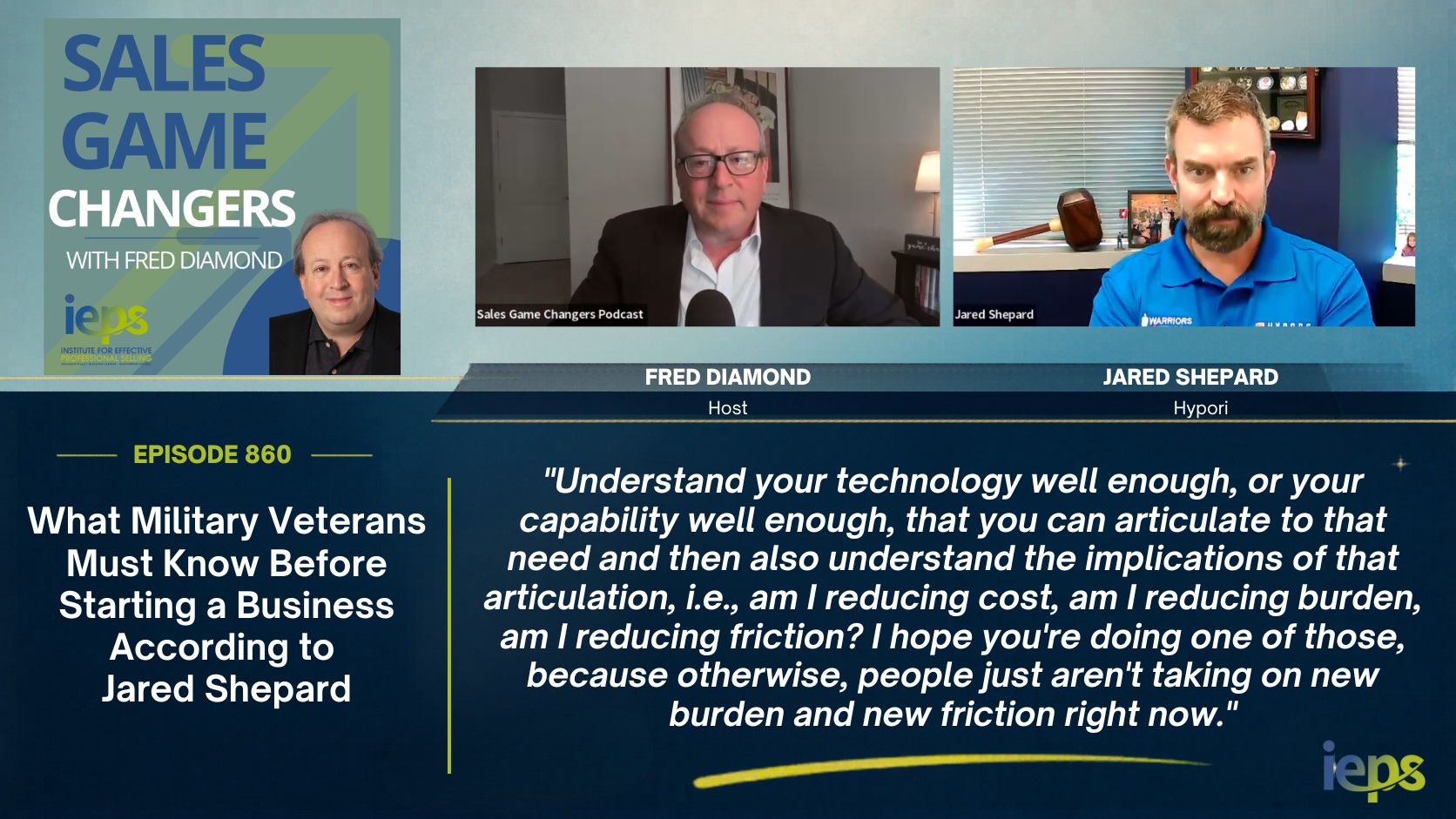
JARED’S TIP: “Understand your technology well enough, or your capability well enough, that you can articulate to that need and then also understand the implications of that articulation, i.e., am I reducing cost, am I reducing burden, am I reducing friction? I hope you’re doing one of those, because otherwise, people just aren’t taking on new burden and new friction right now.”
THE PODCAST BEGINS HERE
Fred Diamond: We’re doing a different interview today. I’m talking to Jared Shepard with a company called Hypori. We’re both members of the Northern Virginia Chamber. Many of our listeners know that I’m based in Northern Virginia. At the Institute for Effective Professional Selling, we work with a lot of companies that do B2G, business to government, selling to public sector, etc. Jared, I saw you on a panel that the Northern Virginia Chamber ran. I guess it was in May of 2026. We’re doing today’s interview in June of 2026. I was really impressed.
I was impressed by two things. One is your directness in participating in the panel. But I also liked how you started giving some advice for veterans that were looking to start businesses. For people that are listening to the show, again, I’m based in Northern Virginia. Government contracting obviously is a huge part of the economy. Former military veterans going into government contracting and related services to move from their military service into their commercial ventures.
You had some very, very specific things that you discussed on the panel and I said even though you’re not a VP of sales, I thought it would be interesting because a lot of the companies that service them sell things to the military, etc. That’s what we’re going to be talking about today. I think this is going to be a great show. I’m very excited. What I’ve learned about you and your company is quite remarkable. We’ll get deep into that.
We’re also going to get deep into your advice for veterans, for former military, what they should be thinking and doing as they make their move into commercial and starting businesses. Jared, it’s great to see you. Tell us a little bit about your military background and your journey into the business world. What does your company Hypori do and why did you create it?
Jared Shepard: That could go on for an hour by itself just because I’ve had a very atypical story. I usually answer that by saying I’m the atypical CEO. I was a high school dropout and homeless kid that joined the army to get off the streets. I largely self-created. I was a knucklehead when I was young. The military ended up giving me the principles. I don’t by accident have a nonprofit called Warriors Ethos. It gave me the ethos or the moral compass that I really needed to build my future. It taught me leadership. It taught me accountability. It taught me the importance of impact and mission, which then later led to me starting my first company almost 20 years ago to the month.
Now my second company, I joke, when you said I’m not a VP of sales, I feel like I am because I am the best sales guy in the company. At least I feel that’s my responsibility as the CEO, is always to be the best sales guy in the company. I always look forward to having a great VP of sales that I can learn from.
My military background, I originally was an infantry guy. I served for a little while as a sniper. I got to do some cool stuff. Ultimately, ended up deciding to reenlist and become an IT guy, in part because it was during the late ‘90s and I didn’t like Fort Hood, Texas at the time. I reenlisted into IT to get away from Fort Hood, and God had a sense of humor and sent me back to Fort Hood as an IT guy. But it ended up being a great experience for me because I got to work for a three-star general on September 11th of 2001, and being told to work for a three-star general in September 11th, 2001. I was a strap hanger that got to sit in the corner of a room and listen to people like Condoleezza Rice, or Chad Edwards, or Newt Gingrich talk about how the country was going to respond to September 11th.
I realized, coming from a guy that still had a GED and didn’t have a perspective on the world, that, man, the world is way bigger than I thought it was and I could have potentially a much larger impact. I made the decision to get out of the military because I felt that I could more quickly and more effectively have the impact that I wanted to have.
Fred Diamond: That must have been some pretty heady stuff being in the room with some of those people at that time. I’ve interviewed a couple of people over the course of the Sales Game Changers Podcast who were very involved with the response. Obviously, there was a lot of communications companies. One of the things we learned is companies had to come together better to get communications more unified, etc. That may be a separate show that we’ll do some time down the road.
Along the way, you also founded Intelligent Waves and Warriors Ethos. Tell us a little bit about that and how did that come together with your creation of Hypori?
Jared Shepard: Hypori was actually the third of the creations. I started out with Intelligent Waves. I was working as a civilian advisor for a guy named General Ray Odierno and a gentleman named General Joe Anderson, and they asked me to step in and help build a new military organization called JIDO, the Joint IED Defeat Organization. Along the way, I had a bunch of great mentors who were like, “Hey, you should start your own company.” This is after I had already deployed once with the III Armored Corps in the beginning of the Iraq War as a lead technical planner, and I decided to start to wear my own t-shirt, as I told General Anderson at the time.
General Odierno puts his maw of a hand, he was this giant human being, soft-spoken, very intelligent, but giant human being, puts his maw of a hand on my shoulder and says, “Jared, this is the American dream, to have come where you’ve come from, to have served your country, and now have a chance to start your own company.” He’s like, “I’ll tell General Meigs I support it.” That was the birth of Intelligent Waves and it was also the beginning of me becoming the J6 for JIDO, and a tremendous amount of great experiences and great mentorships and great leadership examples that I was a witness to and got to participate in after that. That would be 20 years ago next month, I think.
Along the way, spent almost three, four years in deployed environments, Iraq, Afghanistan, Kuwait, Qatar, Yemen, Somalia, etc. In the first few months of my first deployment with General Odierno, he gave a speech to his leaders that caused me to have a bit of an epiphany. That epiphany was the idea of the ultimate sacrifice. As we all learn in school, the ultimate sacrifice is when you die for your country. But what I realized was, that’s a little bit of bullshit. I don’t mean it as in that’s not the ultimate sacrifice. It is. Unequivocally, it’s a sacrifice that the country can never repay and there’s nothing that we can ever do to give back to the family who’s lost a member of their family for something greater. But the ultimate sacrifice could also be bigger than that.
It could be losing a limb for your country. It could be being injured for your country. It could be watching one of your friends die next to you for your country. It could be just spending time away from your children as they grow for your country, for something bigger than you, for the idea of freedom, for the idea of what we represent, what our democracy represents. I think those are all forms of the ultimate sacrifice. When I had that epiphany, and this is back when it was me and one employee, and I decided, “If this Intelligent Waves thing becomes a real thing, I’m going to have to find a way to give back.”
It started out with, I think 18 months later, I wrote my first check to the Wounded Warrior Project, same way almost everybody else was giving back back then. General Odierno actually came in and flew in and presented it to them on my behalf, which was a great blessing and privilege. I think we wrote a $134,000 check to the Wounded Warrior Project at the time, which was big for a little company, but we did that for a few years. Then I ultimately separated ways with the Wounded Warrior Project and met a young man who was a wounded special operations communications guy.
I realized that I had developed this mantra in interacting with wounded soldiers, and that mantra was, what’s next? What do you do next? Like, okay, yes, you were injured, but your life isn’t over. What are you going to do next? That fundamentally became the basis for what Warriors Ethos became, which is, what’s next? We started out purely helping and servicing wounded soldiers, and this was 12 years ago, wounded soldiers, which there was a plethora of, unfortunately, at the time. But as we grew and evolved, we really found that anybody who served, especially those who had served 20 plus years, they need help figuring out what’s next. Because you become so fundamentally institutionalized with the military and the way that the military functions, learning how to then adapt, it’s not implied. It’s something that has to be learned of Warriors Ethos.
Then along the way, I was asked to solve a really hard technical problem to allow people to communicate in most of the disparate environments under disparate challenges. Fundamentally, that became what is now Hypori, which is the company that I run now, because we’ve essentially been able to solve the idea that you could use an edge device, a phone or a tablet, to communicate with the security enterprise with no data in transit and no data at rest. Subsequently, we assume that your phone is already compromised, and the advantage of that is that means you keep your privacy. We can allow you to interact with an enterprise and you get to keep your privacy. Enterprise doesn’t take risk and you don’t take risk. Everybody wins. That’s when I realized what Hypori was going to be.
I hired a CEO to run Intelligent Waves for me. I spun Hypori out of Intelligent Waves. Intelligent Waves is still running around today, doing great. Now I run Hypori. That’s my legacy of where I’ve been and where I am.
Fred Diamond: First off, my apologies for not saying thank you for your service prior to this. Thank you for your service.
Jared Shepard: I tell people all the time, it’s always an uncomfortable thing to hear sometimes when you say, thank you for your service. The reason for it is because I got way more out of my service than the service probably got out of me. I learned so much from the Army. The Army is so much of what I was that the best thing I can tell you is, no, thank you. Thank you for my ability to serve.
Fred Diamond: That’s great. We could have an offline conversation about that because living in the Northern Virginia area as long as I have, and having met so many veterans who have given the sacrifice that you talked about, it truly is genuine. We talked prior to the show about some of the companies that I’m involved with, and many of the people we’ve dealt with have come from service.
I want to get right to some of the heart of the conversation here. Again, you were on the panel and you were talking about misconceptions that veterans have when they are going into commercial business, which could be government contracting or technology, whatever it might be, professional services. What’s the biggest misconception military veterans have about starting a government contracting or any other type of commercial business?
Jared Shepard: If you’re talking about entrepreneurship and them starting their own business, one is, I tell them never to do it when they first come out of the military, in part because when you’re getting out of the military, you probably have every skill set necessary to be successful in business, except for the single most important skill set, which is a fundamental understanding of money. The military by design doesn’t teach money. Nobody gets laid off if they don’t make numbers. Nobody doesn’t get bonuses. The military, they want you focused on mission and people. Money is never one of those things that, whether you’re an officer or enlisted, it doesn’t matter, it’s not a serious consideration for your day-to-day life inside of the military. You have to learn that when you’re getting out and running a business is the antithesis of taking risk and applying all of your time to produce an outcome, which is generally measured in money, and how could you do that without a knowledge of how that works.
I always advise veterans, if you’re getting out of the military and you have that entrepreneurial spirit, great. Go work for somebody else for the first year or two. Go learn on their dime and on their risk before you make that decision to do it for yourself.
Fred Diamond: That’s a great point. There are so many aspects of the business. You just alluded to the fact that you as a CEO are essentially the VP of sales. We talk about this a lot. The entrepreneur is responsible almost invariably for could be years, may even be a decade worth of business. Then as the company grows, they need to figure out how to leverage their ability, bring in other professionals to focus on that. There are so many aspects.
What are some of the advantages that veterans bring to the federal public sector marketplace that many non-veteran entrepreneurs don’t have?
Jared Shepard: I think it’s their ability to triage and prioritize. Having an operational understanding, a lot of people, when you ask, what’s the best skill set a veteran has getting out of the military? A lot of people will go, leadership. The military teaches leadership wholesale, and they do, but what else they teach that you don’t hear people talk about a lot is followership. When I say followership, I mean the military’s integrated necessity of learning how to make the people that are your peers, the people below you, and the people above you successful. The military lives off of that.
You got to make your boss successful. You got to be able to do your boss’s job. You got to be able to do the guy two steps below you’s job. You got to be able to help make the person to your left and your right successful. Corporate America thrives off of people who are successful with that. Military may not necessarily have all the technical skills necessary for success outside of the military. They definitely have the operational understanding and the ability to navigate an organizational structure.
Fred Diamond: You alluded to this a second ago, but if a veteran came to you today, maybe they saw you on a panel or you get referred, whatever, because you’ve had your success, and they say, “Jared Shepard, I want to start a GovCon business,” what would be some of the questions you would ask them to find out, are they suitable to be successful?
One thing that you talked about on the panel was coming out of service, most of them have the mission. A lot of the VPs of public sector sales that I’ve interviewed, one of the questions I ask them is, why have you been committed to the B2G marketplace, business to government? It almost always comes down to mission, if they’re selling to military, if they’re selling to intelligence organizations, or medical organizations, health care, whatever it might be. What might be some questions you would ask them to get to the heart of why they want to do this?
Jared Shepard: One of the big ones is it depends on where they’re at in their stage of life. I always tell people, what do you think it costs to start your own business? Most people always think it has a dollar value associated to it. Ironically, it doesn’t. It costs time and risk. If you’re retiring after 20 years, you’re in your late 40s, you have a 13-year-old, a 12-year-old, and a 6-year-old at home. Can you really give 100% of risk and 100% of time to be successful in an entrepreneurship journey?
When I started mine, I wasn’t a parent, I didn’t have kids. There’s no way I could do it today with young kids at home and give to my company the amount of time and effort and risk that was necessary to start my first company to be successful. A lot of that had to do with the risk goes up when you don’t have experience. If you’re just out of the military, and you don’t have experience running business because you’ve never done it with anybody else, then your risk profile is even higher.
I would ask about your risk profile. I would ask about, who’s at home, who’s depending on you? How much risk can you take? How much time can you commit? How much flexibility do you have? Then the number one thing I always ask is, how are you going to differentiate yourself? It has to be simply more than ambition. It has to be something that you’re going to do that you can say, I can do this thing better than anybody else out there.
Fred Diamond: I agree with you, that they go work somewhere. How hard is it for a former military person, a veteran, to find an opportunity to join a company to learn? Are there many places? Do they know about the places they can go? Obviously, there’s websites with companies run by military. Is it easy to find a job if you have those ambitions?
Jared Shepard: I don’t think anything is ever easy. The most important thing to do when you’re transitioning out of the military is to be receptive to mentorship. That means when you get out, whether you’re getting out as an E-6 or an O-6, as a colonel, you have to realize that when you’re getting out, whatever company you go to work for, everybody in that company has more experience than you do now in business. In some ways, it’s a reset. You have to be receptive to, regardless of what rank you’re taking off when you’re getting out of the military, that, Joe, that former sergeant in the Army, who’s been out for 10 years now and is now a vice president of services or a vice president of marketing, he knows a crap ton more than you do. You better not come to him and tell him how things work. You better come and ask him how things work and figure out how that fits.
The way I tell guys is like, look, when you make the decision to get out of the military, you made that decision because you hit some glass ceiling, whether you just didn’t get promoted anymore, or you chose that you served long enough, or that you wanted to do something different, or your family needed something different, whatever it happened to be. You hit some kind of obstacle that made the decision that you’re not staying in the military any longer. When you get out of the military, sometimes you have to take a step back to get out of under that ceiling to then get to a place where there’s no ceiling again, or where the ceiling is much higher.
That is the step of getting out of the military, is you sometimes have to take a step back. Especially senior leaders, E-9s, O-6s, etc., telling them like, “Look, don’t put you are the COO of an organization, or the CEO of an organization on your resume,” because to be frank, it’s bullshit. You are no more the CEO of a company than I’ve ever been the captain of a ship. As a CEO of a company, I’ve never been in command of a brigade or the captain of a ship. Even though you were a brigade commander, you sure have never been the CEO of a company either. Be honest with yourself about that. Be receptive to talking to people who have and be prepared to learn from and get back to it.
Transitioning folks from military, ironically, the higher rank they are, the harder time they potentially have, because they have to unlearn some of the habits that they had for so long in the military to learn the new habits that are necessary for success.
Fred Diamond: Once they’ve made the decision, let’s say that they’ve made the decision, they’ve gone through the year, two or five, whatever it might be, and they decide, “You know what? I really do think that I, whoever I am, have the capabilities.” We’re talking about a small percentage of the veterans. First of all, to be a CEO and an entrepreneur, it’s something that is very unique. We interview business owners all the time. If you are fortunate enough to have some of the skills that you’re talking about here, Jared, you’ve grown to understand some of the things related to running a business, managing people, hiring the right people, teaming with the right people. Many veterans then focus on getting certifications, like Small Disadvantaged, if you will.
What do they need, or what’s been your experience, or what do you want to share about what they need to understand about going that route?
Jared Shepard: If you’re going to go into GovCon, that stuff matters. If you’re going to go into GovCon, go use every tool that’s available to you. Go get your 8(a), I don’t know if 8(a) is around anymore, but go get your HUBZone, your SDVOSB, anything that gets you to the door to get you an opportunity. Now that being said, I tell folks, especially 8(a) folks, don’t go get an 8(a) until you’ve built the past performance that you can actually use that, because it comes with a timeline, and that timeline expires.
I still am learning every day how to be a CEO, and I’ve been doing it for 20 years now. I routinely have been challenged by my board, by my other executives, etc., and I’ve had to learn to be a better person. You don’t have to know how to be a CEO to start your own company, but you should understand the risk and the time that’s involved. Then specifically, you hear about those things called an elevator speech, 30 seconds worth of how do you distinguish yourself from your peers? Can you honestly look at yourself in a mirror, and in 30 seconds, tell me how you’re going to distinguish yourself as a new company against your peers? If you can’t comfortably do that, I’d say go back to the drawing board until you can.
Fred Diamond: 20 years. A lot of guys and women have tried to start companies and many have failed, obviously. Most companies will fail at some point, let alone companies that we’re talking about here that are being run by veterans. What have you seen from your experience that separates the veteran-owned businesses that have successfully won contracts, created a truly successful company, from those that have struggled?
Jared Shepard: I’m blessed that I’ve had two different veteran-owned companies that have both been successful. I wish I could say it’s because of me, but maybe that’s the secret to success, is that it’s not about me. It’s about you have to constantly challenge yourself. You have to constantly try to bring smarter people into the room with you, people with more experience than you. I always say, never be the smartest guy in the room, because if you are, you’re the only one who walks out with nothing. Be humble enough that you know, even if you’re the CEO, it doesn’t mean you need to be the guy that knows the answer. You’re just the one coordinating the answer from people who you trust to achieve an outcome of some kind.
Understand that when you’re small especially, if you’re going to start your own company, you can’t do everything. You just simply can’t. There are so many small companies that try to say that they can, “Well, if I can’t do it, I could go hire somebody.” Yeah, so can Booz Allen Hamilton, and they can probably do it more effectively than you. How are you going to do one thing, or maybe a small set of things, very well, and distinguish yourself in that way and surround yourself with experts, define yourself by your ability to deliver it at a lower cost than a big integrator could, with a more effective or better set of skill sets than a big integrator could. Then now you’ve made a business argument as to how you could stand up and be successful.
Then last, the most important piece is, never get comfortable. Every time you win, you have to go back to the drawing board again and start over. A good friend and mentor of mine who became one of the youngest VPs in Booz Allen’s history, and then his twin brother is now the youngest partner in Booz Allen’s history, he told me two decades ago, “Jared, every day you’re not growing is a day you’re dying.” So many small businesses rely upon that SDVOSB status, or that 8(a) status, or this one contract award or this other contract award, and they sit back in their seat and they go, “Huh, I did it.” No, you didn’t. The golden rule of owning a business is it never gets easier. No matter what anybody says, it never gets easier. It just gets bigger. It gets more complex, but it just doesn’t get easier.
Fred Diamond: There’s constantly challenges. We’re doing today’s interview in June of 2026 and the federal government spent the last 18 months rethinking how they want to procure products and/or services. They’ve implemented a lot of things and AI coming in has also made a lot of shifts.
I’m going to ask you a question that just occurred to me. I’m just curious on your thoughts and don’t overthink this. If you could have done something differently in the last 20 years, and you’ve probably thought about this. I doubt that you’re the kind of guy who has a whole lot of regrets, but if there was something along the way that you wish you had done maybe, or you maybe should have done 10, 15, 20 years ago, what’s the first thing that comes to your mind, if anything?
Jared Shepard: Know your weaknesses and hire against them. My kryptonite had always been a CFO. Ultimately, somebody who truly understands money management. I am a charismatic leader. One of my mentors and my board members is a guy named Ray Lane. Ray Lane was one of the founders of Oracle, and then Larry Ellison built Oracle. He told me something that’s important for all of you who are listening to understand, he’s like, “Jared, don’t confuse inspirational leadership with good management,” because those two things are different.
You can be an inspirational leader, like I believe I am considered, but that doesn’t make you a good manager. That doesn’t mean you know how to make the trains run on time. If you’re not going to be that person, then you sure the hell better go hire that person and make sure that person is on your team. Same thing with money, same thing with operations, same thing with recruiting, same thing with HR. You have to know where the pain points are and you can’t just hope that they solve themselves. You’ve got to solve for them.
Fred Diamond: You mentioned Ray Lane, one of the founders of Oracle. You mentioned a couple of high-ranking generals that you had the privilege of working with. Would you recommend for the people listening that if they are starting, or maybe the first year or two, that they strive to get that level of people either on their board of advisors or board of directors? Ray Lane, that’s like hitting a home run type of a thing. I don’t know the history, we don’t have to go into the detail of how you got to them. We talked about somebody during the prep of today’s call who is an amazing leader who is great to have in your camp as well. Would you say that may not be the smartest thing to do in the beginning, but as you grow, I don’t want to put the answer into your mouth, but what are your thoughts on striving for that level of assistance?
Jared Shepard: I think one of the most important things to do to be successful is to be receptive to mentorship, period, and to seek the appropriate level of mentorship for the level that you’re operating at at that time. When you’re starting a brand new company, going and getting a Ray Lane or whoever the business magnet is, is probably not the right guy, because they’re just simply not going to give you advice on how to start your first company and how to get your first contract. They’re going to talk to you about how to build a billion-dollar organization, but you have to have that in your toolbox already.
Going and hiring a four-star, I’ve hired a bunch of them. I’ve had a bunch of great four-star advisors, etc. That’s great if you’re operating at the four-star level, but if you’re starting your own company, you probably aren’t. Go find somebody who built a $30 million company, a $40 million company, a $50 billion company, who then may be retired and sold it, and go ask him. Or go find a medium-sized business as a mentor protege and just go say, “Hey, I admire what you’ve done and I’d like to try to do something similar. What can I do?”
It might start with table scraps and advice and lunch, and you take somebody to lunch and you maintain these relationships, and these relationships build. I’ve been blessed to have some really well-known mentors and coaches, but it’s not because I sought them, it’s because I think they saw my ambition and my passion, and when I got an opportunity to meet them, they said, “Hey, I’m willing to help that guy.” I think if you’re willing to be receptive to getting help from anybody you talk to, and you’re willing to have that elevator pitch down and believe in it and have the passion for it, that you’re going to find those appropriate mentors at the different stages of your life.
Fred Diamond: We talked today with Jared Shepard from Hypori. Thank you so much for sharing your insights and your lessons for military veterans who are looking to start businesses, to create their own entrepreneurial success stories. Usually, Jared, we end the show with an action step for selling professionals to implement. You’ve given us a lot of great ideas, but things they should implement and act upon right now. I’m going to ask it for you, slightly different.
What would be an action step for either the CEO who’s selling his company services, or maybe a first level VP of BD or something along those lines? Give us an action step for a CEO in your place or the VP of BD that they should do right now to take their company’s business to the next level.
Jared Shepard: There’s a lot of the traditional stuff, the build back better, build great, it’s actually like that, and I could give you the traditional sales stuff. But I’d actually say today, understand the implications of AI to your technology. I’m not saying you have to understand AI, I’m not saying anything else like that, but today, if you’re going to go and talk to most sales leaders out there, or most buyers out there, they want to at least understand, does your product impact AI? How does AI impact it? Do you alleviate, not add to their existing burden?
Understand your technology well enough, or your capability well enough, that you can articulate to that need and then also understand the implications of that articulation, i.e., am I reducing cost, am I reducing burden, am I reducing friction? I hope you’re doing one of those, because otherwise, people just aren’t taking on new burden and new friction right now.
Fred Diamond: Once again, my name is Fred Diamond. This is the Sales Game Changers Podcast. I want to thank Jared Shepard for being on today’s show.
Transcribed by Mariana Badillo