
This is a Women in Sales Leadership sub-brand of the Sales Game Changers Podcast.
Watch the video of this podcast on YouTube here.
The Sales Game Changers Podcast was recognized by YesWare as the top sales podcast. Read the announcement here.
FeedSpot named the Sales Game Changers Podcast at a top 20 Sales Podcast and top 8 Sales Leadership Podcast!
Subscribe to the Sales Game Changers Podcast now on Apple Podcasts!
Purchase Fred Diamond’s best-sellers Love, Hope, Lyme: What Family Members, Partners, and Friends Who Love a Chronic Lyme Survivor Need to Know and Insights for Sales Game Changers now!
Find Kristyn on LinkedIn.
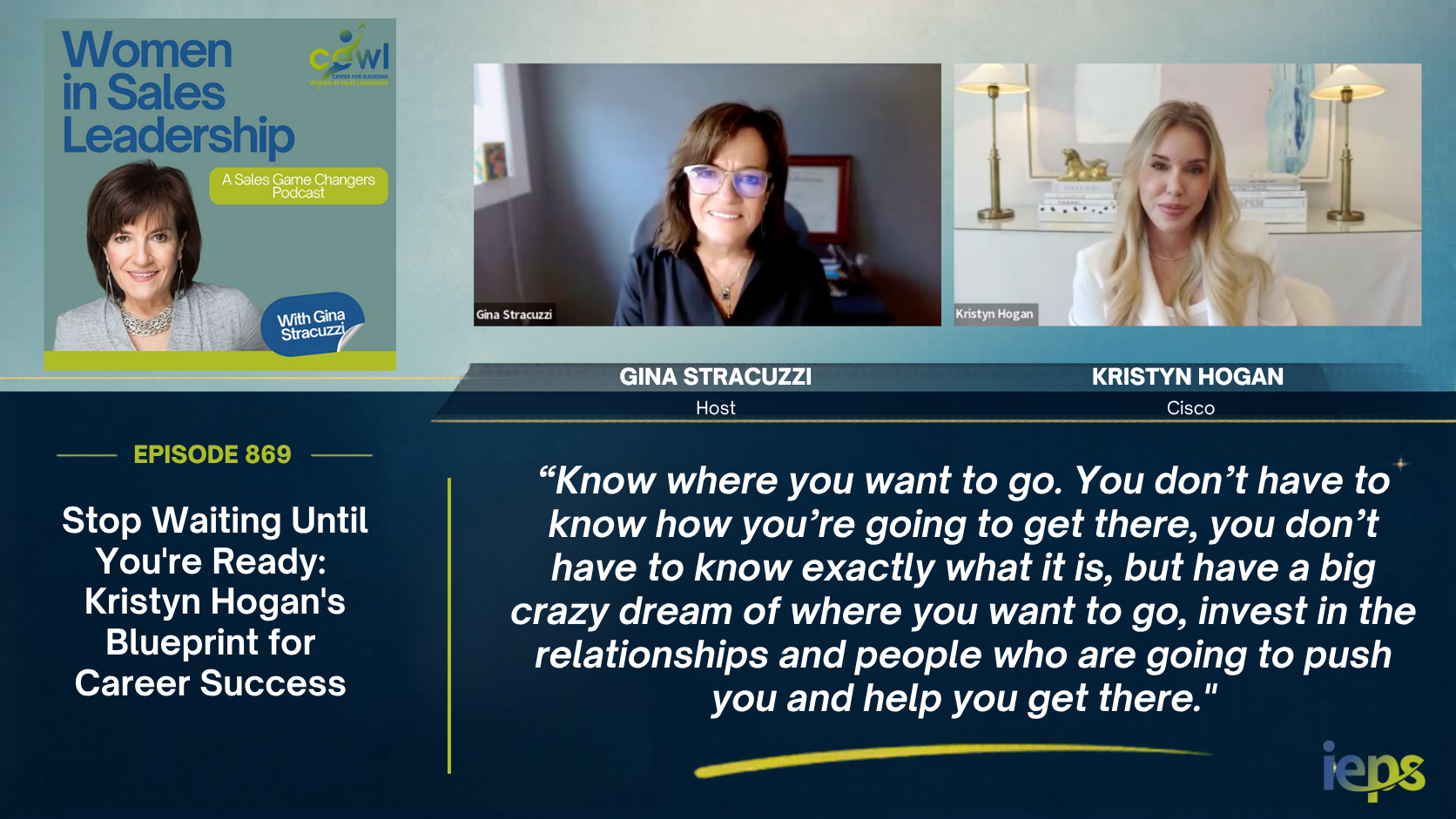
KRISTYN’S TIP: “Know where you want to go. You don’t have to know how you’re going to get there, you don’t have to know exactly what it is, but have a big crazy dream of where you want to go, invest in the relationships and people who are going to push you and help you get there.”
THE PODCAST BEGINS HERE
Gina Stracuzzi: Today, my special guest is Kristyn Hogan, global vice president of partner sales at Cisco. Welcome, Kristyn.
Kristyn Hogan: Thank you, Gina. Happy to be here.
Gina Stracuzzi: We’re happy to have you. I always like to start with our guests telling us a little bit about how they got to where they are today, and then we’ll go into some deeper questions.
Kristyn Hogan: As you mentioned, I lead our global collaboration partner sales team at Cisco. If you think about Cisco, big company, most often known for really being that networking infrastructure, powering the AI era, but the other part of our business, which I lead, is collaboration. When you think about what is collaboration in the context of Cisco, think about the video conferencing and how we’re re-imagining work with our customers. Think about something that we’ve all experienced, which is calling into a customer support, really powering how our customers engage with their customers, and then obviously enterprise calling. All of these things make up the collaboration business. I look after really accelerating all of that through our channel, which for those of you who are familiar with Cisco, you know that over 90% of our business goes through the channel. That’s what I do.
How did I get here? It’s an interesting year for me in that this coming February, I will celebrate my 23rd anniversary at Cisco, and not to age myself, but interesting anniversary for me in that it will mark over half my life will have been spent at Cisco, which is unbelievable. Time flies. How do you put 23 years into a 30-second blurb? I was really fortunate, I joined Cisco right out of college. Cisco has a new college hire training program that we actually just brought back. It’s been on hiatus for a couple of years. Just quick plug, if there are any listeners who know a new college graduate who’s a star, we’d be lucky to have them.
Nevertheless, back in 2004, Cisco handpicked, you couldn’t have cast a better reality show, 25 sellers, 25 engineers from around the country, brought us to North Carolina, where we really had this great fortune to get what I call a masters in Cisco and a masters in sales. Truly, I look back and that has been the foundation, that year, foundational to my career. That’s how I got into Cisco.
Left that program and moved home to Houston, Texas. I did commercial sales in Houston for a number of years where I quickly learned that the key to my success was figuring out a way to have more than 24 hours in a day. How do you do that in sales? By activating the channel. I spent a significantly, probably disproportionate amount of my time as a young seller at Cisco, really engaging with our channel partners, using them to scale myself. Then it was just a natural progression to move into the channels organization at Cisco.
Moved into the channels org on the collaboration side of the business, which funny enough, wasn’t called collaboration back then. I was tasked with really building practices at our partners for this cutting-edge brand-new technology at the time, IP telephony. Did that for a number of years and then really got to a crossroad where I thought to myself, “If I stay on the partner side, it can’t be in collaboration. If I stay in collaboration, it can’t be on the partner side.”
Cisco had just acquired a company called Meraki, and really interesting turning point in my year. I often say I had this this opportunity to both leave Cisco and stay at Cisco, in that I truly turned in my Cisco laptop, reissued a new Meraki laptop. Even after a decade of being at Cisco, went to Meraki new hire training for two weeks. Did a number of years at Meraki.
Then fast forward in 2020, we all know what was happening in the world in 2020. I got a call saying, “Hey, we’d love for you to come back to collaboration.” I think we all know, I don’t like to revisit these years yet. Collaboration had an interesting time in 2020 in that we were not the company that became the verb and noun for the virtual meeting during the pandemic. Got the call to come back and lead this global collaboration channel. Fast forward six years, that’s what I’ve been up to.
Gina Stracuzzi: I get that you’ve technically been at the same company, but I like how you moved around and gathered more knowledge, which is always good for a career, the more knowledge you can have. It’s something that comes up in the forum quite a bit because sometimes women get little tentative about making a lateral move. Sometimes that’s the best thing for your career. I like how you embraced new opportunities and made them work for you.
That’s a nice lead-in to what I want to talk about channel sales. We know that channel sales is built on influence rather than direct control. It’s all about the relationships. What have you learned, and certainly with collaboration, what have you learned about getting people aligned and moving in the same direction when they don’t actually report to you?
Kristyn Hogan: It’s funny, and my answer to that question would be the same. I feel like the same attributes that can drive that success of the channel are candidly foundational to being the steward of one’s career. Number one, it really comes down to being able to build solid relationships built upon trust. When I think of that, both in the context of leading a channels organization and even in the context of my own career, if you look across Cisco, 80,000 plus employees at Cisco, we’re lucky to have a disproportionate number of people who are remarkably smart, bright, doing the work. What I’ve learned is, again, in terms of a career and in terms of leading the channel, it’s not enough. It’s foundational to do that remarkable work. But the real differentiator, and taking this to the next level, is that ability to build the relationships inside of Cisco, outside of Cisco that are going to equal parts, back to what you mentioned, to expand your thinking, push you outside your comfort zone.
It’s interesting, in this long career I’ve had at Cisco, I often share, I’ve interviewed two times. I interviewed to come to Cisco and I interviewed when I made that Meraki rotation. Every other move I’ve made at Cisco, and I’ve made a lot of them, has been because I built relationships and trust with people who opened a door for me. Those same two tenets I think are what differentiates being a good channel leader and building good channel relationships.
Gina Stracuzzi: It really goes to people knowing your work and being willing to be an advocate for you when you’re not in the room, like, “We need to be looking at Kristyn for this.” That’s an important part, that’s something I talk to women about all the time. It also makes me think about the new program that Fred is standing up, the Partner Revenue Academy. It’s really all about how those roles have changed. Partner selling is not the beast that it once was. It’s a very different beast. It seems like you’ve really managed to leverage every change in those relationships and make it work for you and for the company, which I love.
Now, let’s talk about the roles, talking about how you’ve moved around within the company. You’ve had direct sales, business development, distribution, global partner sales, you’ve done it all. What did you learn from those responsibilities and as your leaderships go through, but what did you have to unlearn too?
Kristyn Hogan: That’s such a great question. In terms of the unlearning, you’re going to see some common threads. I think it’s that to not really believe your own limiting beliefs. I’ve often told folks, “Don’t believe everything you think.” Specifically, and again, goes back to these relationships, there’s two folks who I credit as both driving two unique turning points in my career.
Earlier, the story of my very first leadership job at Cisco is an interesting one in that I had moved into the collaboration business at the partner business for having done sales and was working for a wonderful woman, Kris Zimmerman, and simultaneously was building my career and I also had my very first baby. I’m out on maternity leave and Kris Zimmerman calls me to check in, and I’m holding that newborn first baby, and she’s like, “How are you?”
I tell her, “I’m great. Kris, I don’t know if I’m going to come back. I think I’m done.” Kris is a mom. She had twin girls. I thought she’d be like, “Great,” and see me off into the sunset.
She was furious. She was like, “I know you, absolutely not. Not only is that not your path, but as a matter of fact, one of the reasons I’m calling you, what I’d like for you to do is interview while you’re out on maternity leave for your very first leadership role. Disclaimer, Kristyn, don’t worry. No one gets the first manager role they go for, but this will be great. Let’s go for it.”
She pushed me. I interviewed for the role. Spoiler alert, sometimes you do get the first leadership role that you ever go for. I think that first unlearning was sometimes don’t trust yourself. Trust others sometimes who might know you and have that ability to push you farther than you might think is possible and push yourself and figure it out later.
Then years later, when I stepped back into this collaboration business, we were in the depths of the pandemic, like day two, this newly brought together collaboration SLT was pulled into our Cisco headquarters, at the time, Building 10 San Jose. Parking lots empty, it is COVID, the office is technically closed, two conference rooms full. It’s dark in the building. One conference room, our CEO and his ELT prepping for an earnings call. Second conference room, this deer-in-the-headlights collab team who’s tasked with turning around this business.
I’ll never forget, Chuck Robbins popped in, he’s like, “You guys got this.” I remember thinking like, “I don’t know if we’ve got this.” Jeetu Patel, who was at the time our collaboration security product leader, now our chief product officer and president, he was at the front of the room. Really and truly, it was that moment where what I had to unlearn was every single reason why I thought we couldn’t do it, and had to relearn. Again, this is what I call like, “You got to figure it out.” That was another level-up moment where it wasn’t so much of an unlearning as a like believe that anything is possible type of moment.
Gina Stracuzzi: That was such an unbelievable time for everyone. I think we all learned a great deal about what was possible, and look at us now. Ten years ago even, if you had said to somebody, “90% of the workforce is going to be talking through screens,” everybody would be like, “Forget about it,” especially sales, right?
Kristyn Hogan: Yes. I walked out of that meeting, flew home, and it was game on. It took a little longer than we thought, but we had a Cisco earnings call last week, the collaboration business got a little shout out, record highest year on record for collaboration in seven years. We did it. Full circle moment.
Gina Stracuzzi: That’s really awesome. Let’s talk a little bit about those partner relationships and how you build on them to make sure you get to numbers like those. Now, partner relationships are often described as strategic. Even when the day-to-day is still pretty transactional, it’s still built on strategic relationships. In your estimation, what separates a genuinely valuable partnership from one that just looks good on a slide when you’re presenting?
Kristyn Hogan: I have what I call my money slide for explaining, what does the channel do? What is the power of the channel? It’s one of those classic iceberg images where I’ll start with, people who haven’t done a partner role or are deeply ingrained in a partner emotion, when you ask them, so what does a channels team do? What do you think about a partner team? Nine times out of ten, you’ll get, “They show up, they do like lunch,” and it all looks very glamorous, the top of the iceberg stuff, “They meet with their partners.” Yes, we do spend a lot of time enabling partners, but the internal mechanics of running a partner organization are a lot more strategic and there’s a lot more depth that’s building that transformational three-year plan, five-year plan, what routes to market will we need to have to support our business years down the road?
I often say that channels and the partner org, we are busy planting the seeds for revenue dollars that will sprout, not this year, not next year, but we’re driving the business of the future. First and foremost, I think there’s a whole strategic element of running a partner business that unless you’ve done it is unknown or underappreciated.
From there, when you look at it through the lens of a partner and what sets apart our most strategic partners from those that are more transactional, I always come back to really four key pillars. These pillars were tried and true for me 10 years ago. They were relevant when I led the Meraki channel. They’re relevant in collab.
Number one, it’s on, in our case, Cisco, to provide to our partners the world’s best technology platform to go sell and go wrap their services around. Number one, we owe our partners that. But number two, we’ve all been there, our partners, they’ve shown us, are willing to go sell the world’s second best or third best technology platform in the world if it’s more profitable. If you can make more money selling the second best, that’s the path we’re all going to take. I find our most strategic partners are those that are maximizing these profitability programs that we put in place to drive their success.
Third element, the onus is on Cisco and our most strategic partners, is mind share. We have to earn it every day and it’s not something you do once a year. I’m a little more of the above the iceberg, but waking up every day, ensuring that we have the mind share at our partners from the highest executive level all the way down to that frontline seller and everything in between. When I look at our most strategic partners, these are metrics that we look at. They are the ones who top to bottom are investing and most enabled.
Then last but not least is this pillar around really simplicity. Listen, till the day I die, my time at Cisco will be spent, like we aren’t necessarily always known for our simplicity, and it’s not something that you can master, but the degree to which we can make it simpler for our partners and our partners can also make it simpler on their end of working with Cisco, engaging with their customers, that’s an area that I believe really sets our partners apart and can set us apart. Platform, simplicity, profitability, mind share.
Gina Stracuzzi: Those are good tenets. I would think that keeping those in mind would bring you to this level of success that you’re knowing. We have to throw an AI question in there at some point, because who would we be if we’re not talking about AI. We know it’s changing how companies are selling and some are doing really well with it and others it’s rather scattershot and they’re not knowing the same success. How do you see it changing in partners and what they need from vendors? Where do you think channel leaders need to rethink the old playbook rather than simply adding AI to it, which is something that really comes up? We have people who are just like, “Yeah, it comes down from on high. We have to use AI.” There is no strategic thought to it and there’s five or six or seven tools that companies have bought with no direction. What are you doing and what are you seeing?
Kristyn Hogan: I’ll use an analogy that we’ve all heard in that AI is the icing on the cake, and AI strategy can’t be the cake. I’ll go back to those four tenets. If you don’t have a rock-solid platform that you’re arming the partners with, a profitability story, winning their mind share, and a maniacal focus on simplicity, if you don’t have those four things in place, AI is not going to get you out of that. You can’t AI your way out of a foundational solid partner strategy.
Number one, I think is not an over rotation to thinking that AI is going to solve everything. You still have to have this foundation. I think where both Cisco and our partners can really shine and then kick it up a notch is layering innovative AI on top of that rock-solid foundation. When I look at even just some of the interesting ways, it’s evolving every day. We’re in this super charged cycle, but there’s a productivity pillar of AI, and I’m fascinated. I love productivity hacks, and for me personally and for my team, we’re always looking at ways of how can AI, again, it can’t be the cake, but how can you layer it on top to be more productive, get more time in your day.
The other area that I think is fascinating is this reinvention of managing and engaging with partners across a sales process. Cisco recently has rolled out Gong on the sale side, it is now our forecasting tool. On the partner side, it has really reinvented how we’re engaging with partners. A real-life example, I love it in that lead a big team, global team, big business, first thing I log into every day, I log into Gong and I see a snapshot of what the whole organization is up to. If I have a meeting with partner XYZ today, Gong sees that I have that meeting and says, click here to catch you up. Instead of having to call my team and bother them for some briefing doc, I can quickly scan through and understand all of the meetings, all of the deals this partner is working. Again, just two ways of how we’re leveraging AI, and we’re just getting started, but AI is nothing if you don’t have that foundation in place. You’re way out of a bad strategy.
Gina Stracuzzi: I have to say that is probably one of the most definitive answers that I have received anyway, I can’t speak for Fred, on how teams are using it. Even leaders don’t seem to be able to wrap their minds or their hands around everything that’s available and how they should be using it to really elevate their teams. But it sounds like you’ve got a great handle on it, which is awesome.
You’ve been recognized as the channel leader and you publicly champion women in the field, which I absolutely love. What helped you become such a visible leader? What do women in the channel need to recognize about making contributions and making sure they’re recognized?
Kristyn Hogan: It goes back to what I mentioned previously, which foundationally, remarkable work. Table stakes, deliver remarkable work. Number two, invest in those relationships that I think are mutually beneficial, that are going to push you outside your comfort zone. It’s funny, literally just this week on Monday, if I could spend my whole day mentoring rising star talents, my favorite thing to do, I never say no. I actually found myself on one of those calls on Monday with a rising star at Cisco, 28 years old. She’s in our PR and AR team at Cisco and is getting curious about what she wants to do next. She’s about to get her masters, has these big plans for her career, but a little tentative. Halfway through the call, we’re on a video call, and I stopped me in my tracks, I truly felt like I had been put in a time machine and I was looking in a mirror at myself, which 20 years ago, time flies.
To answer your question, for me, the differentiator, it’s been specific, there are freeze-frame specific people and specific moments where I was pushed. I was pushed to do something I didn’t think I could do. I mentioned Kris Zimmerman who not only said, “You’re coming back to work and you’re going to be a working mom and you’re going to be a leader,” I was pushed outside my comfort zone to do something I’d never done, which was be part of the team to turn around this collaboration business.
Number one, do great work, invest in these relationships, and then if there’s one quality that I look for in who I hire, who I mentor, who I coach, who I want to be, I call it the figure-it-out factor. I’d never done any of those things before. I don’t look for people who have done the thing. I look for, do you have the figure-it-out factor? Do you believe in yourself or do you have someone who believes in you and is going to push you to do it, and just go figure it out?
Gina Stracuzzi: If I could add something to that too, it’s don’t be afraid. Don’t hesitate to talk about what you’ve done.
Kristyn Hogan: Or what you want to do, for that matter.
Gina Stracuzzi: Another one, yeah. Don’t keep your aspirations to yourself. No one can help you if they don’t know what you want. You’re aligned on quite a bit of what we talk about in the forum. I absolutely love that.
We are at that point in our conversation, which has been really fabulous, where we like to ask our guests for one piece of advice, something that anyone listening can put into place today to take their career, their selling to the next level.
Kristyn Hogan: You teed it up perfectly in that number one, know where you want to go. You don’t have to know how you’re going to get there, you don’t have to know exactly what it is, but have a big crazy dream of where you want to go, invest in the relationships and people who are going to push you and help you get there, write it down. I stumbled upon this document I wrote in 2009, old style word document where I mapped out. I had the beginning, I didn’t really have the middle, but it ends, the document ends, I wrote down, as I thought life ended at 40, because it said, “By the age of 40, I would like to be a VP of sales at Cisco.” Probably need to write the next chapter, but have a goal, write it down, invest in the relationships with people who are going to push you, and above all else, hone that figure-it-out factor. Figure it out. This is corporate sales. This is not curing cancer. This is not solving world peace. There is nothing that we do that isn’t figure-outable. Figure it out.
Gina Stracuzzi: That is fabulous advice. Really great. There’s always a solution. There’s always an opportunity. You just have to figure it out. Thank you, Kristyn Hogan, and we hope you will stay in touch with us. Thank you everyone for listening and we’ll see you next time.
Transcribed by Mariana Badillo