
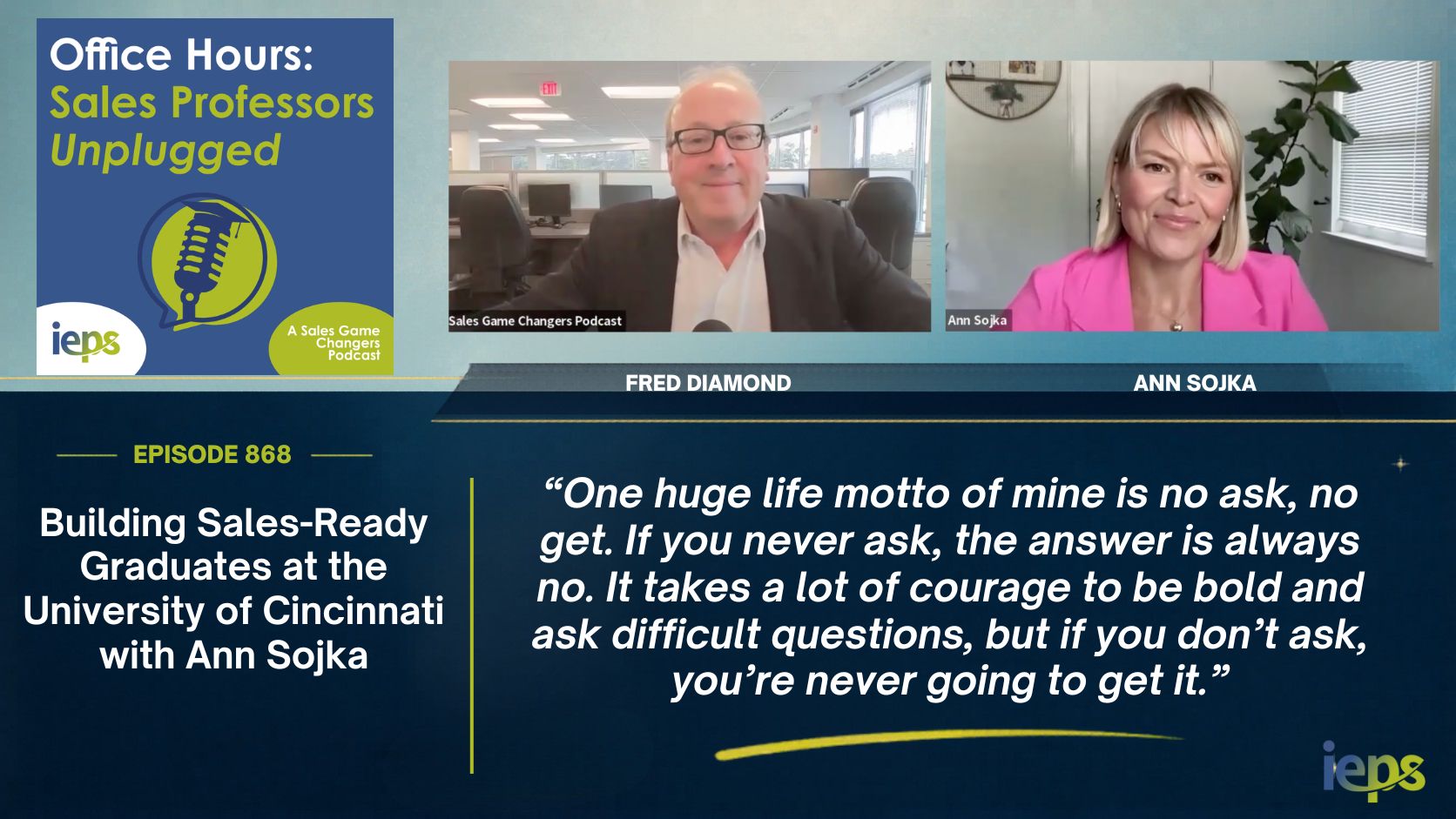
This is an Office Hours: Sales Professors Unplugged sub-brand of the Sales Game Changers Podcast.
Watch the video of this podcast on YouTube here.
The Sales Game Changers Podcast was recognized by YesWare as the top sales podcast. Read the announcement here.
FeedSpot named the Sales Game Changers Podcast at a top 20 Sales Podcast and top 8 Sales Leadership Podcast!
Subscribe to the Sales Game Changers Podcast now on Apple Podcasts!
Purchase Fred Diamond’s best-sellers Love, Hope, Lyme: What Family Members, Partners, and Friends Who Love a Chronic Lyme Survivor Need to Know and Insights for Sales Game Changers now!
The Institute for Effective Professional Selling has launched the Partner Revenue Academy for partner account managers who are looking to become more effective active sellers. The next 6-session cohort launches on October 16.
Learn more here.
Today’s show featured an interview with Ann Sojka, Assistant Professor of Marketing at the University of Cincinnati.
Find Ann on LinkedIn.
ANN’S TIP: “One huge life motto of mine is no ask, no get. If you never ask, the answer is always no. It takes a lot of courage to be bold and ask difficult questions, but if you don’t ask, you’re never going to get it.”
THE PODCAST BEGINS HERE
Fred Diamond: I’m very excited to be talking to Ann Sojka with the University of Cincinnati. A little bit of Sales Game Changers Podcast trivia. Your mother, who also teaches classes with you, was on our Women in Sales show with Gina Stracuzzi, who runs our Center for Elevating Women in Sales Leadership. That was in the heyday of the pandemic when we interviewed your mother, but she’s very active in women in sales. That’s where we originally got to her. That was before we started doing the Office Hours shows and that was way before we got involved with the University Sales Center Alliance. Every couple of weeks we post one of these shows.
I met you at one of the USCA organizational meetings. It’s such a great organization that is helping young adults get educated on professional selling, but also providing great value to companies that are looking to hire selling professionals who are ready to go. One of the amazing things about the young adults who come out of programs such as yours is they’re ready to go. They may need to learn the marketplace and the products and how the company uses HubSpot, Highspot, or Salesforce, or whatever it might be, but how you and your peers at the USCA are preparing young adults is something that we’re really excited about at the IEPS.
I got a lot of great questions here. I’m excited to learn more about what you’re doing at University of Cincinnati. Give us a brief intro to yourself and tell us a little bit about the program at University of Cincinnati. What do you offer the young adults who go through your program?
Ann Sojka: A little bit about me. I spent 10 years out in the field as a seller. I worked my way from a sales development program all the way out to the really good life, other than being a professor, which is enterprise outside sales. I did that all within the same company. Once I started teaching, I developed a really strong passion specifically for our students at the Grau Center for Professional Selling at the University of Cincinnati.
A little foreshadowing, but I pivoted my career. I’m a full-time educator now at the University of Cincinnati. Along with my counterpart, my executive director, Jennifer Barlow, I’m the academic director of the Grau Center for Professional Selling. We are a really large sales program. We offer a sales minor, and our program is interdisciplinary. It’s very inclusive. As a result, we have 400 students each semester in one of our sales classes. Students can earn a sales minor, or they can take the introductory confident selling course, develop some life skills, that’s what we’re really hoping for students to walk away with, and use those to help them interview or feel more confident in their classroom.
Our program is based around a couple of principles. We believe everybody sells something. We think sales skills are life skills. We believe that sellers are made and not born. We want more people to be equipped with the skills that sales curriculum and sales education helps them learn, hopefully, to go into professional selling, but if not, just to feel more confident in whatever career path they take.
Fred Diamond: That is amazing. We have listeners all over the globe. For those who don’t know much about Cincinnati, tell us a little bit about the University of Cincinnati. Is it an urban school? Just a little bit of a background on the school.
Ann Sojka: It’s really unique. University of Cincinnati, it is an urban campus. We have a couple of remote locations as well. It’s a regional campus. A very large percentage of our students are commuters and first-generation college students. That makes their experiences really unique, and in my opinion, and what I teach my students to talk about, it makes them really uniquely qualified to be really successful in sales. We have a really diverse student body and it’s concentrated in a really small campus, since it’s urban, but our students at the Lindner College of Business are required to co-op during the summers. They’re getting real-time experience, and like I mentioned about our program, it’s co-curricular. Our classes are fun because we have engineering students, we have design students, media, all in our sales classes, which makes the conversations really robust and dynamic.
Fred Diamond: As you alluded to, you’ve lived sales from three different perspectives. You were a student. Then you were in enterprise sales for about a decade. Now, you’re an educator. Just curious, which experience most influences how you teach today?
Ann Sojka: My students know this about me, Fred, and you’re going to find it out as we have this conversation, I love quotations and mottos. One of the mottos I impart on my students is that no experience is wasted. That’s true for me in each of those experiences that you asked about.
As a student, I was part of the Global Sales Leadership Society at the Kelley School of Business. I joined because I saw a poster that indicated that most marketing majors get their first job in sales. I said, “I want to get a job. That’s where most marketing majors get their jobs? I’m joining this club because I want to learn how to sell.” It was also, as a student, where I learned this closing line, how to ask for the job in an interview. I teach that to my students to this day. I’ve used it on every interview I’ve ever had, and it’s been a few years since then. That really influences my teaching and my passion for my students and teaching them sales.
My students love hearing about my experiences in the field. I can talk to them about what it’s like cold calling. I did smile and dial, 100 dials a day, getting hung up on, and talk to them about the victory and the feeling of accomplishment when you take a deal from a cold call to execution and getting the purchase order. I get to talk to them about the value and the fun in building relationships. It’s really fun being in outside sales because you get to entertain your customers, take them to concerts, take them to happy hours, and like a doctor, you’re on call. When data centers go down, it’s usually not from 8:00 to 5:00 on a weekday. I talk to my students about that. They love hearing about those experiences. I always keep in mind too, what do I wish I had known when I was their age that I can help them get ramped up faster and fill the needs of the partners who hire from students? That’s a big influence.
Fred Diamond: I like the way you said you’re thinking about what can they learn, what can you teach them so that they’re prepared? One of the great things that we’ve learned at the Institute for Effective Professional Selling about what’s happening at the USCA universities is you’re preparing these young adults to hit the ground running. One of the great things is because of how you’re preparing them, the retention that is going to be happening at the companies that do hire is going to be much higher.
I’m just curious, before we continue the conversation, is there another quote, or two? I’m a big quote guy as well. My favorite quote that’s had even more validity in my life recently is the Henry Ford quote, “If you think you can or think you can’t, you’re right.” I used to think that was just about business, if I think I can get another client or something, but it attunes to almost everything in life. If I think I can get a meeting, if I think I can do this. I’m just curious, do you have any other go-tos? Do you go by Professor Sojka in front of your students, or Professor Ann?
Ann Sojka: I do, yes. I go by Professor Sojka, and I have a couple. One huge life motto of mine is no ask, no get. If you never ask, the answer is always no. It takes a lot of courage to be bold and ask difficult questions, but if you don’t ask, you’re never going to get it. I try to impart that on my students.
Then another one is it’s about showing up. I have it on a post-it right here on my desk. It says, “Being pleasant and having a good attitude is a simple way to be luckier.” I love that, because as salespeople, we generate opportunities by being nice to be around, by building relationships, being trustworthy, and having a positive attitude. I love salespeople because they’re the most optimistic people in the world. They’re solutions oriented. They want to help their customers get out of pain and, by the way, make a lot of money while they do it. Those are a couple of quotes. My students have fun with this. We collect all the quotes every semester. We start off our class, every meeting with somebody giving an inspirational quote of the day.
Fred Diamond: I’m thinking about one of our clients who said to me recently that his salespeople are really, really good at waiting for the phone to ring. That ain’t going to get you any business, especially now. We’re doing today’s interview in the mid-summer of 2026. I love that, no ask, no get. It’s like the Gretzky quote, “You don’t score any of the shots you don’t take.” It’s all about doing that.
You alluded to before that sellers are made, not born. What’s something you’ve seen students develop that completely changed your mind about their potential?
Ann Sojka: I mentioned this before. I was selling for 10 years and really didn’t have a plan to stop selling. I love selling. If I weren’t teaching, I would still be in sales, because it’s fun, it’s dynamic, make a lot of money. But I started teaching at night because there was a need for sales instructors, and I had the experience and I applied and got the job. It was my first semester of teaching where came in, 6:00 to 8:50 at night, after selling all day, teaching a workout class 6:00 in the morning, and I think I’m going to teach these students what they need to know is the sales fundamentals. They need to learn SPIN selling, how to ask good questions, uncover customer challenges, and deliver benefits to solve problems. They need to learn how to negotiate and how to close. I still teach my students that. They do need to learn that.
But I had a conversation with a student one day that really changed my perspective. She was one of my brightest students. She asked to meet after class because she’s interested in exploring careers in sales. Yes, I love it. It’s working. I asked her, “What do you want to talk about?”
She said, “I really like sales. I’m interested in it,” but she felt a little intimidated, and she had a little imposter syndrome, because she said, “I’ve never had an internship or co-op during the summer.” She didn’t feel qualified in other words.
I said, “Well, you’re in my class. What other classes are you taking? What do you do when you’re not at school? Let’s see how we can frame a story.”
She said, “Well, I take most of my classes at night or online. I’m a commuter. I’m living at home because I’m paying for my own school. I’m the first person in my family to go to college, paying for my own school. I take my classes at night because I work full time at a bank in the day.”
I said, “How many hours a week are you working?”
She said, “40 hours.”
My jaw was on the floor. Talk about somebody who has the potential to hit the ground running in a sales career, because she has a high motor, she’s self-reliant, responsible, can manage competing priorities. She had all the skills that it takes to be successful in a sales career, accountable, and yet it was a messaging problem.
What I recognized about our students, and my mindset shift in the potential of our students, is they need to see sales in a different light. This is why we have our philosophy. We teach an abundance mindset in our sales program, which is that we are actively dispelling the myth that you have to have a specific sales pedigree. You have to be an extrovert, competitive, cutthroat, pushy, aggressive, persuasive person to be successful in sales.
Instead, what we focus on educating our students with is that anybody can sell. Everybody should learn sales skills. We help our students develop the confidence to tell their own story, to demonstrate the value they can offer potential employers as a seller. Even though I thought I was just going to teach my students technical skills, oh my gosh, that’s the reason I pivoted to education, and why I’m so passionate, because my students are hard workers. I want them earning a lot of money because I know they’ll work hard and do a good job and solve problems. They need the encouragement and see their potential reflected back at them.
Fred Diamond: A quick follow up on that. We’re the Institute for Effective Professional Selling. Everybody that we work with is a sales professional, typically B2B, business to business, or business to government, but enterprise. We work with companies like Amazon Web Services, Oracle, Hilton, Gartner, etc. People know that they’re in sales. But I’m just curious, when the young adults matriculate to University of Cincinnati, how many of them are going there to go into your programs? Do they maybe have someone who’s a friend who took a class and they say, “You got to take a class with Professor Sojka. This has been great. I didn’t know I could do this.” Like you said, a lot of first-generation students, so they’re probably working maybe different things as compared to some of the enterprise-type sales things that we’re talking about here. When do they learn, when through the four years, I presume four years, maybe something longer, etc.?
Ann Sojka: We recruit a lot of different ways. Word of mouth is a big one. I have a lot of students in my classes who say, “I’m taking your class because my friend said I need to take it.” Word of mouth is a big one. We have a lot of co-curricular organizations that also draw students in. We have a competition varsity sales team. You have to take a sales course to join the varsity sales team because you need to learn how to sell. That’s a big reason. We also have a sales leadership club, which is a little more open-ended and developmental.
I’m a little sneaky and I teach big sections of intro to marketing every single fall. I recruit for our sales program because I want students, again, we’re trying to change the perception in our program. We’re doing a really good job of it, by the way, of that there’s one type of person who’s a sales person, and that there’s one type of sales role. We also are really fortunate to have a lot of really strong partners who we work with.
They come, we do a sales expo, just a sales-focused career fair. Every fall and spring, we usually have at least 50 partners that all of our students go to. When students, they see, “Hey, there are jobs, there’s a career fair just for sales, that must be an indicator.” They hear from their friends that the sales class is fun. There’s no final exam. You do a sales role play instead. We talk to each other all the time. We practice interview skills. When that word of mouth gets around, in addition to our other faculty and other departments really recognize the value of the skills in our sales program.
Our finance folks, they realize AI can do some things that we’ve been teaching our students they have to do. But what AI can’t do is build relationships and build trust. We need our students to be equipped with those soft skills, competencies, people competencies, so that they’re really marketable to recruiters.
Fred Diamond: Let’s follow up on that with the companies that are participating in your programs, your corporate partners. You mentioned you had about 15 or so that participate. Maybe there’s more. What’s the value for them? Are these employers typically big in Cincinnati or are they from the Midwest or all over the country? Who are you looking to get involved? Which ones are getting involved? What’s the message you want to get across to them?
Ann Sojka: A couple of things are valuable. One note, in our sales expo, we have 50 people come through. Then we have different tiers of partners. But a huge value that our partners see and get value out of is when they come and interact with our students in our classrooms, and when they act as buyers in the final sales role play. I said there are about 400 students every semester in our sales classes. They all have to do a sales role play, at least one. Our partners are really excited to see our students in action. I think that is a big distinction versus hearing a student in an interview talk about, how would you build rapport? How would you close a deal? Our partners get to see our students in action.
Some of our partners assist with the varsity sales team. Those are our most elite group of sales students, who are really, really serious. Otherwise, they get a lot of opportunity to recruit from our role plays and from visits to our classroom.
Fred Diamond: What kind of positions are they recruiting for?
Ann Sojka: Great question. Everything from business development programs that feed to outside sales to business relationship management. More of like a post-sale relationship type of position. Another good benefit of working with the University of Cincinnati, we’re in a metropolitan area. That gives our students an advantage because they don’t have to travel somewhere for their co-ops or internships. We have a lot of big companies that are local who recruit. We have a lot of students who want to move away from Cincinnati or who aren’t from Cincinnati. We have partners who relocate students across the country. What I like to think about University of Cincinnati, it’s a really diverse student body. There are students who are happy and excited to cold call. There are students who want to do more of account management. We find partners recruit for all of those positions.
Fred Diamond: Ann, love your energy. Sales is about energy. You mentioned various types of people, extroverts, introverts they still have to have the same energy, that they are willing to put in the time. If you’re an introvert, a lot of introverts are great at sales because they can think strategically about how to do the business and who needs to be involved. As you know, in enterprise sales, it’s not just a phone call and, “Gee, would you like to buy a million dollars’ worth of stuff?” Yes, great. Good. it’s a process that may take months, years, and you may have to speak with six, seven people, and you need financial thought through the process and strategic thought. There’s a lot of ways to go.
If you had the opportunity to speak to a parent, they came to you and said, “My child registered to go to University of Cincinnati. I never thought of sales. No one in our family is in sales. Why should they take your classes?” I’m just curious, what would you say to them?
Ann Sojka: Frankly, same. My parents are teachers. Nobody in my family was in sales until I was in sales, and I had no experience selling until I had my first sales job. I think about this pragmatically, everybody needs to interview. I think every student that I talk to that is enrolled in a college and in a business school wants to get a job. An interview is selling yourself. If nothing else, if you take a confident selling class, which is our introductory course offered at least eight sections every semester, your student will be equipped with the confidence they need and the skills to sell themselves in an interview. That’s a low-hanging fruit.
When it comes to considering a career in professional selling, one of the objections I get a lot is about, “I don’t know about living on a quota. I’m concerned about making commission. Don’t sales people get laid off really quickly.” Nobody knows the future, but I’ll say for myself, I spent 10 years at the same company in sales and progressed from a sales development program to the best job in the world, other than teaching, which is outside enterprise sales. I did that for five years. I was never laid off and I made a lot of money. I like to tell my students, listen, I am not competitive. You don’t have to be competitive in sales. I am ambitious and I would describe myself as coin-operated, but really, I went into sales because I like helping people.
A big philosophy that we have in our business program in the Lindner College of Business is that our students are problem solvers. That’s what selling is. A good seller needs to know how to ask the right type of questions, uncover a customer need, and then deliver value to solve that problem. By being the seller, you help your customer solve their problem faster and you get to make money.
Fred Diamond: A thing we usually add to the end of that is having the skills and ability to be in a position to communicate that value that you uncovered. One of the challenges right now is that with AI, and it’s been like this for years, the customer can get whatever information they want to know off of the internet and of AI. If they want to know your product strategy, they don’t need you to come in for half a day to present it like you and I might have done in our previous roles. But they could just type in, what is the product strategy for company X, whatever it might be. As a selling professional, you need to be able to think ahead, where your customer might be going to, and it’s not hard to do that, but it requires work. Then you put yourself into the opportunity to communicate that value.
Ann Sojka, is there anything else that you want to get across that we might not have covered today?
Ann Sojka: I hope that I have conveyed a lot of enthusiasm and passion for not only the sales profession, but for the potential of the students in the sales program at the University of Cincinnati. These students are hardworking, like many college students, they’re hardworking, they’re gritty, they’re resilient. They have what it takes to be really successful and contribute to student organizations. I’m really passionate about the potential of our students. I want to see more young people go into this extremely lucrative, challenging, and rewarding career, because I think it’s so fun. It’s so fun.
Fred Diamond: Yeah, it is the greatest profession. We talk about this all the time, is that we think the most important job in every company is the selling professional. There are no jobs for the accountants, and there’s no jobs for the finance people, no jobs for HR or marketing if things don’t get sold.
Before I ask you for your final action step, do you have one more quote you want to pull out that you want to impart upon us?
Ann Sojka: I want to paraphrase because this is part of my educational philosophy, and it comes from Stephen Covey, and it’s his perspective on leadership. This really drives how I interact with my students. He said that leadership is seeing another’s worth and potential so strongly and communicating that so clearly to them, that they begin to see it in themselves. That’s what I see my responsibility as an educator to be. I want my students to see the potential and I want to make it so explicit to them that they see it in themselves and they feel confident to go out and take a risk, try something new.
Fred Diamond: You know what, Ann? That comes through in today’s Sales Game Changers Office Hours podcast. There’s no doubt about your passion. One of the cool things since we’ve been doing the Office Hours shows is that the educators that we’ve been speaking to, they want their students to have amazing futures. We all know that the potential in sales, it’s not going to be easy, there’s going to be bumps and you may be working really hard on a prospect and they go silent and you’re wondering, “What did I do? What do I need to do?” You may be making up things about your pipeline. But if you stay with it, if you work hard, if you really put yourself into the athlete’s mindset of what should I be doing to practice, and you do a lot of that.
You mentioned the teams, and to go to the competitions, you might have to practice a role play like 500 times to get it down. That’s one thing that amazed us at the IEPS, when we started going to the competitions, is how amazing these young adults were. I’ll give you an example. I went to a competition where Gartner was the main sponsor, and Gartner does a lot of work with the universities at the USCA. I’ve been a Gartner customer 10 times. The students that I saw at the role play, it was the National Collegiate Sales Competition in 2025, even the worst student was great, and was even better than the best Gartner sales rep that I’ve seen.
Ann, it’s been great talking to you. Congratulations on the success and the continued success. Give us a final action, something specific selling professionals listening to today’s show must do to take their sales or sales leadership career to the next level.
Ann Sojka: I’d say take action. Go do it. Fail fast. It ties back into my no ask, no get mentality, which is you can do all the account planning, you can rehearse your pitch over and over again many times, but until you go talk to a customer, you don’t know if it’s successful. I got one more line for you, Fred. You either win or you learn. That’s what happens when you try. You either get the deal, you get the call, or you learn what didn’t work. Then you go back to the drawing board.
Fred Diamond: Once again, I want to thank Ann Sojka from University of Cincinnati. My name is Fred Diamond. This is the Sales Game Changers Podcast Office Hours – Sales Professors Unplugged.
Transcribed by Mariana Badillo