
This is an Office Hours: Sales Professors Unplugged sub-brand of the Sales Game Changers Podcast.
Watch the video of this podcast on YouTube here.
The Sales Game Changers Podcast was recognized by YesWare as the top sales podcast. Read the announcement here.
FeedSpot named the Sales Game Changers Podcast at a top 20 Sales Podcast and top 8 Sales Leadership Podcast!
Subscribe to the Sales Game Changers Podcast now on Apple Podcasts!
Purchase Fred Diamond’s best-sellers Love, Hope, Lyme: What Family Members, Partners, and Friends Who Love a Chronic Lyme Survivor Need to Know and Insights for Sales Game Changers now!
The Institute for Effective Professional Selling has launched the Partner Revenue Academy for partner account managers who are looking to become more effective active sellers. The next 6-session cohort launches on October 16.
Learn more here.
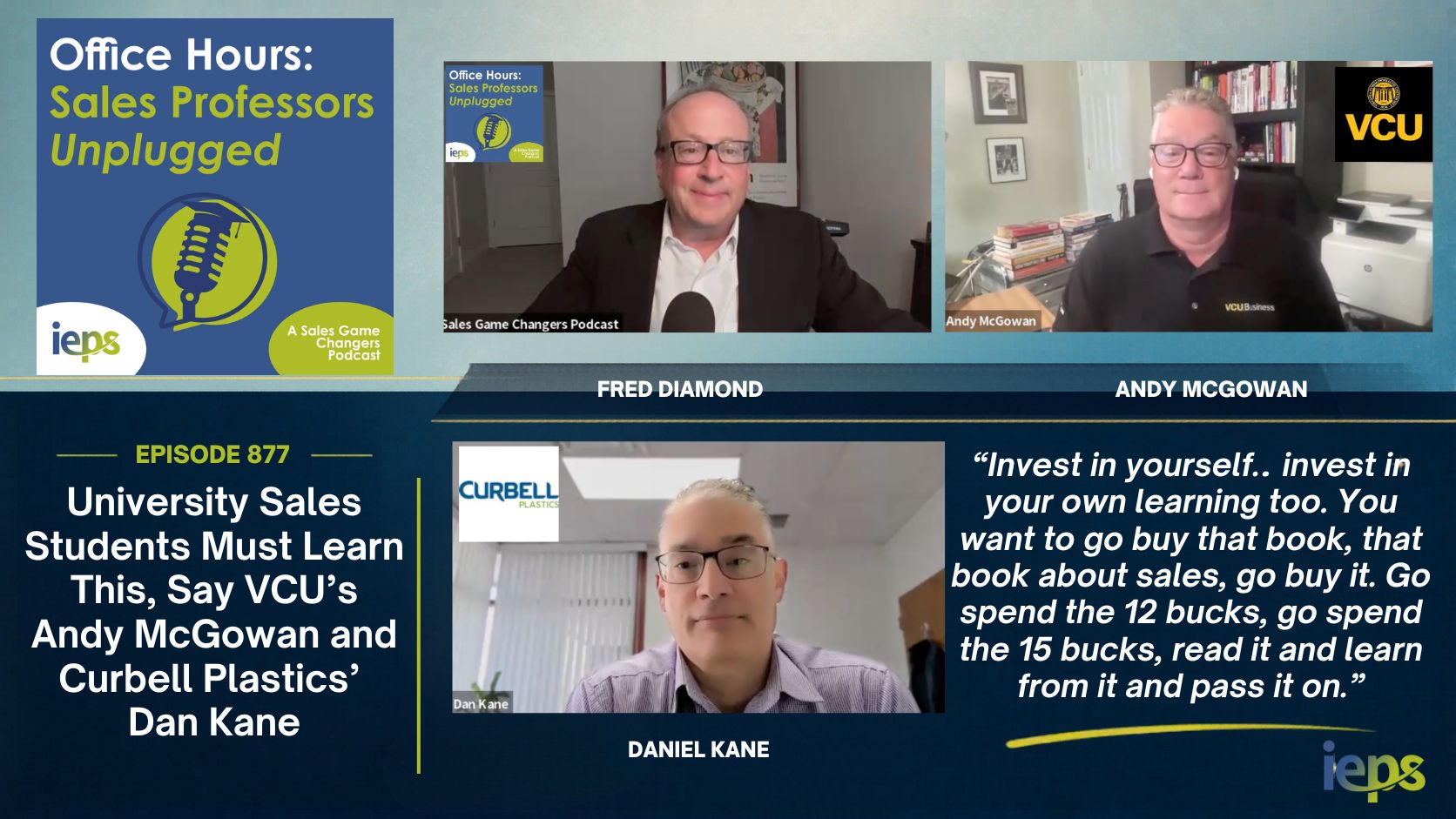
Today’s show featured an interview with Andy McGowan, Director of the Center for Professional Selling at Virginia Commonwealth Universisty; and Daniel Kane, Director of Training, Systems and Processes at Curbell Plastics.
Find Andy on LinkedIn. Find Daniel on LinkedIn.
ANDY’S TIP: “Sales is hard. It’s not easy. You have to learn to talk to people… You have to get out there and you have to talk to people.”
DAN’S TIP: “Invest in yourself… invest in your own learning too. You want to go buy that book, that book about sales, go buy it. Go spend the 12 bucks, go spend the 15 bucks, read it and learn from it and pass it on.”
THE PODCAST BEGINS HERE
Fred Diamond: Gentlemen, it’s great to see you here. We’re doing today’s interview in July of 2026. Andy, it must be an interesting time for you, obviously. I presume you’re between school years and it’s probably a very busy time as well. You appeared on the show in January of 2026. Get our listeners caught up on the Center for Professional Selling that you run at Virginia Commonwealth University. I know it’s a fast-growing program.
Andy McGowan: It is, and thank you for having me and thank you for letting me bring Dan on. We’ll talk about Curbell. But yeah, this is a very busy time prepping. We are four weeks till school starts. Our semester starts August 18th, so the clock is ticking, which you can’t see below the camera, is syllabi and books behind me and things getting prepared for the term.
Since we last spoke, our program continues to grow. We’ve gone from, just a few years ago, just before I started, offering only three intro sales classes. This fall, we’ll have seven sections of our intro sales class. We started last year adding a sales enablement and analytics class. Now we have a fabulous instructor who comes to us from Salesforce and LinkedIn. We put in our advanced sales class. It reconstituted from my predecessor, Wayne Slough. It was a really busy spring since we last spoke.
Now it’s trying to continue to grow the program. It’s like one of the growth areas. As the Dean said to me, he goes, “This is one of the growth areas for the business school and for the university, because sales is a great profession.” I try to convince our students of that all year when they’re looking for jobs when we get to the spring term, and sponsors like Dan at Curbell come on. He’ll probably tell you stories about students that they’ve brought in. It’s been a fun off-season. I think of my hockey days, like this is the off-season, you get ready for training camp right now, and then we hit the ground running in a few weeks.
Fred Diamond: I’m going to bring Dan Kane on in a second here, but before I do, tee it up a little bit. What is the importance of corporate partners, corporate sponsors for a program like you’re running at VCU? For people who are listening, VCU is based in Richmond, Virginia, correct? Not too far from downtown.
Andy McGowan: Correct.
Fred Diamond: I’m based in Northern Virginia, about 100 miles north, straight up 95. Been in your campus, driven through it, stopped and walked many times. One of the great things is, a lot of your students are taking jobs in Northern Virginia, or they come from Northern Virginia, the metropolitan DC area, if you will. It’s exciting to hear all the great things that you’re doing. Give us some insights about corporate partnerships.
Andy McGowan: Corporate partnerships are really the lifeblood for the program. It’s great to be able to be an academic and teach. I come from the business world. I went into teaching as an adjunct a long time ago. I always remember, when I was an adjunct, it was the students really loved like, “Oh, you’ve worked in this business. You’ll be teaching the class. You have real insight into what the course is, what we’re talking about.”
Now in my role as the director for our Center for Professional Selling, I work closely with our sponsors because I call Dan up all the time asking, “What am I missing? What are those things that we should be teaching our students? How the world is changing?” I know we’re going to talk about all the things in the world that are going on, from AI, how it’s changing it. They’re on the front lines. They give us that insight that we then take into the syllabus, and again, all over my desk here, making sure that I offer that.
They also come on campus a number of times this year and really have developed relationships with our students. They not only, as a sponsor, get to meet all of the students in the class, because they’ll come in four times during the term, they grade the midterm and the final. They come to class, they get to know the students. They also do our internal sales competitions. As they tell me, it’s like, they build a relationship with them early in the year, and over the course of the year, they’ll come back in the spring for other competitions. They get to know our students, and then they’re calling me up going, “Does that one have a job? I really want to know if they’re available,” and they are taking our top students and putting them right into jobs, which is great. I feel really good about being able to prepare those students. My goal now is really to help our students when they graduate, that they have a position when they exit school.
Fred Diamond: One of the great things about the sales programs that are being recognized by the University Sales Center Alliance, the USCA, and I’ve interviewed a lot of your peers, Andy, at the various USCA schools, is that they’re going to get jobs. I’m doing today’s interview in July of 2026. I’ve met a bunch of these young adults and I’ve linked into them, or they’ve listened to one of the previous Office Hours shows and linked into me. Now I’ve seen over the last couple of weeks them posting where they’re going to work. One of the great things is they’re going to blue chip companies, such as Curbell.
Dan, before I ask you about your relationship with VCU, give us an introduction to yourselves. Tell us a little bit about Curbell and tell us about your journey and what you do there.
Dan Kane: Curbell Plastics, we’re a national plastic supplier of plastic sheet, rod, tube, and fabricated parts. We’re a distribution company, but I like to think of us as much more of a solutions company. You talk about how they’re teaching SPIN at VCU, we’re solving problems and we’re helping people solve problems within their companies. We’ve been in business since 1942. We are supported across the country with 30 locations, many salespeople. I’ve had the opportunity to work here, it’ll be 24 years in February of 2027.
I started as an inside salesperson. I was inside sales for a couple of years, and then I was given the opportunity to move to outside sales. I did that for like three years. Then in 2008, I was put into a business management role of actually running the business in Virginia. When they asked me to do that, I was absolutely not interested. I really love the sales environment, and so I was thinking, “I don’t want to be a manager,” but then one of my peers and mentors of many years said, “Well, you can still be a salesperson. You’re going to be a sales manager. You’re going to teach people how to do it.” I did that from 2008 to 2025.
Back in 2020, I got the opportunity to run our Pittsburgh location as well as the Virginia location. I had two locations for four years. I started hanging out with the VCU gang, with Dr. Slough, back in 2018, I think it was, 2018, 2019. I got to know Wayne, and we became fast friends, and we had a couple of pains in common. I did a career fair at VCU and I didn’t meet any students that wanted to have a career in sales. We started talking about that and Wayne said, “You’re the type of person I need to help me get the message out at VCU.” That’s how it started.
Last year with all the recruiting I’d been doing, Curbell offered me an opportunity to move into this director of training and systems and processes, so recruiting, interfacing with universities like VCU, finding talent, and bringing them on board.
Fred Diamond: Before we get deep into that, you mentioned that you don’t think of yourselves as being in the plastics world. You think about being in the solutions world. I’ve done over 860 Sales Game Changers Podcasts, and I can confidently say you’re the first person I’ve had on the show who’s a sales leader in the plastics solutions industry. Before I ask you specifically about your relationship with VCU, just tell our audience, what are those things? What are some of the solutions that you bring to your customers?
Dan Kane: Great question. Curbell Plastics, the vertical markets that we spend our time in, it’s all pretty much manufacturing. It can be from aerospace to machine builders, to food manufacturing, sign printing. Andy knew us in a former life in his printing career with substrate to print on. From a sales perspective of I need to sell plastic sheets, or fabricated parts, or plastic tubes, well, you can do that, you can go to Amazon, you can go to Lowe’s, you can go all over the place.
One of the things we like to do is really identify the folks, we study our vertical markets, so that if I talk to somebody in a machine builder environment, say, an engineer, I can actually be a trusted advisor to say, “I know your industry, I know your business, and here’s how we’ve helped other people within your space solve problems.” One of the big things with plastic is going to be weight reduction. Think about airplanes, think about vehicles, specialty vehicles, ambulances, for example, how do you make these lighter, more fuel efficient, safer? We get involved with a lot of those conversations with folks instead of saying, “I can sell you five sheets of ABS and the price is $10 a sheet.”
Fred Diamond: Obviously, if you’re selling solutions, you got to know the industry, you got to know the customer with AI, which we’ll talk about in a little bit. The performance of the selling professional needs to improve. That being said, Andy’s program, again, VCU, you talked about how you first became partnered back at the end of the 2010s, 2018, 2019. What are some of the things that Andy teaches his students, what are some of the skills that they learn, specifically at VCU through Andy’s program, that make these students attractive to you?
Dan Kane: I’ve been doing this for a long time. I got into sales by accident. One of the reasons I’m so passionate about sales is I went to college at Clarion University of Pennsylvania. I was on a six-year plan. You can laugh if you want, Andy. It’s okay.
Andy McGowan: I did five, so I’m okay.
Dan Kane: I was a goof. I tell students this all the time, I didn’t know what I wanted to do. I wanted to be a teacher, elementary ed, K-8. I taught eight months outside of college and I was like, “I can’t do this,” and I got involved with the job with the telephone, and I fell in love with it.
When I would be hiring people a long time ago, they had to teach me sales. These students that are coming out of VCU, they understand the sales process. They understand that it’s hard work. It’s not just, “Hey, I’m a good talker. I talk to people,” because a lot of people think, “You’re great in sales, Dan, because you’re a big talker.” That’s not it. VCU and these other schools are teaching structure, the sales process, that it is a process. It is a profession. It’s not a just-in-case job like I got. It is an absolute marvelous profession.
When we get students in, you know what we do? We teach them product, because they know the process, and the lingo might be a little bit different, but they understand prospecting. Outbound cold calling, cold calling, relationship building, I’ll bet you, it expedites that learning process a year, just because of the education these students have, and they understand that it’s not just going to be people are just going to flock to you to buy from you. It’s a lot of work.
Fred Diamond: I like what you just said. That’s one thing we keep hearing time and time again, is that the universities that we’ve come to learn about that are part of the USCA that have these programs, the young adults who are going to graduate and go to work at a company like Curbell Plastics, they have a three-year advantage because they understand the sales process, and they understand a lot of the things that you just alluded to.
Andy, why don’t you go a little bit deeper on that? What are some of the deeper messages that you want to get across to the companies, like Curbell Plastics, that you’d love to get involved with your program at VCU? Or maybe if they’re out of the area and they’re listening and they may have another university that’s maybe regionally closer or something like that, what’s the message you want to get to them?
Andy McGowan: I think the thing I want to tell them is what Dan hit, is like we’re teaching them the sales process so that they’re going to interview and bring someone in that has learned sales. We’re working on it in terms of a real message for prospective companies and HR and sales programs, is for those companies that may not be sponsoring programs in their area, that they should get involved because the students are learning the sales process. They are coming out very prepared to walk into an entry-level sales job, whatever it might be, and they’re not having to teach them, “Well, gee, what’s sales?” They have done role plays. They’ve had to learn to prospect. They understand what objections are. They understand how to handle it. They understand how to build a relationship, and it’s not just, as Dan said, I’m a good talker.
Sure, there are those students that do it, but we try to mold them in terms of there’s a reason we’re doing this. We use the SPIN methodology and we ask those questions because it’s all about the questions you ask. Dan said it earlier, you might be selling plastics, but it’s first selling solutions, and that’s what we’re trying to help them. The sales process is uncovering those problems and then being able to provide solutions.
It’s a process. The students are getting it and I feel really confident in hearing back from sponsors that the students are stepping out of our program and are getting hired and are successful. Conversely, that’s when I’m calling up Dan going, “What am I missing? What are you seeing that we haven’t taught them that’s helpful?” Dan’s the one that said to me last year, was prospecting. Our class was just teaching them role play, and role play is great, it’s important, you’ve got to be able to do it, but man, when I was selling, and that’s how Dan and I connected. I led a printing company for a number of years. I bought half a million bucks a year from Curbell Plastics in terms of all their materials because we were a grand format manufacturer. I knew their products, or at least one stream of their products, but it’s teaching those students like you’ve got to understand the product, and now we’ve got you ready to go so that when Dan hires you, it’s like, okay, pitch your product, and away you go.
Fred Diamond: Dan, let’s get specific. You mentioned that your people sell plastics and solutions related to selling plastics to many different verticals, I presume. What are you looking for when you’re recruiting a college student? For the students who might be listening, or parents potentially, what might be some of the characteristics, some of the traits, some of the personality traits perhaps that you have seen would be good for some of these young adults to sell plastic-related products.
Dan Kane: That’s a loaded question. I love it. I know we only have so much time, so I’ll try to rein it in here. The biggest thing that I’m looking for all the time when I meet young folks, and I’ve got a 22-year-old son and twin girls that are 20. They’re all college-age kids, they’re in school, whatever, but I tell them all the time like, what I’m looking for, I’m looking for students who are curious, who are well put together, who can talk to me without looking at this. Who can talk to me instead of texting me, who can look me in the face and just have a conversation with me, where they’re curious, coachable, eager to learn, they stand out in class because they engage.
Like I said, I was this knucklehead in school for six years because I was, “I don’t know what I want to do.” Well, sometimes I go to these classes and I can go to a class, in Andy or at VCU, any of these classes, I can stand in front of 30 kids, and within 10 minutes of standing in that class, I can tell what students are there to learn, who are there to get engaged and learn something. I can tell the students that just can’t wait to leave and go to Chipotle, or like, “I got to get the hell out of here.” You can see it in the body language. The students that are asking questions, instantly, there’s a connection. I gravitate because they’re curious.
The biggest thing I think for a young person today is to be willing to have a conversation with somebody and be able to network, be able to put yourself out and just have a conversation. I think meeting a lot of young folks, we start talking about making out calls or cold calling. It doesn’t have to be scary. We’re just having a talk. We’re just having a conversation. I think that’s the biggest thing for me. It’s curiosity, coachability, and humility.
Fred Diamond: Andy, I just want to follow up with you. A lot of the students who are in college now, again, we’re doing today’s interview in 2026, let’s face it, they grew up during the pandemic. For people who are not watching on YouTube, Dan picked up his phone at one point and said he doesn’t want the kids who are just sitting there looking at their phones. Talk about that for a minute, Andy. Talk about how do you educate these young adults that you need to engage, you need to physically talk and meet. We’re going to talk about AI. AI can get you pretty far down the path, but it ain’t going to solve all the problems, especially when you’re dealing with a 50-year-old plant manager who needs a whole bunch of plastic for things in the plant that you were just talking to, the manufacturing. Andy, give us some insights into what are you telling the young adults that it’s not just about the tech thing and the social?
Andy McGowan: Dan said, it’s like, I started sales, I never thought of it, but when I applied for this role full-time and I was talking to my sister, who’s a year younger than I am, I got into sales at 10 years old and I was selling hockey tickets. I’m from Upstate New York, I played hockey through college and my parents had to pay a fee every year. It was 150 bucks a year, which is nowhere near that now because both of my girls played hockey, and we had to go door to door selling. We sold the raffle tickets for a buck a piece and my mother made it so that my brother and I both played, so we got 300 of them. The advantage was, for every ticket you sold, you got to keep the dollar. My mother made sure we sold every last one of them. I remember, my mother worked in the banking industry, she had a little bank box for your checks, and my sister, brother, and I went out, my mother had a territory plan. She mapped out all the streets. We had to go literally door to door, and my brother sat in the car and complained for the whole time, he was the youngest. My sister and I went door to door selling.
I tell students sales is hard. It’s not easy. You have to learn to talk to people, and you said it earlier about the pandemic. I think that’s the biggest thing that’s different about the students now, that they were in a bubble for a number of years, either in high school or most of them now was in middle school to high school, and they just don’t connect with people. What we really work on is we make them talk to people. We make them do role plays. They have to use AI to help with a script, but you got to go one on one with Dan or another member of his staff and you’ve got to go sell. I always say this, one, sales is hard, and two, it’s hand-to-hand combat job. You have to get out there and you have to talk to people.
Sure, technology is going to help you, but I do not think sales jobs are going away, and they are always going to be in-person because, where’s my Jeb Blount book? I’ll give Jeb Blount a plug, people buy you, and it’s true. For sales, if I have two people, if everything is the same or very close, I’m going to pick that sales rep that I think is going to be personal, is going to get it done, is going to do the follow up. I’ll even pay more money, pay a higher cost, if I know I’m going to get sales service, which is the end of the process which we’ve started to add in going, “Okay, great, you did the sale. Now what? How do you keep the customer?” Those are the things that we’re trying to get students to understand.
What I like most is, at the end of the semester, I get a number of students that take the course, and I always ask day one why you’re taking it, and a couple of them are like, “Sounded interesting.” I remember most, I had a young lady, and Dan had her a year ago, she was in a bubble. She was terrified to do these role plays. I make them practice live in class. She went in front of Dan and she came up to me and she was terrified to do it. Dan came up to me after and he goes, “That young lady, she was really good.” I kept telling her and she came up to me at the end of the semester and she goes, “Thank you for making me take this class. It put me out of my comfort zone. I am much more comfortable talking to people and I really could see myself, if I had to go get a sales job, I can do it.” For me, that was the best.
Fred Diamond: Dan, there’s about 70 universities out there that have programs like this. There’s five in Virginia. What is it about Andy’s students, the VCU students?
Dan Kane: I have this kind of relationship with five different universities across the country. My opinion of the students at VCU is that they’re just grinders. I use that word, I’m a Pittsburgh guy, and that was always a word I grew up with, like, “You got to be a grinder.” I see these VCU students, they’re grinders. They’re not afraid of hard work. I know a lot of them are first generation college students, which I think gives them a bit of an edge, and they understand that these things aren’t just going to be handed out. A lot of these students are going there because they’re putting themselves through there. I’ve got a young lady sitting 20 feet from me that graduated from VCU in May. She put herself through college. She put herself through VCU, she’s from Northern Virginia, and she decided, “You know what? I’m going to do this. I don’t want to be in debt. I want to go to college and I’m going to be debt free.” First generation college student, she sits 20 feet from me right now, she’s in her fourth week at Curbell, and she was hired as an outside salesperson from VCU, but I think that’s it, it’s the grit. I think they have that grit and they know it’s not going to be a handout.
Fred Diamond: Andy, let’s talk about that for a little bit here. You mentioned that your dean said that your sales program is one of the big growth programs in the business school. It’s a relatively new program, like we alluded to, where’s the program? Why is it growing? Young adults, like the one that Dan mentioned he just hired, telling their friends. I don’t want to put answers in your mouth, but for a parent to see that their kid is graduating with a job after having spent six figures, that’s a big thing.
Andy McGowan: It is a big thing. I know the young lady that Dan hired. I teach two classes. I teach consumer marketing and then I teach sales. I had her for both classes and she’s a rock star. She was phenomenal. When D called me and said he hired her, I was, “I’m thrilled, but I know her situation and I know she’ll be fantastic.”
There are a lot of students like her at VCU, as Dan mentioned, and why is it really growing? Our program is really growing because we are doing things to get them involved. Since I got involved, and taking over from Wayne Slough, he had really set the table and got us into USCA. He had made some inroads with some great partners. I’ve been lucky to just be able to try to grow it because we run more internal sales competitions. Our sales club finally became official in the business school last year. We have over 150 students that are signed up that come to events, not all at once, but we’ll get on. Our sales events, we do it twice a week, which is a club, it doesn’t cost anything to join, they come and we practice role playing. We practice quick pitch competitions. We practice different things so then the best of the best go for our sales team, our competitive team, which competes at events.
A lot of the kids figure out like they get to go travel to ICSC in Orlando, or NCSC in Atlanta, or we’re going to go to AMA which is in New Orleans, it’s all paid for. The students are like, “Really? I get to go to this competition?” For them, that’s a carrot, that they really work hard. Then they see that because not only do they get to go, but they’ll walk out with internship and job opportunities.
We came out of a competition last year in the spring competition, three of my students had job offers from that competition. That word gets around, so everybody’s like, “Oh, I got to go hang out with this.” We had a great student, he just graduated, his name is Tyler Lynn. He and the board really networked the heck out of it. They know all the ins and outs. They’re literally walking out with placards at school going, “Hey, join the sales club,” and kids come out of the woodwork to do it.
The thing that’s also interesting is Wayne had started trying to get other colleges involved. We are now an approved elective for the engineering school so that, as Dan and I were talking, to go get sales technicians. I have a meeting with them the first week of school to go to one of their fairs where I’m going to pitch sales. The dean was interested because he had a meeting with our really well-known health program, the VCU health, they were like, “Yeah, we’re going to start some sales classes,” and our dean’s like, “We have that,” and he’s like, “Really?” We’re going to be meeting with him in the near future, he’s got to set me a date to go talk to the leadership.
We had a young lady who was a premed student come to a sales practice and she goes, “I’m premed track. I want to go into pharmaceutical sales. Can I be on the sales team?” I’m like, “Absolutely, you can.” Full disclosure, I have a biology degree. I did hardcore biology and chemistry. My parents wanted me to be a doctor, that was my track through college.
I’m thrilled that we’re going to expand sales, because the other thing I tell them outside of sales is hard is that every company needs sales. No matter what you are, if you don’t have sales, you don’t have a company. Forget all the you need finance and accounting and marketing people. If I don’t have sales, I got nothing, and they’re the last people to get let go.
Fred Diamond: Speaking about that, Dan, you’re not the only company that’s becoming a sponsor or that has seen the opportunities here. A lot of the good students, like Andy has, and you talked about the competition in Atlanta, we went there, the Kennesaw State National Collegiate Sales Competition, 300 young adults, number 300 I would hire in a second. The talent that you’re training and that you’re educating, Andy, is actually quite remarkable. Dan, here’s your opportunity. Why would someone, one of these elite students, or mid-range, whatever it might be, why would they come to work at Curbell when they have so many in-theory opportunities?
Dan Kane: They do, you’re right. They have a lot of opportunities. There’s a lot of great partners. What I typically talk to them about, like with the internship program, one of the things I’ve learned a lot is students, they want to be trained. I don’t know if it’s the COVID thing, or this generation of students, they want more training, they want to learn. I’ve had situations where we’ve said, “Okay, listen,” they’re struggling, maybe you set an appointment and they’re like, “I need more training.” Sometimes it’s like, “Well, no, we’re done training with that. Now we just need to do the work.” But a lot of them want a lot of training and they want to understand their stability.
Curbell Plastics, we have three core values. Our values are respect, integrity, and learning. We have a learning culture at Curbell to where learning is very important. I’m the director of training, systems, and processes, but I’ve only been doing that for six months. There are many people before me. My colleague, Peter DelGado, that hired me 24 years ago, he is the vice president of training now, and retiring. They put all this into place where we’ve got product training, we’ve got sales training, we’ve got our LMS or our CLE is online where they’ve got thousands of courses. We pretty much let them know, I give them the structure of our onboarding process.
When I came to Curbell 24 years ago, I got a legal pad and a pencil. They said, “Hey, listen to Scott for a couple of days and then get on the phone,” and that’s what I did. Now, it is a structure. It is a curriculum structured out through our LMS and it’s a lot of spoon-feeding information as they go. Then there’s a lot of live time in the field with myself or another peer at Curbell. I just tell them all the time, and a lot of our interns say, “Man, the training here has been awesome,” and I say, “Well, this has just been a 12-week internship program. Think about what it’s like if you just come here to work full time. That training is never going to go away.” I just think that’s a strength that we have. It’s one of the things we pride ourselves on, is really the training piece, but also that it’s a learning culture. I’ve been doing this for 24 years. I learn something about plastics every day.
Fred Diamond: We alluded to AI, I don’t want to spend a whole lot of time on it, but give us a thought or two. Andy, I want to ask Dan first on what is he expecting his selling professionals to use AI for? What are you talking to them about? What should they be doing, etc.? Just give us some general thoughts. Then, Andy, talk about how AI is playing a role in the curriculum.
Dan Kane: AI is so new and evolving so fast. The biggest thing is, are they at least embracing AI to learn about it? A lot of people have their own, oh, AI this and it’s killing the planet, or some people love it, but it’s like, do you understand what it is? Do you understand how powerful it is? Because you may go into a job interview and say, “I don’t like AI.” You’re going to be passed up immediately.
It’s just like when the World Wide Web came out. Remember when that came out and you had to get your disk and plug it in? It’s like, learn about it, understand it, appreciate it. Like our ownership says, AI is not going to replace people at Curbell. It’s going to make people at Curbell more efficient in their jobs if you learn it. That’s how we’re looking at it. We’re looking at learn it, embrace it, and just understand it.
Fred Diamond: Andy, how’s it playing a role in the curriculum?
Andy McGowan: It’s similar, because talking with Dan, he’s one of the people I lean on when I go like, “Hey, what’s up? What are you using it for?” We have embraced it. Our associate dean, Carol Scotese, at school, this whole past year, she has led the charge with, “We’re going to open our mind and eyes to AI, talk to people.” I’ve been to some workshops. I’ve spent time, I’ve taken a few workshops on it, but how it’s become important with our program is they’re allowed to use AI within some limits and some guardrails. Because as Dan said, it’s going to make you more efficient.
Man, I wish I could have just punched a couple of things into AI and gotten a whole bunch of research on a company, or give me a draft to script. What questions should I ask? That helps them get material more quickly, but they still have to go through it, read it, and understand it, and then use it when they have a conversation with a prospect or a particular client. It just makes them, I hope, smarter. We got to be careful that the information is correct, but it’s a tool that, as Dan said, I’m hearing the same thing, if you don’t embrace it, you’re going to get passed over.
Fred Diamond: I want to thank Dan Kane with Curbell Plastics and Andy McGowan with Virginia Commonwealth University for being on today’s Sales Game Changers Podcast and Office Hours – Sales Professors Unplugged. Why don’t you give us a final action step? We typically end every show with something that selling professionals, managers, and leaders who are listening to the show should do to take their sales career to the next level. Andy, why don’t you go first and then, Dan, you’ll bring us home.
Andy McGowan: Mine’s easy. Dan said it earlier. It’s network. I try to teach my students that, like they come to competitions, or they’re like, “I don’t want to go do that. Professor, really?” I’m like, “You’re going to go to the sales competition because Dan Kane and other people are going to be there because they want to meet you.” That’s the thing that I tell all the students, like we do the competition for experience, but I really push it because it’s a networking opportunity, and because of it, Dan’s there cherry-picking. Like the young lady that he just hired, she was in the competitions and he got to meet her a number of times. Then the students are like, “Oh, you’re right. I really should go to those. I got an internship or a job out of it.” I push networking. That’s my big thing.
Fred Diamond: That is a great thing. Nothing happens in your apartment that’s going to lead to great things. You got to go out there. You got to meet people. You got to talk. You got to expand the conversation. Dan, bring us on.
Dan Kane: I would say invest in yourself. You’re going to go get a job, Curbell may hire you, we’re going to train you, but invest in your own learning too. You want to go buy that book, that book about sales, go buy it. Go spend the 12 bucks, go spend the 15 bucks, read it and learn from it and pass it on. I just think that the folks that are willing to invest in themselves, to learn as they continue, don’t just, “I got my job so I’m just going to sit here on the coast now,” become an expert at it. I wish somebody would have told me that 30 years ago. Don’t wait around.
Andy McGowan: That’s why I have my collection of sales books right here. I’m pushing through them and I give them out. I tell students all the time, “I don’t have time for this class, but here’s a cheap book. Thrift books, go buy this book.” The kids that really get it, they’re the ones that come back and go, “I read that book. That was good.” You can only give them so much before they just overload.
Fred Diamond: Like we tell people all the time, it’s like, you might be a sales rep at wherever it might be, Curbell, etc., but you are the CEO of your career. What are you doing to continually grow and take yourself to the next level?
Once again, thank you so much, Dan Kane and Andy McGowan. Thank you for being on the Office Hours – Sales Professors Unplugged Podcast. My name is Fred Diamond.
Transcribed by Mariana Badillo