
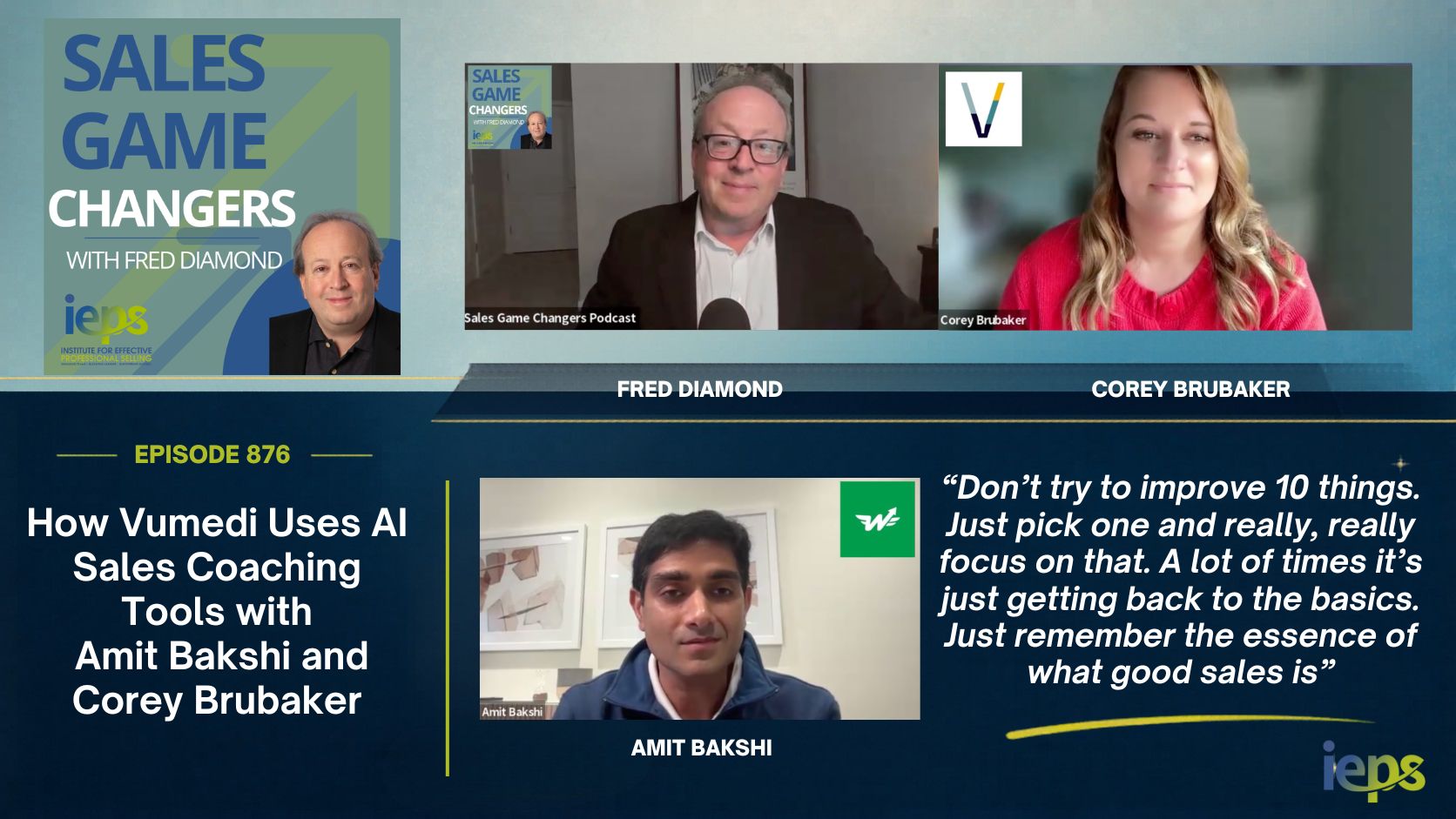
Watch the video of this podcast on YouTube here.
The Sales Game Changers Podcast was recognized by YesWare as the top sales podcast. Read the announcement here.
FeedSpot named the Sales Game Changers Podcast at a top 20 Sales Podcast and top 8 Sales Leadership Podcast!
Subscribe to the Sales Game Changers Podcast now on Apple Podcasts!
Purchase Fred Diamond’s best-sellers Love, Hope, Lyme: What Family Members, Partners, and Friends Who Love a Chronic Lyme Survivor Need to Know and Insights for Sales Game Changers now!
The Institute for Effective Professional Selling has launched the Partner Revenue Academy for partner account managers who are looking to become more effective active sellers. The next 6-session cohort launches on October 16.
Learn more here.
Today’s show featured an interview with Corey Brubaker, Head of Enablement at Vumedi; and Amit Bakshi, Founder and CEO at WingRep.
Find Corey on LinkedIn. Find Amit on LinkedIn.
COREY’S TIP: “The organizations that are winning are the ones that are creating the fastest learning loops. They identify what’s happening in their customer conversations. They coach against it quickly. They reinforce those right behaviors, and then they constantly improve.”
AMIT’S TIP: “Don’t try to improve 10 things. Just pick one and really, really focus on that. A lot of times it’s just getting back to the basics. Curiosity, judgment. Just remember the essence of what good sales is. It’s not about AI. It’s about using AI to get back to the basics.”
THE PODCAST BEGINS HERE
Fred Diamond: Amit Bakshi, thanks for being here. We’re going to be talking about WingRep and how Corey at Vumedi is using the tool. To tee her up, tell us a little more about WingRep and what it does.
Amit Bakshi: WingRep is the partner to the sales rep, and we help them before, during, and after their calls to close more deals.
Fred Diamond: Corey Brubaker, it’s great to have you here, with Vumedi. Tell us about your role at Vumedi and then tell us about this particular tool, how you’re using it. I’m also curious on how many tools you might be using. Is this one of hundreds or the only tool that you’re using in the AI realm? Introduce us to you, to your company, and what you do.
Corey Brubaker: Vumedi is the leading peer-to-peer learning community for healthcare professionals. We actually have never had an enablement person in this space at all. Whenever I came into the organization about nine months ago as the head of enablement, my immediate first action was identifying different gaps within the organization and trying to find different tools that made sense to fill them. Someone actually recommended WingRep to me. One of our internal reps was utilizing it. It immediately became part of our tech stack.
I wouldn’t say that we’re using an overwhelming amount of tools within our revenue organization. We are probably using the typical CRM, Salesforce. We’re using a learning management system, which we use Sana, which is also an AI tool. Then we’re using WingRep, amongst a few others. But I would say that it definitely has had some of the largest impact for our revenue organization.
Fred Diamond: Give us a perspective on what do your sales reps do? What are they selling and to whom?
Corey Brubaker: We have two different sales reps within the organization. We have our pharmaceutical sales reps and our med device reps. Ultimately, whenever you look at the Vumedi platform, we use our platform to educate doctors on the latest innovations within their space. Part of that, we like to get different drugs in front of those doctors from the pharmaceutical space, and of course, from the med device spaces as well. They’re selling to large pharmaceutical and med device companies and marketing agencies.
What is really important for us is that we’re able to get ahead of the conversations that they’re having and we’re identifying different gaps within those conversations early. Sometimes a sales cycle can take a few months, and then sometimes it’s a relationship that’s built amongst a few years. Because of that, we want to treat each and every conversation as valuable as it needs to be.
Fred Diamond: I want to talk generally about the concept of sales enablement. I’ve mentioned this a couple of times on the Sales Game Changers Podcast, I was part of a group of people who created what was then called the Sales Enablement Society. I believe it’s actually now shifted to the Revenue Enablement Society. This was back in like 2016, I was part of a group, we were trying to figure out how do we get our arms around the concept of sales enablement.
Amit, you brought some tools to the marketplace. What have been some of the big shifts in sales enablement over the last couple of years? We’re doing today’s interview in July of 2026. Amit, give us your thoughts, and then, Corey, as the professional, give us some of your insights.
Amit Bakshi: The biggest shift isn’t actually AI. It’s moving from information to execution. Maybe five years ago it was all about more information, more playbooks, more battle cards. Today, there’s too much information. The problem is actually executing under pressure. At WingRep, we review thousands of sales calls. One of the biggest failure modes that we’ve noticed is pitching before understanding the customer’s problem. I struggle with it myself as someone that’s doing sales. Every rep knows that this is an issue, but when they’re live in the moment is when they get excited or they get nervous, or they jump into demo mode. That’s where AI can become interesting, not replacing the rep, but nudging them back to the fundamentals in the moment.
Fred Diamond: Corey, you’ve been a sales enablement professional, nine months at Vumedi, what are some of the major shifts or the major shift that you’ve seen? Is it the same thing that Amit just expressed or are you seeing different things as well?
Corey Brubaker: No, I would definitely agree with that. I’ve actually been in the sales enablement space for about 12 plus years. Because of that, I feel like I have seen so many different trends. I think that the biggest thing now, being in sales enablement, is that there is such an overwhelming amount of tools, data, insight. I think that it’s becoming increasingly easy to get buried in so much information and lose sight of the fundamentals that actually drive performance.
To echo what Amit just mentioned as well, is I really think that we need to lean into AI and technology to tell us where the gaps are. Then we need to empower our leaders to help close those gaps. I really think that the organizations that are seeing the biggest impact are the ones that are actually using technology to make coaching more targeted, and because of that, you end up having more effective execution.
Fred Diamond: Before you selected WingRep, what problem were you trying to solve? Who did the problem come from? Did it come from senior sales leadership or did it bubble up from the sales organization that come from the C-suite? How were you directed to find a solution that eventually led you to WingRep?
Corey Brubaker: Whenever I started, as I mentioned, there was no one in enablement, and also, we didn’t have call recording. What was really challenging for me was scalability, where I was trying to join as many calls as possible and identify gaps. Quite honestly, there were not enough hours in the day for me to do that. Then I started to notice that it was the same for our sales managers. It was the same for our CRO. It was the same for our CEO. It was really difficult for all of us to be on all of these conversations at the same time.
For me, being in enablement, I can’t bridge a gap that I don’t know exists, and it just became increasingly more complicated. This is actually something that I raised to our leadership team, to say, “This is a tool that I think would make our time a lot more valuable. It would help drive what we need to do from an enablement perspective. It’s going to give us more measurable results instead of just guessing at what we needed to improve.”
Fred Diamond: Amit, there’s no shortage of AI tools. I get 5, 7, 10, 12 emails a day and on LinkedIn and other places where I get my information, I see the plethora of tools that are in the marketplace. They all claim the same thing, that they’re going to totally transform your sales enablement processes. Give us more of a global perspective on, where are you? You created WingRep, but where do you truly see where AI is bringing value today from the perspective that needs to happen? Every sales organization has one thing in common, they need to generate revenue. They need to find opportunities, they need to find new customers, grow existing ones, etc. Where really are you seeing the opportunities that AI is making that happen? What led to the creation of WingRep, as it relates to that?
Amit Bakshi: Great question. AI is already working in a lot of ways, meeting summaries, CRM updates, follow-up emails. I think those are pretty common at this point. The next frontier is really helping reps during their conversations. I think we’re getting way ahead of ourselves when we talk about AI replacing salespeople, AI replacing managers. We’re all still here. Customers still buy from people. I think a good analogy is for the next frontier of AI in sales, AI can be like the GPS. It doesn’t drive your car, but it actually helps you avoid the next wrong turn. I think the best AI is not going to replace good salespeople. It’s going to help them execute in the moment. Frankly, it’s the tool that I need. As a founder doing sales myself, I’m learning on the job how to sell, I get constant feedback that helps me improve every single day.
Fred Diamond: Corey, you make a decision to bring on a tool. Every tool, it either gets used or it doesn’t get used, where you learn things about it along the way. Give us some insights into when your company made the decision and you started implementing and you started training the sales reps on how to use it. Has everyone gravitated towards it? Is there a handful? Just give us some insights into once you made the decision, how did it go about bringing it on board and getting it utilized?
Corey Brubaker: I think at first reps were hesitant just because they hadn’t had a tool like this before. Now it’s actually a tool that I don’t know that many of them can live without having on their calls. Like for me, what really surprised me was how quickly WingRep became part of our operational rhythm. It isn’t just a platform that people log into. It really is part of their day to day. It comes up on every single call that I am on in some capacity.
For example, we did a training yesterday, we have new products that we’re rolling out. Our product marketing team actually used WingRep product analysis so that we could guide that training to say, these are the gaps in how we’re explaining our product. These are objections that are coming up.
What I’m finding is that, I know on this podcast right now, we’re talking a lot about sellers, but we actually don’t just use it for our sellers. Our product marketing team is using the analysis tool. I have someone who is an agency liaison who helps us with our agency relationships. She goes in and she pulls a lot of the data as well. Even so much that we’ve been leaning into this from a pre-sales perspective. But now I’ve been working with the WingRep team to also bring this in for our post sales team. We’ve been using this for our customer success team. We’ve been testing a pilot with it. It really is something that I feel like everyone in the organization has really wrapped their arms around. You definitely don’t see that with every tool that you bring into an organization.
Fred Diamond: Amit, I want to ask you a separate question here. Now that Corey explained some of the ways that her company, Vumedi, is using your technology, give us a 30-second elevator pitch. If I see you anywhere and you tell me, “I have this product that’s called WingRep. It helps blank,” give us a 30-second pitch. I’m just curious, now that we have a little more perspective on how Corey is using it.
Amit Bakshi: WingRep helps sales reps before, during, and after their calls. We help prep you for your meeting. We help tell you exactly what your game plan should be during that meeting. During the meeting, we give you live nudges to bring you back on track. After the meeting, we do the work for you. We’ll write to your CRM, we’ll draft your follow up email. It’s really something that subtracts work for you and helps you jump from one call to the next.
Fred Diamond: Corey, does it do that?
Corey Brubaker: It does do that. But I actually think it does a lot more that you definitely didn’t mention, that someone like me, I find to be very valuable. From a leadership perspective, the insights that you can pull from WingRep, you can create automated reports that are sent to your sales leadership saying like, “This is how each rep is doing. This is how the product is doing.” You can prompt it with whatever. I actually think that that’s a huge value add.
Then also one thing to mention is, I know that Amit mentioned that it really preps reps prior to, but before a meeting, it is syncing with their Google Calendar and with a few other resources where it’s giving you very targeted game plan. For example, the other day we had a rep who had a meeting and it actually pulled data, letting us know that the person on the other end of the phone, they had just won an award, which is something that they were then able to bring into the call. I would actually say that the true value for WingRep is that it’s doing all of those things very well, but I would say that it’s doing it to such a deep level that it really truly understands the information that’s going to move the needle for not only sales, but everybody else as well.
Fred Diamond: Amit, there’s an additional 30 seconds worth of things that you could include. It’s got to be great to hear a customer say that to help you understand where it’s being used. Corey, when a lot of the companies invest in a tool, they want to see measurable results. I’m just curious, are there any metrics that you track to see the ROI on the investment? Are there things that your sales leaders are asking about? Do you get feedback from your sales reps? You just mentioned a whole slew of things that you leading enablement have discovered, but from your reps’ perspective, are they using it for one thing, or are they asking you for more things? Give us some of the perspective on, okay, you bought this tool for these reasons, and how have you measured success and how have you decided that it can do so many more things?
Corey Brubaker: I think that using this tool to measure success, it’s complicated because we hadn’t had a tool like this before. Quite honestly, a lot of stuff we just weren’t measuring previously, because we didn’t have enablement, we didn’t have some of the right systems in place. I think that the true benefit, and how I’m measuring success and how my leadership is measuring it, is in behavior change. Are we asking the right discovery questions that maybe we weren’t before? Are we handling objections a lot better than what we potentially were before? Are we pitching our product properly? It’s more of the less measurable, but more of the behavior change. We inject that information into every single enablement session that we’re doing. It is truly part of the day-to-day that we’re seeing that there’s behavior change happening.
Fred Diamond: Amit, I’ve sold a lot of software in my career. Unfortunately, some of it is what they used to call shelfware, where, “Hey, good for us, we got the sale, but it was never implemented.” Obviously here, Vumedi is doing great stuff with your product. It’s great to hear that someone is using and finding new uses and growing and helping the organization achieve its goals. Are you finding that some customers have maybe bigger eyes than stomach, so to speak, where they definitely want to bring in the technology, bring in solutions, but aren’t able to implement it? What are some of the things that you try to do to make that happen?
Amit Bakshi: The biggest difference between our successful customers and maybe the ones that struggle more is they don’t try to improve everything at once. They just obsess over one thing. It could be discovery, it could be locking next steps. Maybe there’s a new leader that believes in Challenger, and he’s trying to spread that across the organization. I think just focus on one thing and then use WingRep to reinforce it consistently, not boil the ocean and do too many things at once.
The other thing that really helps is having an incredible champion like Corey on the inside. Somebody that is really a power user themselves, that is the internal cheerleader showing everyone what more is possible. Corey’s one of those customers that is tinkering with our latest features before they’re even 100% ready and giving us feedback, which is just so valuable. Really what works is to have someone on the inside that is an innovator alongside us so we can build the platform together.
Fred Diamond: We all know this. One of the ways that tools and training or any type of enablement really gets utilized is if sales management is on board. Sales management tells their reps, “This is what we’re going to use. I want you to use it and I’m going to be tracking or whatever it might be to ensure that it gets used.” I’m just curious, maybe from more of a global perspective, what are sales leaders, what are sales managers within your organization, what are they asking you for as it relates to solutions? Amit, you talk to obviously a lot of sales leaders as you bring this product to market and solutions to market. What are some of the common things? Again, we’re doing today’s interview in July of 2026.
Corey Brubaker: My sales leaders, I think that AI and using WingRep has really helped them shift from being investigators to more of coaches. That’s just something that they couldn’t do before, because again, they were just live on the call. I think that there’s a different layer of coaching that they get whenever they are actually able to take a step back, review a call, and then review it with their reps. What I’m finding that my sales leaders are coming to me with is, like actually today, I have one sitting in my Slack right now. One of our sales leaders sent me a Slack this morning with a link to a call saying, “I would love for us to sit down with this rep and go through this call.” We could have never done that before.
I think that it helps them not only be able to say like, “These are the gaps that we need to fill,” but also ask for the right help within the organization to fill those gaps. I’m seeing that on a very consistent basis, that they’re reaching out to people within the organization that maybe they hadn’t done before, and they’re setting up different coaching sessions. Let’s say that they’re listening to a call. They identify that we’re not explaining a product properly. Then they’re taking the initiative to set up calls with our product marketing team with their team. I just think that it empowers them much more than what they would have had previously before we had this tool.
Fred Diamond: Amit, what are people asking you for? You talk to tons. What do they say? Where are the holes in the marketplace that they’re trying to find solutions for?
Amit Bakshi: I just want to echo one thing that Corey said. Managers have always wanted to coach. The problem was never motivation. It’s just time. If you have a bunch of reps that are doing a bunch of calls, in the good old days, maybe when they’re new, you could actually ride alongside them during the call and they can learn with you. Maybe in the last decade, you would review a few call recordings. But what AI can do is actually surface the conversations and the coaching moments that matter the most and let every conversation become coachable.
As far as the gaps, I think that there just really needs to be more focus on what are the few things that could really move the needle the most. I think one thing I struggle with with AI is just I feel like I have so much to read. Everyone on our team is sending me these long AI-generated things and I just can’t keep up with all of this information. I think the gap, and one thing that we’re trying to do, is how do we actually shorten everything that we do? Like we have a game plan email, we have a debrief email, but does it really need to be as long as it is or can we really whittle it down to what’s the most important? I think that would be the next phase for us.
Fred Diamond: Corey, what’s next from enablement? What other challenges are you looking to solve? You’re looking for either tools or other types of solutions.
Corey Brubaker: I don’t necessarily think that I’m looking for new tools right now. I’m just letting these ones help steer the direction of where we go, especially because I’ve been with Vumedi for the last nine months. I filled the gaps right now that need to be filled. Now I’m just taking the direction of them. But I actually don’t think that I’m looking for any additional tools today.
Fred Diamond: Once again, I want to Amit Bakshi and Corey Brubaker. Thank you for your insights. We’re doing today’s interview in July of 2026. There’s no shortage of tools. WingRep, obviously, it’s great to hear how a customer is using it, how they’re providing value, how they’re finding new usages for the technology as well, which is great. We talk, at the Institute for Effective Professional Selling, with hundreds of selling organizations every year. One thing that we’re seeing, I’m just curious on your thoughts, people have invested in tools. We work with some of the top sales organizations in the world, and tools are getting them to a place. They’re saving time, they’re finding ways to be more productive, and the selling professionals in the B2B and B2G spaces we deal with, they still need to sell. They still need to develop relationships. They still need to grow accounts. They need to find new accounts. They need to expand the ones that they have.
As you’re thinking about your final action step, what are some things that you recommend, a specific action step that you both recommend that our listeners do right now to take their sales performance and their sales careers to the next level?
Amit Bakshi: I would say take a deep breath. Then don’t try to improve 10 things. Just pick one and really, really focus on that. A lot of times it’s just getting back to the basics. Curiosity, judgment. Read a sales book from the ‘80s, and all of that wisdom still rings true. Just remember the essence of what good sales is. It’s not about AI. It’s about using AI to get back to the basics.
Fred Diamond: Corey, bring us home.
Corey Brubaker: I’ve been doing this for quite some time just being in the enablement space. I think that the organizations that are winning are the ones that are creating the fastest learning loops. They identify what’s happening in their customer conversations. They coach against it quickly. They reinforce those right behaviors, and then they constantly improve. I always like to say that learning isn’t an event. It’s a cycle. What I would encourage leaders to do is to build a solid coaching cadence if they really want to change behavior and they want to do that for everyone within their organization.
Fred Diamond: Once again, I want to thank Amit Bakshi and Corey Brubaker from Vumedi for being on today’s Sales Game Changers Podcast. My name is Fred Diamond.
Transcribed by Mariana Badillo