
Watch the video of this podcast on YouTube here.
The Sales Game Changers Podcast was recognized by YesWare as the top sales podcast. Read the announcement here.
FeedSpot named the Sales Game Changers Podcast at a top 20 Sales Podcast and top 8 Sales Leadership Podcast!
Subscribe to the Sales Game Changers Podcast now on Apple Podcasts!
Purchase Fred Diamond’s best-sellers Love, Hope, Lyme: What Family Members, Partners, and Friends Who Love a Chronic Lyme Survivor Need to Know and Insights for Sales Game Changers now!
The Institute for Effective Professional Selling has launched the Partner Revenue Academy for partner account managers who are looking to become more effective active sellers. The next 6-session cohort launches on October 2nd.
Learn more here.
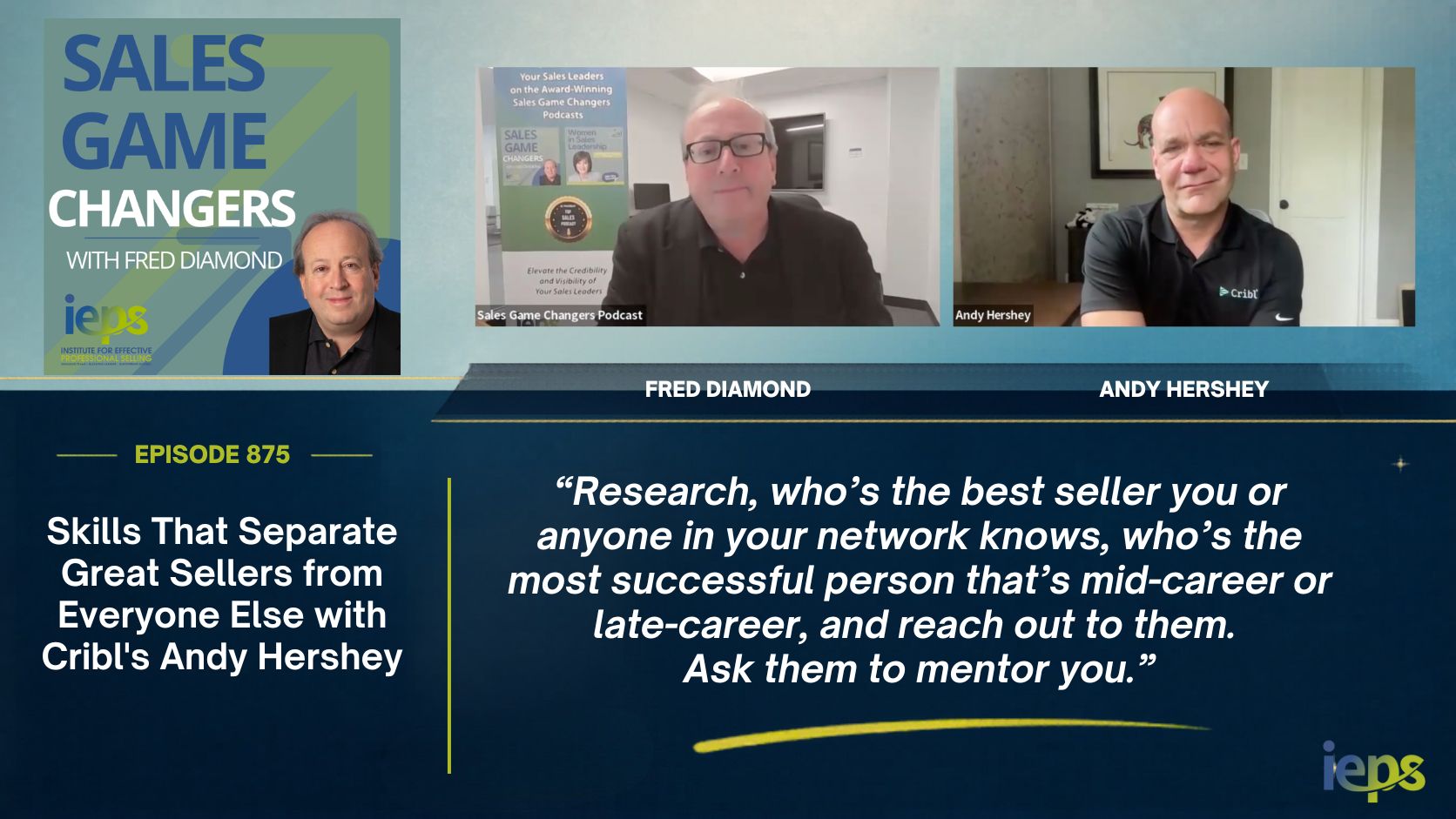
Today’s show featured an interview with Andy Hershey, Vice President of Strategic Sales, Americas at Cribl.
Find Andy on LinkedIn.
ANDY’S TIP: “Research, who’s the best seller you or anyone in your network knows, who’s the most successful person that’s mid-career or late-career, and reach out to them. Ask them to mentor you.”
THE PODCAST BEGINS HERE
Fred Diamond: We’re doing today’s interview in July of 2026, in the summer of 2026. Andy Hershey with Cribl, I’m excited to have you on the show. You’re the first guest that we’ve had with Cribl, but you’ve worked at places where we’ve had numerous people appear on the show. I’m excited to hear a couple of things, a little bit about what Cribl does, but also, your leadership philosophy, some of your thoughts on how the thousands of Sales Game Changers listeners can take their sales career to the next level. Andy, tell us a little bit about what you do at Cribl and tell us a little bit about Cribl for people who don’t know.
Andy Hershey: Cribl, we are an AI platform for telemetry. What does that mean? We help our customers with a wide range of use cases across security and IT and the business, where we leverage data to solve problems. We tie to business value that way. We’re an over $300 million company growing over 40% year over year. My role, I’m the vice president of our strategic account segments. We have our largest, most complex customers. My team, my goal is to build a durable business within that segment and to help customers leverage data to transform how they do business.
Fred Diamond: You’ve led very, very successful and established technology companies. You’ve led the organizations through tremendous changes in technology. Everything right now, obviously AI is a huge topic, not just in the selling process, but as it relates to buyer behavior. What do you think some of the biggest challenges facing B2B or, in some cases, B2G selling professionals today?
Andy Hershey: From a sales professional, I think the biggest challenge is getting access to the right people, and when you do, articulating the right problem, the right pain to the right persona, being very focused. There’s more noise than ever. People are working remotely more than ever. You can’t just walk in an office and go from office desk to desk to desk and so forth. It’s harder. We got to be smarter and more professional or more focused. I believe focus drives execution.
Fred Diamond: I agree with you. As you were talking, and the way you just described it, going into a building, walking door to door, that used to be a great way that the selling professionals got successful. But it hasn’t really been like that in a long time. Obviously, the pandemic has shifted that. A lot of companies are very, very stringent with their security policies. Of course, over the last couple of years, work from home, when people are going to be in the office on both sides has made it challenging.
As it relates to that, buyers keep telling us, and we know this, that they’re overwhelmed with information. They’re overwhelmed with outreach. A lot of it is automated, ways that we’re trying to figure out selling professionals, how do we slip through? From your perspective, what are some of the things that are separating the real successful selling professionals who are able to get those meetings, who are able to get in front of the customer to communicate the company’s value?
Andy Hershey: It’s really interesting when you talk about that. I think there’s two types of sellers I’ve always seen. There’s the hunter that’s going around banging on. I think they have to be very focused on what they’re doing. They’re very aggressive, they work hard, they make a lot of calls, they’re used to rejection. Then there’s the account manager. Oftentimes they build great relationships, support customers, can call high, broadly, very polished. I think the challenge I see, it’s usually one or the other. A rep is usually one or the other. Very rarely do I see someone who has both combined skill sets. That’s really a unicorn to have.
To answer your question, I think having both of those skills together are the key. Being able to get in front of the right people and talk about the business objective or initiative that you can help enable or solve, as well as the technical use cases with the technical sellers. Then also to really be able to execute at a strategic level with an account. That’s, to me, what the best sellers can do, both together.
Fred Diamond: Let’s get back to that question. How are you seeing them, like the ones who are successful in getting the meetings, because people are becoming more and more aware of almost like the way it used to be. They want to have more meetings, obviously. Much more potential will happen in a face-to-face meeting, around a board room, whatever it might be. How are your top performers, or how are you coaching your selling professionals to get those meetings? We’re doing today’s interview in July of 2026. What are you telling them to do? How are you coaching? What are the best ones doing to get those opportunities?
Andy Hershey: In my mind, the best thing you can do is not just focus on the products. We’re in a world now where we’re selling a platform. We had great beachheads that we won by selling a product to get into an account, and it’s a very straightforward motion for us to grow, especially in strategic, where we have big accounts, we have to go broader and deeper in those accounts. We don’t have a gazillion accounts. In the world specifically where I am right now, I think with most accounts, this is true, but especially in my world, you need to understand the business. You need to understand the structure, the business, the initiatives, what partners are they working with of yours? How can you strategically get in? Really having a lot of thoughtfulness into it.
One of the things that we’re doing to help with that, we have some sellers who do that naturally. We call it tops down, bottoms up selling, getting multithreaded accounts, getting more at bats, because one of the challenges I see is typically we have one opportunity in this account, one opportunity in that account, so it’s all or nothing. We need to have more opportunities in the accounts to get a higher batting average. If one of the five opportunities closes, that’s pretty good. We call it multithreading, and our top reps can do that very well.
We wanted to help the rest of the team be able to do that, maybe those who haven’t done it before or they don’t have the skill or the will or just the experience doing it. We used an AI agent. We built an AI agent that combines a lot of data, internal from our intranet and product information, but with investor reports, Glassdoor reports, things like that, and correlating it together to give you guidance about the account, what their business objective is, some potential targets to go after, understanding their business initiatives, but also a hypothesis of how we can help, what message you should communicate, and then you can interact with it as well. You can ask the agent questions and so forth. We’re trying to level the playing field or help everyone raise their game to do what our most experienced sellers do by doing this, and we’re seeing really good results by doing that.
Fred Diamond: I was going to ask you for the next question, tell us a little more about AI. I’m just curious, the tool that you’ve developed or the processes using AI you’ve developed, obviously is seemingly giving your sales reps a lot of information, access to what’s going on with the customer, that AI is obviously able to extrapolate. How are you using AI to get to the next stage? You’re getting your sales reps prepared, you’re getting them educated, and hopefully the selling professionals are taking advantage of that, because one of our main themes through the Sales Game Changers Podcast is that customers have no value for you, or you have no value for the customer, they have no need for you if you’re not bringing value down the road. Not just today, July 30th, 2026, but July 30th, 2027, whatever it might be. I’m just curious, how are you using AI to close the loop to get to the question you answered before, to get in the door, to have the meetings, to be able to show the value that your company brings?
Andy Hershey: You brought up a great point. I mentioned the agents we have that can tie to business initiatives and who you should contact, what your value point should be, how to interact, how to prepare, how to have a hypothesis, but also bottoms up, what are the use cases? We call it three rocks. We have different use cases, and use cases are customer problems, ideally ones we can solve in unique ways. Rather than thinking product first, let’s understand the use cases by buying center, IT, security, or around AI. Who are the people? What are the pain points we can solve, and go prospecting for them? As if you have a black box, don’t worry about the products. Go prospect for the person with the problem, then open up the black box and we’ll figure out what solutions are in there. That outside-in prospecting for use cases is really important. The AI agents are helping us do that with the use cases on a high level.
In a parallel thought, we also have to get multithreaded. I mentioned multithread and not being single thread in an account. We also want to use AI. Back in the day, we would use Visio for org charts or whatever to play chess. We still want to play chess, but we’re using AI to make org charts much more dynamic, so that we can understand the path, the different players, and what the real power map looks like. In addition, that helps us, because we can work with our pre-sales team, with our partners, and have really intelligent conversations with our BDRs, not only to sell, but also like with our success engineers, our CSEs and so forth, and our DSEs and our PS team, to talk about our account strategy and get very strategic. AI can guide us that way too. Those are ways that we spend less time gathering information, reinventing the wheel, and more time selling and driving adoption effectively.
Fred Diamond: Let’s talk about that. You work with very sophisticated, complex customers with very, very important demands and very, very important needs for the technology that you’re bringing to them. How are some of the top selling professionals interfacing with them? You talked about all the tools that you’re getting them prepared, how you’re getting them to the door, etc., what are the best reps doing right now? I just alluded to the fact that you need to show value for the next two years, not just, “Hey, here’s a tool that can help you.” Give us the insight into the top performers and give us their persona per se. What are they doing? What do they look like? How are they achieving right now?
Andy Hershey: I think the top performers are the ones that, whether they’re a Greenfield seller or an account manager, they do both. They don’t get pigeonholed, one or the other, I mentioned earlier having both skill sets. They have a growth mindset. They’re always one to try new things and take new approaches. But a couple of things have also come to mind. One is the research in the customers when they get in front of you, Fred, I would talk to you about what other customers in your situation, how we’re helping them, the challenges. You might say, “Andy, that’s absolutely bonkers. I don’t care about that.” But I’d say, “Okay, Fred, so tell me, where are you focused?” and you can tell me about your problems, versus the traditional way that I think a lot of sellers still do it in a consulting way, “Hey, Fred, I just want to come in. Tell me, what keeps you awake at night?” I think being prescriptive, being prepared, and being intelligent are the way.
If I would highlight one other key point that they’re doing, I would say they’re not talking to the same old cast of characters inside a company. Maybe where we landed before, or the people we’ve talked that may or may not have interest in our solutions, they’re getting broader. They’re developing relationships with partners that may know people. That whole concept of single-threaded, becoming multithreaded, that’s another thing that top reps, to me, are always doing. That growth mindset, I can’t emphasize that enough.
Fred Diamond: That’s a great answer. A lot of times selling professionals get stuck because they’ll be selling to the same people, having the same conversations, and we want them as sales leaders to find other opportunities. I like the way you said it before, in their ecosystem, maybe your account is whomever, but what can you bring to their partners? What can you bring to their suppliers along the food chain? I love that answer. The great sales reps aren’t just looking at, “All right, my quote is $100,000 this month of stuff to Company X.” It’s, “What can I bring in to the broader perspective? Who else can I team with to bring solutions?” I love that.
Andy Hershey: One other thing that just came to mind that top sellers do, they leverage their resources. They pull in the executive team. They pull in all the supporting resources to help them sell. They don’t wait until the deal gets closed to pull in the adoption and the PS team and the customer success team. They use them as advantages to help sell. They have CEO to CFO meetings. They leverage the resources. The ones that maybe aren’t so great, they don’t want to give up the spotlight. But the ones that leverage the heck out of our executive resources and our overall internal ecosystem also do extremely well.
Fred Diamond: I coach a lot of young selling professionals, and one thing I advise them on is get to know your company. Know your company intimately. Know the C-suite leaders and what they do and what their responsibilities are. I love the way you just explained it, to tee them up for those foreshadowed opportunities.
I remember, I was at Apple Computer for a long time, and our customers loved to talk to the C-suite people at Apple, and it always led the conversation further down the path, but they want their time to be used properly. It’s like, don’t send me to Seoul to do a one-minute meeting if it’s not going to lead to a $100 million deal, if you will. But yeah, you got to think strategically, leverage. People that typically spend time in the office, they love to get out with the customers and to learn and talk. That’s a great bit of advice, Andy.
Andy Hershey: I’ve seen sellers over the years say, “I don’t want to bring our CEO in. I don’t want to bring them in. I don’t have a deal on the table to close.” You can position your CEO or any executive any way you want. You can guide them to drive your sale forward or build the relationship. Another great example is the product team, the product managers. What do they benefit from? Hearing customer feedback, getting feedback on new ideas, or how are the current products working? Why would you take them to the customer? “Hey, Mr. Customer or Mrs. Customer, or Mr. and Mrs. Prospective Customer, I really want to earn your business. I really appreciate your business. You’re very valuable. I want to bring in our product management team, at least they can hear your thoughts and what’s valuable to you, what’s working, what’s not working, because you are very important to us.” That gives you credibility in building your relationship. We need to be thinking of doing these things to sell.
By the way, when we do these things with marketing and product management, you know what they do? They see us more of a partner than just some money-centric transactional sales rep, too. That’s how we get more broader support across our internal organizations. These are all things we ask about what the top reps do. These are what top reps do, in my opinion.
Fred Diamond: Actually, from the customer side, the customer is thrilled. Not just at the C-suite, but I remember bringing product managers when I worked at various companies, and those peer-to-peer conversations. A customer, when you give them the opportunity to talk to someone in product management or product marketing, someone who’s an expert on something particular that they’re challenged with, especially if they traveled to get to the meetings. The Zoom is great. It’s easy to pop someone on Zoom to answer some questions. That’s probably a great thing, too. But finding even differentiated ways to show that you’re different than all the other companies who are trying just to get some sales from them. I love that answer.
We have a lot of listeners who are sales managers. What are some things that you see sales managers are doing that just isn’t adding value, that they need to stop immediately? Maybe what’s your advice for sales managers listening that you don’t think they are doing enough of?
Andy Hershey: I learned the hard way. When I first got promoted, I had a pretty good run as a rep, and I was told, “Hey,” it was a peer promotion, which is challenging to start with, “Just get this team to do everything you did as a rep. That’s all we need you to do.” What I found out was that’s exactly the opposite of what you should do. I know what’s really important to do is, first of all, realize everyone on your sales team is different.
I love baseball. I’m not a Pete Rose fan, but I think he had one of the best leadership sayings ever. At one point, he was interviewed years ago, and he said, “Hey, you’re managing the Cincinnati Reds. You have these players, Dave Parker, blah, blah, blah, all these egos. How do you manage all these players?” He said, “You got to know three things, which players to pat on the back, who to smack in the butt, and who to leave the hell alone.” I was in college when I heard that in Sports Illustrated. Ever since then, I think about that with our team. Sometimes I do it better than others, but everyone has a different style, and they respond to different things. It’s not a one size fits all. I see a lot of early sales leaders treating everyone the same, and the way that they wanted to be treated as a rep. That’s one thing.
The second thing I would say is we’ve all heard about the super rep syndrome, jumping and helping sell. We definitely want to help the seller and get deals done, especially when we can teach them how to fish so they can scale, but as a leader, I want leverage. I want my reps doing as much as possible, the blocking and tackling on their own, where I’m involved with the larger deals, the more complex situations and so forth. That’s how I add the most value. I think a lot of people see value, as a leader, just being in the middle of everything.
One more analogy I’ll draw, if I may, I love Broadway musicals. As corny as it may sound, nothing inspires me more than going to New York City and seeing this incredible talent on stage and so forth, and clapping and everything else for the cast at the end of the show. But behind the curtain is the director, and that person’s name is in the play, but no one sees them. But that director is whispering lines, teaching them, hiring, all these things. That director is not on stage battling for the curtain call, but they know, “Hey, it’s all about the actors and actresses. Let them get the awards.”
I think as leaders, we have to help our team get the recognition, help our team get the applause and so forth. If we’re doing that, they’ll know we’re the leaders, but we need to put our team first. I think that’s another thing. We should not be on stage curtsying and battling with the actors and actresses. Be behind the curtain and be comfortable with that. That is your success.
Fred Diamond: I love that answer. Here’s a question I’ve never asked before on the Sales Game Changers Podcast. What’s your favorite musical of all time, and I’ll tell you mine?
Andy Hershey: You go first.
Fred Diamond: Rent. I love Rent. I could listen to it every day.
Andy Hershey: My wife and I were fortunate enough to see the original Broadway cast of Hamilton back in the day. We saw the original cast of Hamilton and that was just inspiring. It was just great. The story, the music, the dancing, just found it all inspiring.
Fred Diamond: That’s a hugely-successful musical. I hate to say this, but I think Betty Buckley, wasn’t she the original singer of Memory in Cats?
Andy Hershey: I don’t know. I guess I am too young to know that, but yeah.
Fred Diamond: We have a lot of young sales managers and young sales professionals who are great listeners of the Sales Game Changers Podcast. Give us two skills. If someone said to you, “Hey, Andy, tell me two things that I should focus on.” You’ve given us a lot of great ideas about differentiating and research and using the technology and showing value to the customer. What are two skills that you recommend that becomes part of their daily life?
Andy Hershey: Having the growth mindset and learning. Another question I would say is, what do you learn from? There’s so much great content. You provide great content and training, but especially early in career, there are so many good podcasts and other things out there, whether it’s through ChatGPT or the internet in general. The one I would really, really highlight that I’d say is available out there for people to access is Command of the Message and Force Management. There’s a lot of content out there you can leverage. These are things that many sellers do naturally in many ways, but as a young seller, learn these. They’re hard, they’re challenging to learn, but they will help you drive large deals consistently throughout your career.
The other book that I really enjoyed was, I’m trying to get the name of it, actually, I enjoyed it so much and I forgot the name. It’s the one where you teach, tell, and take control, where you are prescriptively selling with a customer. I should know the name of it, but that’s a good one. For the purpose of right now, I would say you listen to podcasts and so forth. Your podcast, your content, and a parallel one is Force Management. I think that is just money in your pocket as well.
Fred Diamond: I’ll give you an opportunity here. Let’s say there’s a sales professional you really want to hire. I’ll give you 30 seconds here to give the elevator pitch on why someone listening should come work at Cribl.
Andy Hershey: There are very few companies over $300 million growing 40% year-over-year with the customer base that we have, over half the Fortune 100 and much of the Fortune 500. We’re in the process of transforming from a point solution or from an initial solution to a platform. We have an incredible opportunity in front of us helping customers transform how they do business, with a great team of people and an experienced leadership team that’s done it before. Come here, change your career, grow your career, make a lot of money, and have the highlight of your career. Great leadership team, great people, great product, great customer base. You couldn’t ask for anything more.
Fred Diamond: Andy Hershey, thank you so much for being on today’s Sales Game Changers Podcast. You’ve given us a lot of great ideas, a lot of great advice on how to think differently. One of the key things right now is you got to think differently, you got to sell differently, you got to show up differently to your customer because they’re tuning out. They can easily delete your voicemail, they can delete your message, they can delete your email, so you got to figure out ways to get through to them. I love some of your ideas on that.
You’ve given us a lot of great ideas. Give us a specific action step, something that people should do right now, after listening to today’s Sales Game Changers Podcast, to take their sales leadership or their sales career to the next level.
Andy Hershey: Other than come work for Cribl, that’s number one. Number two, I would research, who’s the best seller you or anyone in your network knows, who’s the most successful person that’s mid-career or late-career, and reach out to them. Ask them to mentor you. Ask them if you could have a monthly call where you could come to them with an agenda as you advance your career, that you want to learn from them, and so forth, but find someone to mentor you if you’re not doing that already.
Fred Diamond: That’s great. Don’t be shy. Reach out to people. I tell young adults all the time, reach out to your parents’ friends who are in sales. They say, “How can I ask them to meet?” Say, “Can we meet at 8:00 o’clock on Saturday at Starbucks?” and 99% of the time, they’re going to say yes.
Andy Hershey, thank you so much for the great insights on today’s Sales Game Changers Podcast. My name is Fred Diamond.
Transcribed by Mariana Badillo